
November 14, 2025
There’s a rhythm to the road that leaves Bogotá, a steady rise into the highlands, where concrete gives way to mist, and the horizon starts to open again. That’s how our journey to Villa de Leyva began.
The private tour promised an eco-luxury escape through Colombia’s most beautiful colonial town, with curated stops along the way. What we found went beyond the postcard charm — it was a day layered with textures, history, and the quiet sophistication of traveling without rush.
This is a route where Colombia’s geological past, artisanal present, and timeless landscapes meet — a journey that feels designed not just to show you things, but to slow you down. Reserve your VIP escape to Villa de Leyva and the Highlands.
Like what you’re hearing?
The Road Out of the City
The Road Out of the City
We set off just after dawn. Bogotá still slept behind us as our driver navigated the mountain curves with the precision of someone who knows the road by heart. Our guide, Camila, had a storyteller’s ease — one of those people who makes history sound alive rather than recited.
She told us how Villa de Leyva was founded in 1572 as a retreat for Spanish nobility, how its vast Plaza Mayor was once a parade ground for horses and soldiers, and how today it remains one of the largest cobblestone squares in Latin America. But before arriving there, we’d trace a different kind of story — one written in water, clay, and stone.
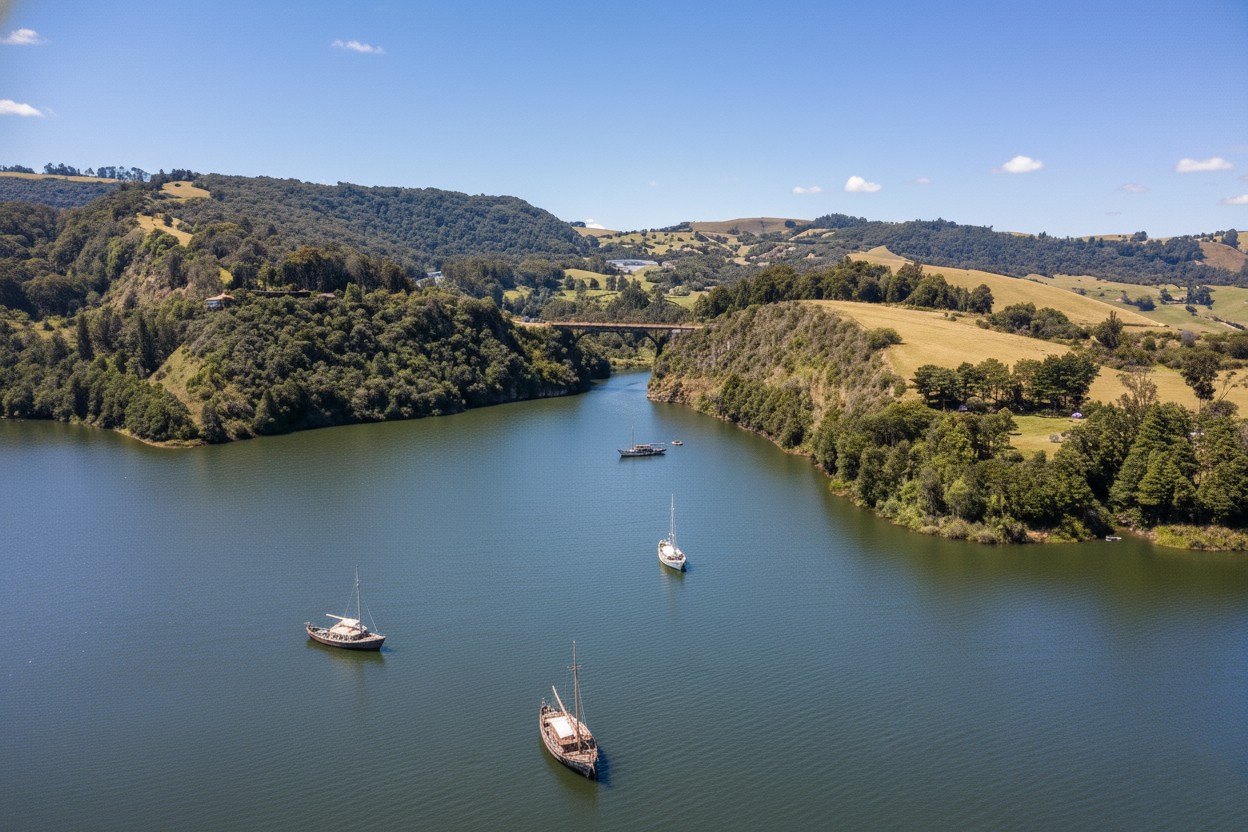
Our first stop came unexpectedly: Sisga Dam. The air there was crisp, thin, and cold enough to wake us up. The water stretched endlessly beneath a layer of fog, framed by pine forests and rolling hills. Locals say it’s one of the most scenic reservoirs near Bogotá, but at that hour, it felt like a private mirror.
Camila suggested we step out, breathe deeply, and take in the stillness — a simple act that set the tone for the rest of the journey. This tour, we realized, wasn’t about rushing between sites. It was about noticing.
The Colors of Ráquira
The Colors of Ráquira
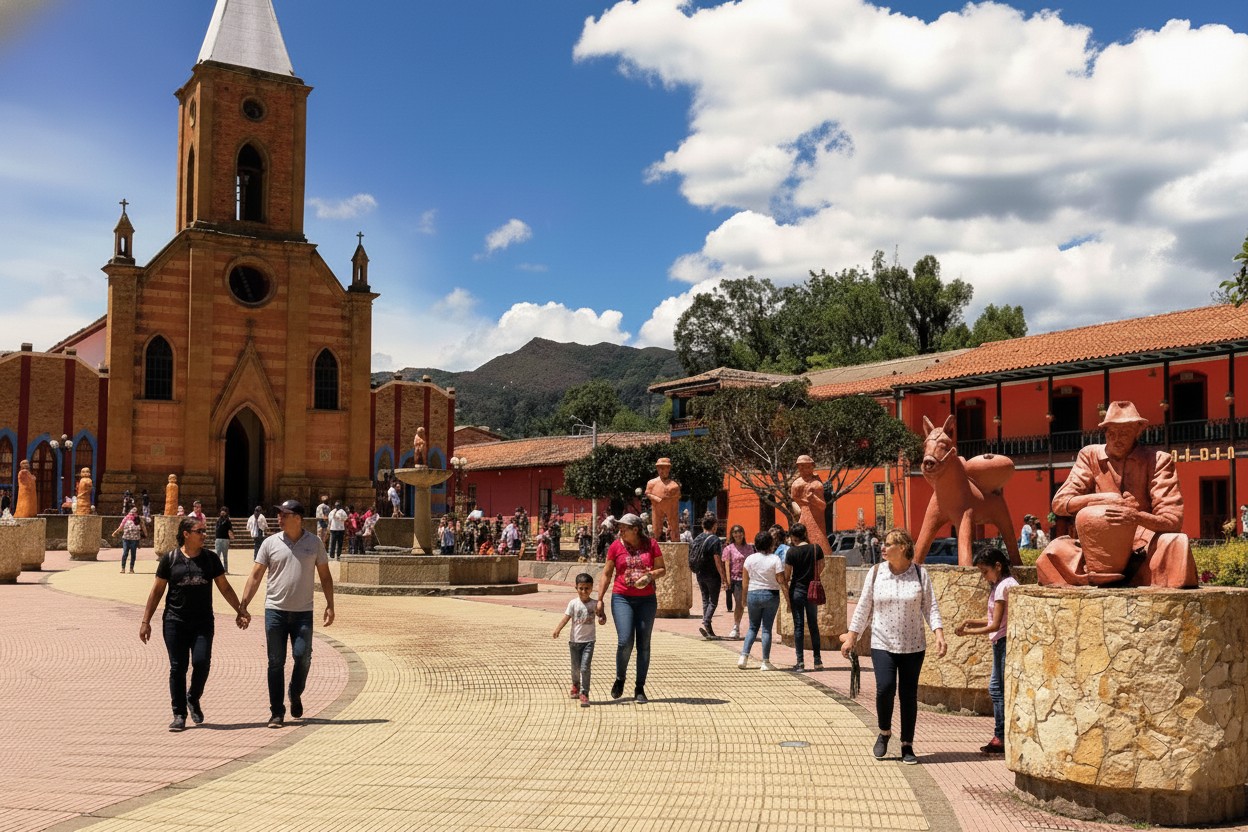
From the silver-blue of Sisga, we descended into color. Ráquira, the artisan town famous for its clay crafts, appeared suddenly, bursting with life. The streets were lined with ceramic pots, painted suns, and wind chimes that rang gently in the breeze. Every storefront seemed to hum with its own palette.
It’s one of those places that still lives off tradition, not nostalgia. Artisans sat at open-door workshops shaping pots and figurines by hand, just as their ancestors did centuries ago. You can smell the mix of earth and smoke that seeps from their kilns — a scent that feels older than time.
Camila introduced us to a local craftsman named Jorge, who’s been making ceramics since he was ten. He told us how the town’s clay comes from the nearby hills, sifted and cleaned by hand before being molded. “It’s not work,” he said, “it’s memory.”
We left Ráquira with small souvenirs — a hand-painted vase, a tiny red pig for good luck — but what stayed with us most was the sound of laughter and the rhythm of Jorge’s wheel turning, steady and circular as the town’s own heartbeat.
Entering Villa de Leyva
Entering Villa de Leyva
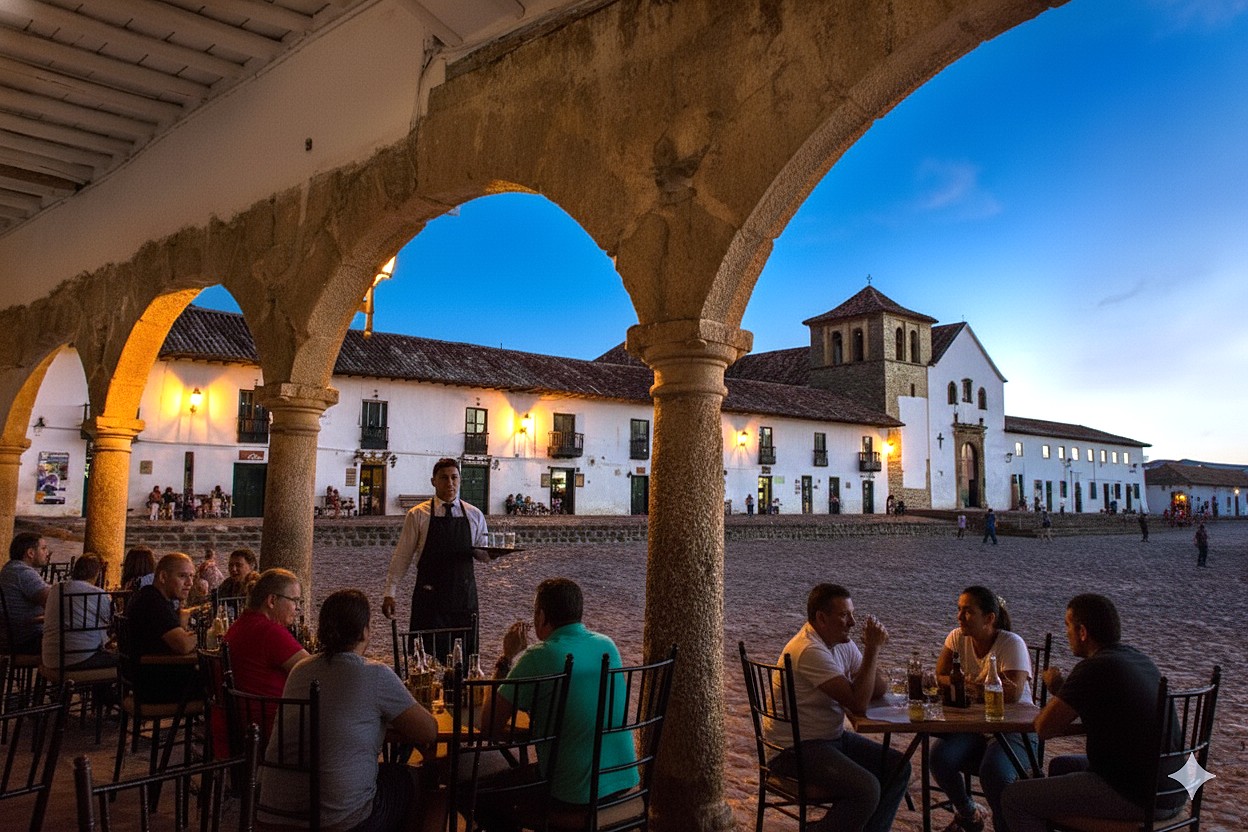
By the time we reached Villa de Leyva, the sun had fully claimed the sky. The first sight of the town always catches you off guard: whitewashed walls glowing in the light, terracotta roofs spilling over balconies draped with bougainvillea, and the mountains framing everything like a painting.
The van stopped at the edge of the main square — the Plaza Mayor — an expanse of stone so vast it feels like a small continent. Standing there, you understand why the town has been a refuge for artists, writers, and dreamers for decades.
Lunch was waiting for us at a restored colonial house just off the square — one of those quiet, elegant spots where wood creaks and time slows. The food was simple and perfect: ajiaco made with local herbs, fresh lemonade, and arepas filled with cheese from nearby farms.
As we ate, Camila told us stories of the town’s layered identity — how it has preserved its colonial essence while welcoming new generations of chefs, winemakers, and designers who are bringing contemporary life into its centuries-old bones.
“You’ll see,” she said with a smile, “Villa de Leyva offers a small-city quality of life within what feels like a living museum”.
Still thinking of a quick getaway near Bogotá that offers a complete change of pace? This might be just it! See our available dates and let us plan your trip.
History Beneath the Surface
History Beneath the Surface
That afternoon, we left the cobblestones behind to explore El Fósil Museum, a short drive away. It’s a modest building, but what it holds is extraordinary: the fossilized remains of a 120-million-year-old Kronosaurus, found almost perfectly preserved in this region.
Standing before it, surrounded by ancient shells and marine imprints, it’s almost impossible to imagine that this dry highland was once the floor of a prehistoric sea. The museum, small and unpretentious, reminded us that Colombia’s beauty isn’t just in its landscapes — it’s in its deep, geological memory.
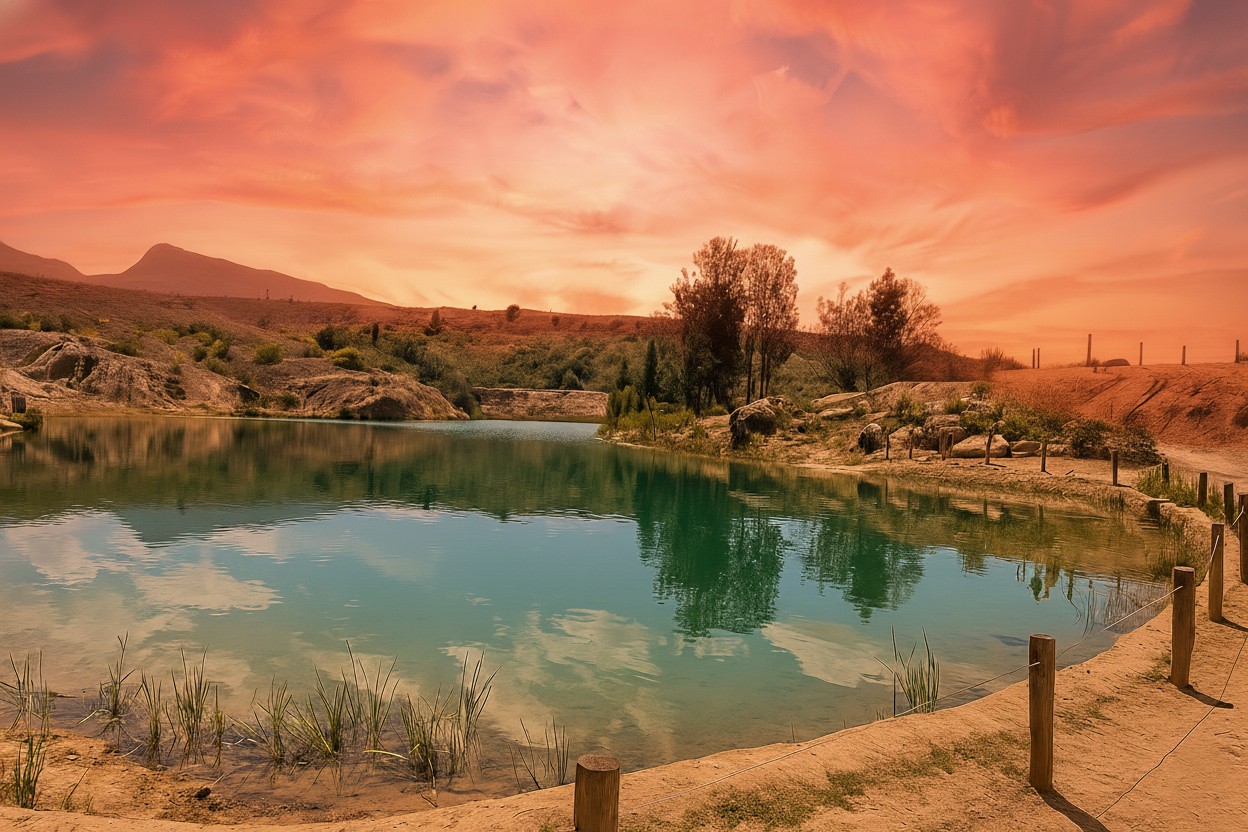
From there, we continued to Pozos Azules, two turquoise lagoons hidden among arid hills. The color is unreal — an intense, mineral blue that shifts with the sun. It’s one of those rare spots that feels both cinematic and serene, where silence hums louder than sound.
We stayed longer than planned, taking photos, yes, but mostly just looking. It’s the kind of place that doesn’t ask for words — only attention.
A Town Caught Between Eras
Back in Villa de Leyva, the light had softened. The streets glowed gold, and locals began closing their shops for the evening. You could hear the faint notes of a guitar drifting from a courtyard.
Camila led us on a final walk through the alleys, pointing out details that might otherwise go unnoticed: the carved wooden doors, the hidden courtyards filled with orchids, the mix of Muisca, Spanish, and modern influences that coexist quietly in every corner.
We passed by the Casa Museo Antonio Nariño, the home of one of Colombia’s most important independence figures, and paused outside Iglesia del Carmen, its red-brick façade standing out against the surrounding white walls. Even if you’re not religious, it’s worth stepping inside just to feel the echo of centuries in the air.
When night began to fall, the plaza came alive again — this time with people, not history. Locals walked their dogs, children ran across the stones, and couples sipped wine at the edge of the square. Villa de Leyva, it seems, belongs equally to the past and the present.
Comfort in Every Detail
By the time we got back into the van, the stars had begun to appear — clear and sharp in the mountain sky. Blankets, snacks, and soft music waited for us, just as they had in the morning. Those small comforts turned the drive home into something meditative rather than long.
The tour’s design was seamless — not rushed, not overly scripted. Every stop felt purposeful, every pause intentional. It’s what luxury should mean in travel: ease, not excess.
For Travelers Who Appreciate Depth
This private tour isn’t for those looking to check off landmarks. It’s for travelers who want to listen to a place — who appreciate craftsmanship, stories, and stillness as much as scenery.
From the reflective waters of Sisga to the bright pottery of Ráquira and the eternal calm of Villa de Leyva, every stop offered a different tempo, a new facet of Colombia’s Andean heart.
It’s a day that reminds you that travel doesn’t have to be fast to be full — that the most memorable journeys are often the ones that slow you down just enough to notice what’s always been there.
Traveler Tips from Cielo
- Timing: Depart early (around 6:00 a.m.) to enjoy Sisga and Ráquira before the midday crowds.
- Footwear: The cobblestone streets of Villa de Leyva are charming but uneven — wear comfortable, flat shoes.
- Weather: Bring layers. The highlands can swing from warm sun to cool wind within an hour.
- Local shopping: In Ráquira, buy directly from artisans — they’ll often tell you the story behind each piece.
- Photography: Pozos Azules is best captured between 3:00 and 4:00 p.m., when sunlight deepens the turquoise hue.
- Disconnect: Mobile service drops frequently along the route — treat it as an invitation to unplug.
Why We’d Go Again
We’ve visited Villa de Leyva before — for festivals, for work, for quick weekend escapes — but never quite like this. Traveling privately, with time to listen and space to breathe, changes everything.
It allowed us to rediscover what makes this route so timeless: not just the colonial beauty or the artisan towns, but the sense of continuity that links them all. Water from the páramo, clay from the earth, fossils from the sea — everything in this region feels connected.
Meet the Team
We’re creators, marketers, and explorers — united by our love for Colombia and passion for storytelling. From content creators and strategists to social media experts and tour managers, we bring your journey — or your brand — to life.
CEO & Founder
Shawn Christopher Leamon
Read More
Social Media Director
Daniel Cardenas
Read More
Operations
Camilo Ceballos
Read More
Graphic Designer
Juan Sierra
Read More
Sales Manager
Juliana Gama
Read More
Social Media Specialist
Dayana Parra
Read More
Sales
Fabian Briñez
Read More
Sales
Johanna Vargas
Read More
Content & Multimedia Strategist
Diana Bustos
Read More
Visual Content Creator
Gabriela Munoz
Read More
Marketing Tours & Content Manager
Sergio Gonzalez
Read More
Storytelling Specialist
Brian Nino
Read More
Finance & Strategy Lead
Fernando Soto
Read More
Community Manager
Paula Rodríguez
Read More
Technology
David Álvarez
Read More
CEO & Founder
Shawn Christopher Leamon
Read More
Social Media Director
Daniel Cardenas
Read More
Operations
Camilo Ceballos
Read More
Graphic Designer
Juan Sierra
Read More
Sales Manager
Juliana Gama
Read More
Social Media Specialist
Dayana Parra
Read More
Sales
Fabian Briñez
Read More
Sales
Johanna Vargas
Read More
Content & Multimedia Strategist
Diana Bustos
Read More
Visual Content Creator
Gabriela Munoz
Read More
Marketing Tours & Content Manager
Sergio Gonzalez
Read More
Storytelling Specialist
Brian Nino
Read More
Finance & Strategy Lead
Fernando Soto
Read More
Community Manager
Paula Rodríguez
Read More
Technology
David Álvarez
Read More