
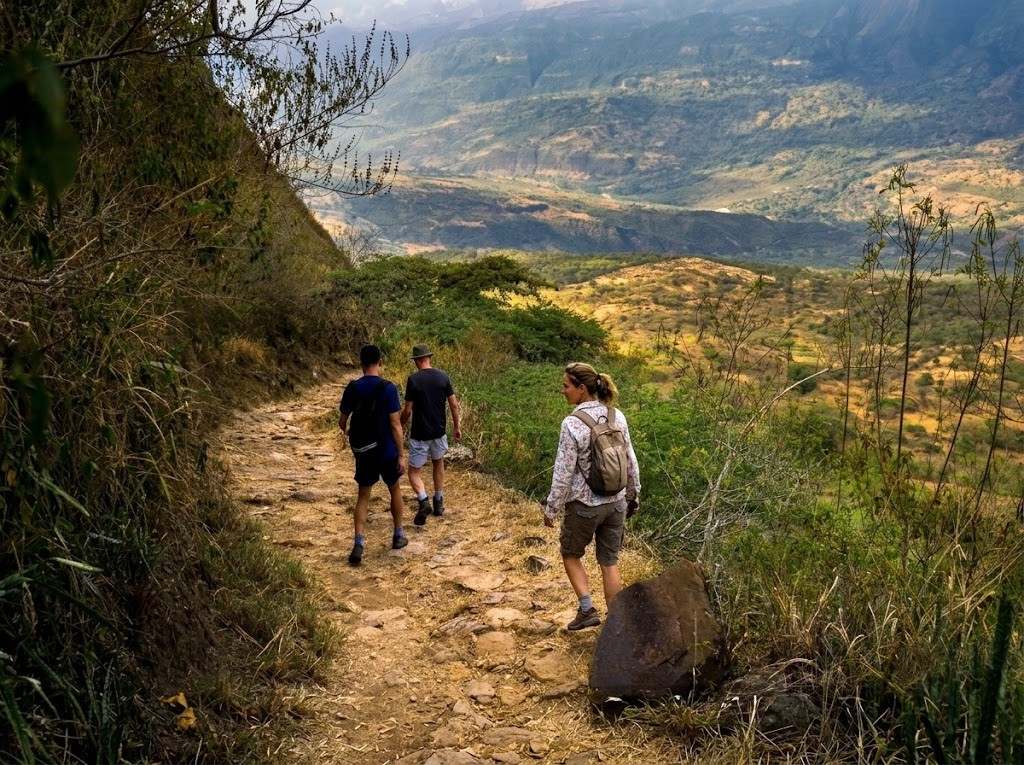
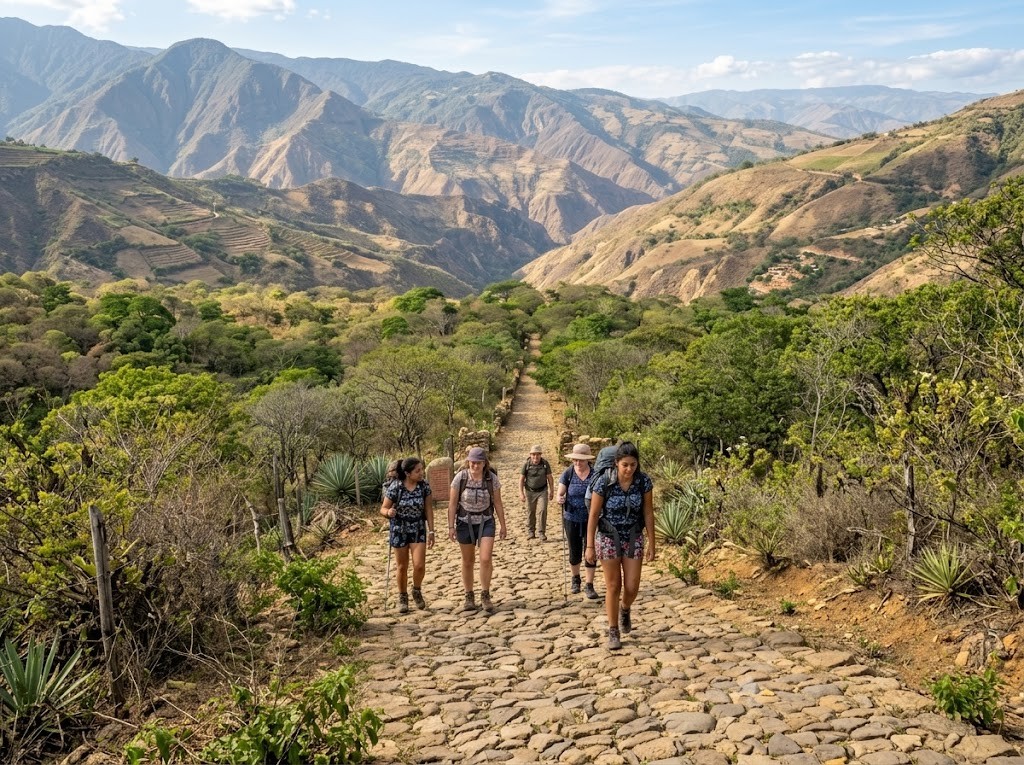
+ 1,200 verified five-star reviews for Cielo.Travel on Google and TripAdvisor.
Duration
Tour Type
Pricing
Languages
Overview
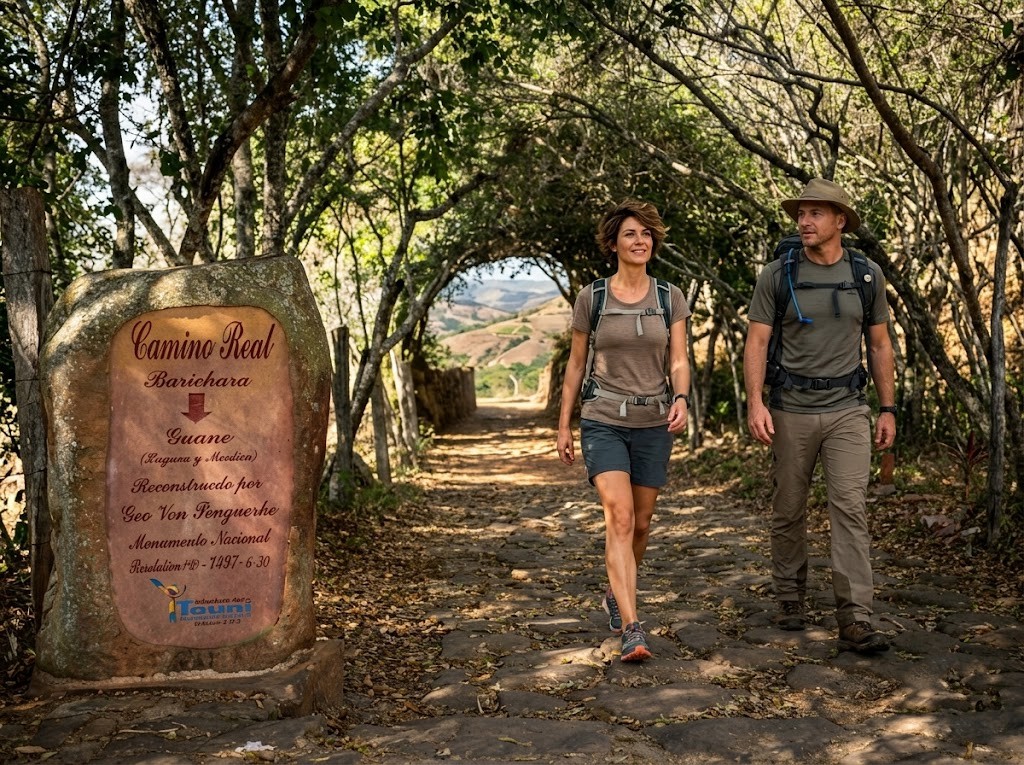
The Camino Real from Barichara to Guane is a 5.5-kilometer stone path built by the Guane Indians — the pre-Columbian civilization that inhabited the Santander highlands before Spanish colonization — and used for centuries afterward as the trade route connecting the canyon communities of this region. Declared a national monument in 1977 and restored in 1988, it is not a hiking trail designed for tourists. It is the actual surface the Guane built, maintained by the stone of the canyon itself, wide enough for commerce and durable enough to have survived several centuries intact. Walking it with a guide who knows the history transforms the landscape underfoot from scenery into evidence.
Barichara — the starting point — is a national monument town founded in 1705, with stone streets, cream and terracotta facades, and canyon viewpoints that make the depth of the Santander highlands legible before the walk begins. The path descends through dry tropical scrub toward Guane, a village of a few hundred residents that has been largely bypassed by the last several decades of development and is, as a result, entirely itself — a paleontological museum with Guane artifacts and marine fossils, a colonial church on a quiet plaza, and the particular quality of a place that has not been asked to perform for visitors. The return on the same path is worth doing: the light shifts, the views open from different angles, and the rhythm of a walk you’ve already completed once settles into something meditative rather than exploratory.
Itinerary
Highlights
Walk the Camino Real — a 5.5-kilometer stone path built by the Guane Indians, declared a national monument in 1977 and restored in 1988, that connects two of Santander's most preserved colonial towns at your own pace.
Discover Barichara, consistently ranked among the most beautiful small towns in Colombia, where colonial architecture, cobblestone streets, and the light of the Santander highlands have remained largely unchanged for centuries.
Arrive in Guane — a town so small and so frozen in time that walking its streets, visiting its church, and sitting at its viewpoint feels like stepping out of the present entirely.
Learn the history of the Camino Real from a guide who knows the Guane culture, the colonial-era significance of this trade route, and why santandereanos today are working to make it one of the region's most recognized heritage trails.
Disconnect completely on a low-medium difficulty hike through a landscape that combines cobblestone trails, dry tropical vegetation, canyon views, and the warm hospitality of people who live alongside this path.
What's Included
Private English-speaking guide (full day).
Hotel pickup and drop-off in private transportation.
Gastronomic experience.
All risk insurance.
What's Excluded
Breakfast and lunch.
Extra purchases.
Know before you book
Most of this tour is done on foot — 5.5 kilometers each way on cobblestone and dirt trail. Bring comfortable trekking shoes or sturdy walking shoes. Sandals and fashion sneakers are not suitable for this terrain.
The Santander highlands can be warm and exposed. Bring sunscreen, a hat, light breathable clothing, and plenty of water. Your guide can advise on refill points along the way.
The hike has a low-medium difficulty level. The path is wide and well-maintained, making it accessible to most fitness levels. If you have joint concerns or limited mobility, contact us before booking so we can advise honestly.
Transfer time is included in the total tour duration of 6-9 hours. The exact time available for hiking and exploration depends on your departure city within Santander.
Breakfast and lunch are not included. Eat before departure and bring snacks for the trail. There are options for a refreshing drink in Guane and food available in Barichara before and after the hike.
More Info
Cancellation Window
12 hours before starting date
Difficulty
Moderate
Cancellation policy
Free cancellation up to 12 hours before departure. Cancellations made within 12 hours of the tour start time are non-refundable.
Guest Reviews
Why Book With Cielo
1,200 five-star reviews from real travelers — read them before you book.
Best Price Guarantee — find this tour cheaper elsewhere and we'll match it.
Private transportation door-to-door — no shared shuttles, no waiting around for strangers.
Booking directly with us means your money stays with a Colombian-owned company, not a platform commission.
Our team coordinates everything — pickup timing, pilot briefing, and return logistics — so you focus only on the flight.
Other Info
The Camino Real from Barichara to Guane is one of the most historically significant walks you can do in Colombia — and one of the most rewarding precisely because it asks nothing more of you than the willingness to put one foot in front of the other for a few hours. This is not an adventure trail. It is a heritage path: 5.5 kilometers of stone laid by the Guane Indians, the pre-Columbian civilization that inhabited this part of the Santander highlands long before Spanish colonization, and later used for centuries as the trade route connecting the communities of this canyon region. Declared a national monument in 1977 and restored in 1988, the Camino Real is the most faithful physical record of the Guane people’s presence in this landscape — a path built from the stone of the canyon itself, wide enough for commerce, durable enough to survive several centuries intact.
Barichara
Barichara is the starting point, and it earns its reputation. The town has been called the most beautiful colonial village in Colombia so many times that the description has worn slightly smooth, but it remains accurate. The streets are paved in stone, the buildings are painted in the cream and terracotta palette of the Santander highlands, and the scale is human — everything within walking distance, nothing hurried. Barichara was founded in 1705 and has been a national monument since 1978, meaning that its colonial fabric has been protected from the concrete modernization that has altered the character of most Colombian towns its size.
The architecture here is not a reconstruction or a tourist aesthetic. It is the original built environment of an 18th-century highland settlement, maintained by a community that has made a deliberate choice about what their town should remain. The cathedral, built from the local sandstone that gives Barichara its distinctive warm color, took decades to complete and still anchors the main plaza the way the Spanish intended their colonial churches to anchor public life. The cemetery, located at the edge of town overlooking the canyon, is one of the most serene public spaces in Santander — not morbid, but quietly beautiful in the way that old cemeteries in historically significant towns can be. The artisan workshops scattered through the streets produce toquilla straw goods, ceramics, and the handmade paper that Barichara has been famous for since before most visitors had heard of the town. Your guide can take you into any of these before the walk begins, or leave time for them on the return.
The viewpoints at the edge of Barichara deserve specific attention. The canyon system of the Río Suárez — the geological formation that gives this entire region its dramatic character — drops away from the town’s edge in a series of ridges and precipices that make the altitude of the Santander highlands suddenly legible. Standing at the mirador before the walk, with the path visible descending into the dry scrub below, is the right way to orient yourself before you start moving.
The Guane People
The Camino Real did not begin as a colonial road. It was built by the Guane Indians, the pre-Columbian civilization that occupied the Santander highlands for centuries before Spanish contact. The Guane were skilled weavers, known across the region for their cotton textiles and their ability to cultivate the dry, difficult terrain of the canyon system. They were also traders — the path connecting Barichara to Guane and beyond was part of a network of routes through which goods, information, and people moved across the highlands.
When the Spanish arrived, they recognized the practical engineering of what the Guane had built and used it themselves. Colonial merchants, administrators, and travelers walked this same path. The stones underfoot were laid by indigenous hands centuries before the Colombian republic existed, and they have been walked by every generation since. The restoration in 1988 did not rebuild the path — it stabilized and cleared what was already there, which is part of what makes the Camino Real worth more than a standard hiking trail. You are walking on the actual surface that the Guane built, not a recreation of it. Your guide explains who they were, what happened to their civilization after Spanish contact, and why the preservation of this path matters to the people of Santander today.
The Walk: Dry Tropical Scrub, Canyon Views, and the Logic of the Landscape
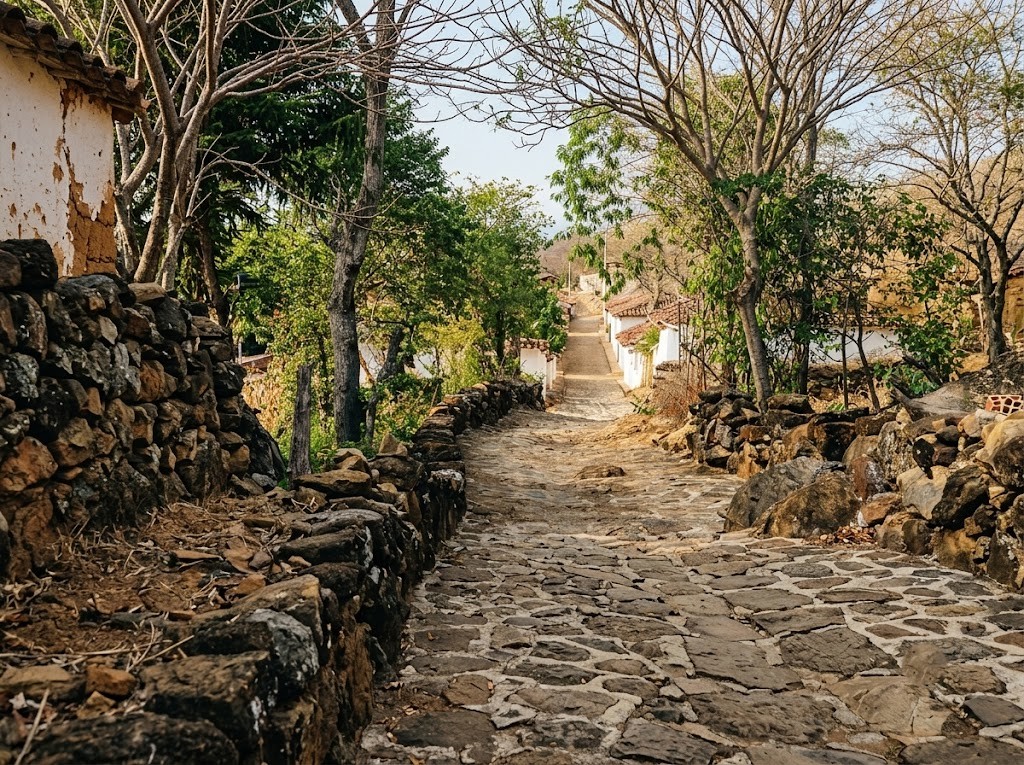
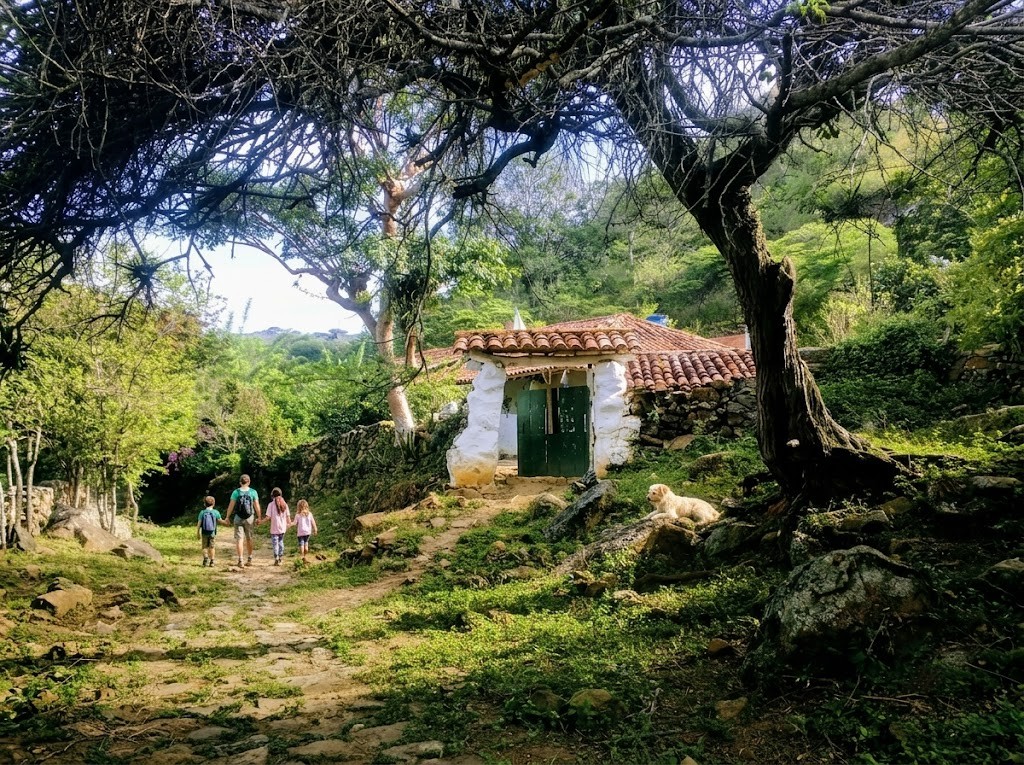
The Camino Real begins just outside Barichara and descends through the dry tropical scrub of the Santander highlands toward Guane. The landscape here is immediately distinctive — spare, sun-bleached, with the deep cuts of the canyon system visible in the distance and a flora adapted to the heat and aridity of the highland dry zone. Cacti, thorny shrubs, and the occasional flowering tree punctuate a landscape that looks very different from the green Andean hillsides most visitors associate with the Colombian interior. The light here is sharper, the colors more muted, the silence more complete.
The path is wide enough that two people walk comfortably side by side, and the gradient is gentle enough that conversation is possible throughout. This is deliberate — the Guane built the Camino Real for commerce, not for sport, and its engineering reflects the practical requirements of people moving goods and animals across terrain that would otherwise be difficult to navigate. The stone surface manages water runoff, provides grip on steep sections, and holds its shape across the temperature swings of the highland seasons. Several centuries of continuous use have only confirmed the quality of the original construction.
The views shift as you descend. From the upper sections of the path, the full width of the canyon system opens to the south, with ridgelines layered against each other in the afternoon haze. As you move lower, the canyon walls close in and the vegetation becomes denser in the gullies where moisture collects. The birdsong changes register. The temperature drops slightly in the shaded sections. The walk is 5.5 kilometers, and the time passes differently than it would on a treadmill or an urban street — the terrain keeps your attention, and your guide fills whatever space remains.
Guane: A Town That Has Been Bypassed by Time
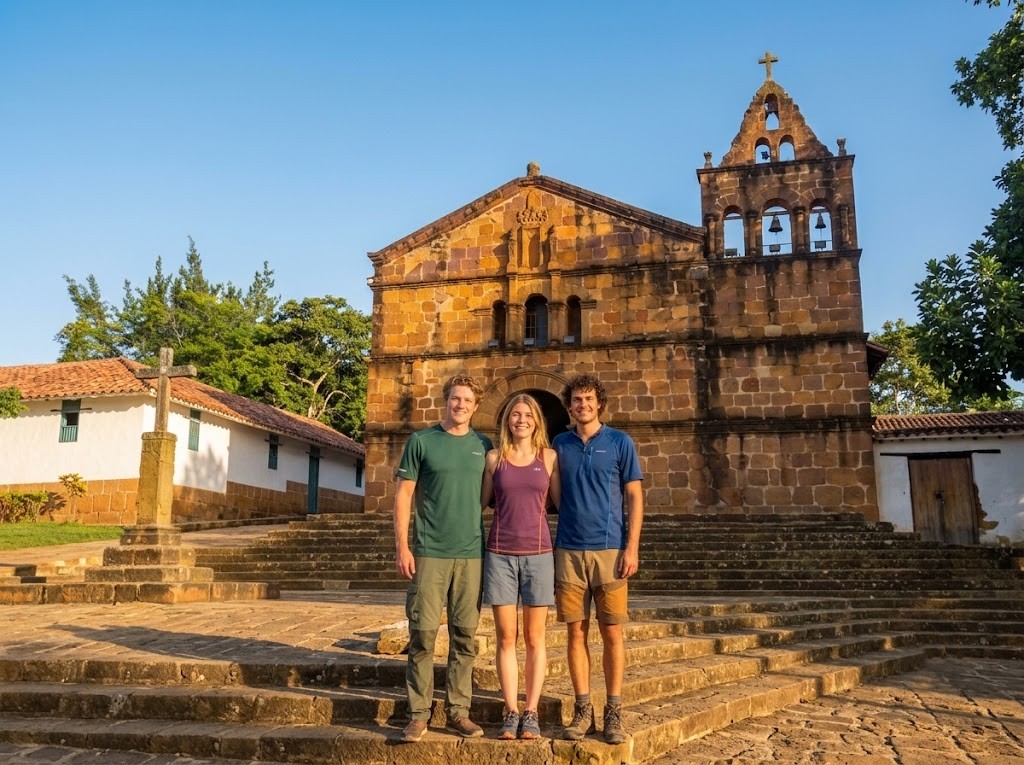
Guane itself is one of those places that is difficult to prepare for. It is tiny — perhaps a few hundred permanent residents — and its main square, colonial church, and surrounding streets operate at a pace that is simply different from anywhere you’ve been in Colombia. There are no tourist restaurants, no souvenir markets, no infrastructure built around the fact that people walk here from Barichara. There is a plaza, a church, a museum, and the kind of quiet that accumulates in places that have not been asked to perform for visitors.
The Paleontological and Guane Artifacts Museum holds a collection that reflects two aspects of the town’s unusual character. The fossils — ammonites, marine mollusks, the remnants of creatures that lived in the shallow sea that covered this plateau millions of years ago — give the landscape a geological depth that the canyon views hint at and the museum makes explicit. The Guane Indian artifacts in the same collection connect the geological past to the human one: pottery, textile fragments, and objects that survived the colonial period and the centuries after it. The museum is small and unassuming in the way that small-town museums often are, but what it contains is genuinely significant, and your guide provides the context that transforms it from a room of objects into a window into who lived here and when.
The viewpoints around Guane extend the canyon panoramas that Barichara began. From different points around the village, the Río Suárez canyon system opens in new directions, and the understanding of the landscape you’ve been walking through becomes more complete. There is a quality of arrival in Guane that is specific to places reached on foot — you have covered the ground between here and where you started, and the distance gives you a relationship to the space that arriving by vehicle simply cannot provide.
The Return: The Same Path, a Different Experience
The return walk on the Camino Real is the same path in reverse, and it is worth noting that it doesn’t feel the same. The light shifts through the afternoon — the morning clarity replaced by the warmer, softer tones of midday moving toward afternoon — and the views open from different angles when you’re facing uphill toward Barichara rather than down toward Guane. The physical rhythm of a walk you’ve already completed once settles into something meditative rather than exploratory. You know the path, you know the distance, and the mind is free to move differently than it was on the approach.
Most guests find the return easier than the outward journey — not because it’s shorter, but because the anticipation has been replaced by familiarity. The final stretch back into Barichara, climbing from the scrub back into the stone streets of the town, ends the day with a sense of completion that is specific to walking between two places and walking back. A coffee or a cold drink in the main plaza is the right way to close.
Continue Exploring Santander
If Barichara opens your interest in the Santander region further, the Barichara and San Gil Day Tour pairs it with San Gil — the adventure capital of Colombia, where the Río Fonce meets the Río Suárez and every outdoor activity from white-water rafting to paragliding is available within a short radius. For a perspective from above the entire canyon system, the Paragliding in Cañón del Chicamocha puts you in the air over the deepest gorge in Colombia — the same geology you walked through, seen from a completely different angle.
Ready to walk the Camino Real? Book the private Barichara to Guane day tour above and your guide will handle everything from hotel pickup to the return drop-off — all you have to do is bring good shoes and show up ready to walk.
Building a longer itinerary? Start with our Santander tours.
Before you go: our Colombia guides
Written by the team that runs this tour.
FAQs
The hike has a low-medium difficulty level. The Camino Real is 5.5 kilometers in each direction, mostly on a wide cobblestone path with some sections of dirt trail. The terrain is not steep or technical, and the pace is entirely yours. The main demands are distance and sun exposure — bring water, sunscreen, and comfortable shoes. Most fitness levels manage it without difficulty.
The walk from Barichara to Guane takes 2 to 3 hours at a relaxed pace. The return walk adds another 2 to 3 hours. Combined with time in Guane and the transfers, the total day runs 6 to 9 hours depending on your departure city within Santander.
The Camino Real is a 5.5-kilometer stone path that connects Barichara and Guane. It was built by the Guane Indians — the pre-Columbian civilization that inhabited this part of Santander before Spanish colonization — and later used as a trade route during the colonial era. The path was declared a national monument in 1977 and restored in 1988. It is one of the best-preserved indigenous stone trails in Colombia, and walking it is a direct physical connection to the region's pre-colonial past.
Guane is a very small town — and that is precisely its appeal. You can visit the colonial church, walk to the viewpoints over the canyon, explore the old houses and narrow streets, and take a local drink at one of the small spots in the main square. Your guide can provide context on the town's history and the Guane Indian civilization it was named after. Allow at least an hour to absorb it properly.
Breakfast and lunch are not included. A gastronomic experience is included in the tour — confirm the exact details with the Bokun listing. Eat a good breakfast before departure, bring trail snacks, and plan for a meal in Barichara before or after the hike.
Related Tours
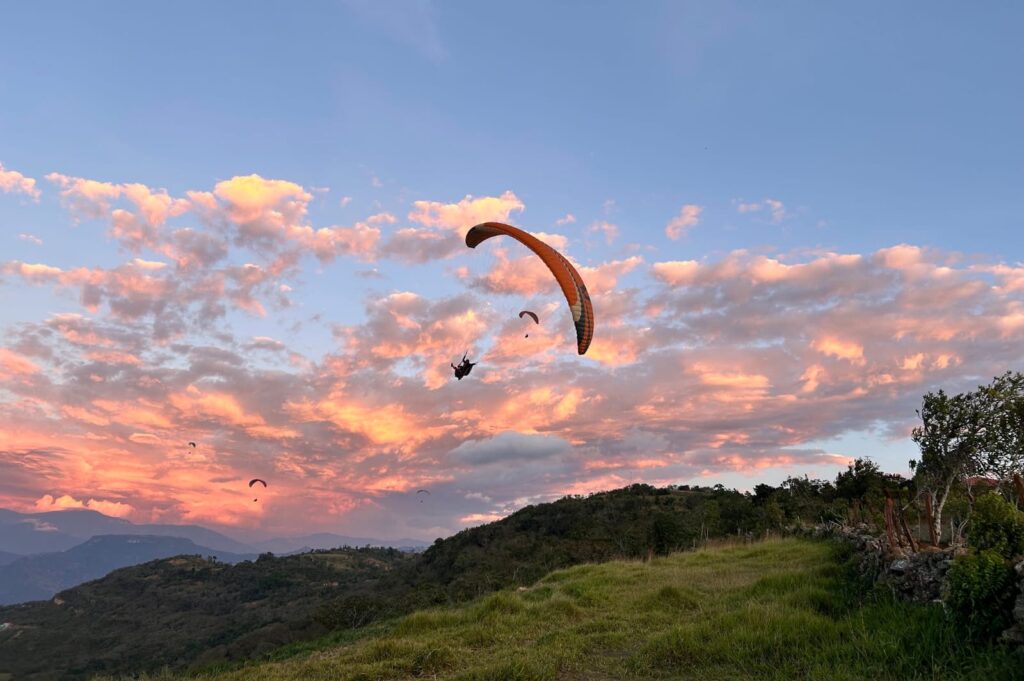

Paragliding in Chicamocha Canyon, Colombia
Santander
Private
Paragliding Chicamocha Canyon is one of the most thrilling ways to experience Santander, Colombia’s adventure capital. From a hilltop launch…
$$$
3-4 hours
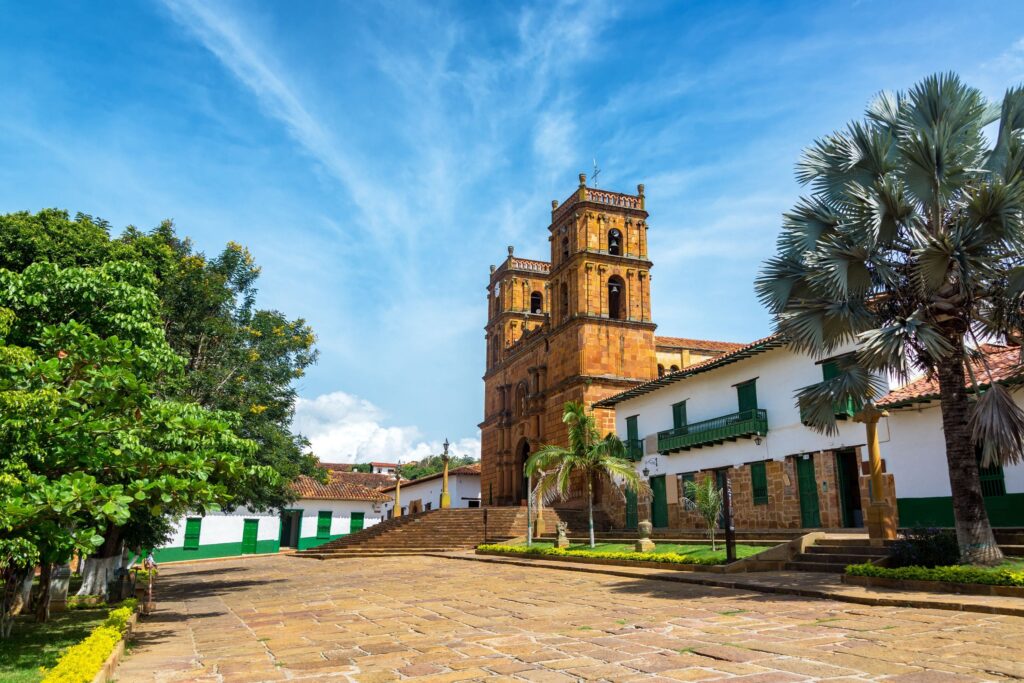

Private Barichara Tour & San Gil Day Trip
Santander
Private
A Barichara Tour takes you deep into the heart of Colombia’s Santander department, where colonial history, dramatic canyon landscapes, and…
$$$
6-8 hours
Private Chicamocha National Park Tour with Cable Car
Santander
Private
A Chicamocha National Park Tour is one of the best ways to experience the raw, dramatic landscapes of Colombia’s Santander…
$$$
8 hours