September 13, 2026
The short version
Santa Fe de Antioquia is the town Medellín came from. It was founded on 4 December 1541, it was the capital of Antioquia for 285 years until Medellín took the title in 1826, and it still has the seven churches, the cobbled grid and the courtyard houses of a colonial capital, 57 kilometers and a tunnel west of the city. It also sits at 500 meters, a kilometer lower than Medellín, which means the day is hot from nine in the morning and the town is, for the people who live in the valley, the weekend place with pools rather than a museum. Its most photographed object, the 291-meter suspension bridge over the Cauca that José María Villa finished in 1895, has been closed to cars since September 2024 and is now a walk, which is better.
We are based in Colombia and we run the day trip to Santa Fe de Antioquia from Medellín hotels, which means this guide is the one we give our own travelers: what the town actually is and how the heat decides the day, the road and the tunnel and what the toll costs, the plaza, the churches and what the August 2026 earthquake did to them, the bridge and the rules for crossing it, the museum, the tamarind, the risk by the police’s own figures, and how it compares with Jardín and Guatapé, the other two days out of Medellín, so you pick the right one. It sits alongside our Medellín guide.
If you read one paragraph, read this one. Leave Medellín early, do the bridge and the museum first, while the river still has a breeze, walk the plaza and the churches before lunch with a hat and a bottle of water, eat late and slowly under a roof, and let the return trip be the siesta. Carry a copy of your passport rather than the original, keep the phone in your pocket in the plaza on a Sunday, and do not plan the day around the inside of the cathedral until you have called it, because the earthquake of 10 August 2026 damaged it and neither the archdiocese nor the ministry has published a reopening date that we could find.
What Santa Fe de Antioquia is
The Gobernación de Antioquia’s own page for the municipality gives the outline. Jorge Robledo founded it on 4 December 1541 as the town of Antioquia, and it was the civil capital of the province for more than 250 years, until Medellín became the capital in 1826. It belongs to the Occidente subregion, it has six corregimientos, Cativo, El Pescado, Guasabra, Los Azules, Sabanas and Tonusco Arriba, seven churches inside the urban core, an average temperature of 27 degrees, and a population of 27,844 on DANE’s 2022 projection. The Alcaldía’s page adds the rest: 493 square kilometers, 500 meters above the sea, 28 degrees by its own reckoning, 57 kilometers from Medellín, and three nicknames it is proud of, Ciudad Madre de Antioquia, Cuna de la Raza and Ciudad Señorial, the mother city, the cradle of the paisa people and the lordly city.
Two labels matter for a visitor. The historic center was declared a national monument in 1960 and is today a Bien de Interés Cultural of the nation, by the heritage network’s page for the town, and Santa Fe de Antioquia has been one of the Red Turística de Pueblos Patrimonio since 2010, the year the network was created, which puts it in the same eighteen-town club as Jardín and Jericó in the same department. The Church got here first: Pope Pius VII created the Diocese of Antioquia here on 31 August 1804, it was suppressed in 1868 when Medellín got its own, re-established on 29 January 1872, and raised to an archdiocese on 18 June 1988, by the bishops’ conference’s own record, which is why a town of 28,000 people has a metropolitan cathedral and an archdiocese, seated on the Plazuela Martínez Pardo.
What that adds up to on the ground is a compact grid of narrow, cobbled streets shaded by eaves, with the Plaza Mayor Simón Bolívar in the middle, the cathedral on one side of it and the Alcaldía on another, the smaller plazuelas of Jesús Nazareno, Santa Bárbara and Chiquinquirá each with its own church a few blocks out, and single-story houses with wooden windows and inner patios that have been hotels, restaurants and family homes for four centuries. It is small enough to see on foot in a morning and old enough to reward a second look in the afternoon light, if the heat lets you.
The heat, and why it decides the day
The number that matters is the drop. Medellín sits at 1,479 meters with an average of 24 degrees, by its Alcaldía’s figures; Santa Fe de Antioquia sits at 500 meters, 28 by its own Alcaldía. That is almost a full kilometer of altitude and four degrees of average in 57 kilometers, and the average understates it. IDEAM’s 1991 to 2020 normals for the Hacienda Cotové station, inside the municipality at 534 meters, put the daily maximum at 34.3 degrees across the year, from 32.9 in November to 36.3 in February, and the nightly minimum at 21.2, never below 20.4 in any month. There is no cool part of the day. There is a warm night and a hot afternoon, all year, which is exactly why the valley empties into the town’s pools every weekend and why the town’s hotels are built around water.
The rain follows the two Andean seasons. The same station logs 1,057.9 millimeters a year on 113.7 rainy days, with January the driest month at 21 millimeters on three days, February close behind, and May and October the wettest at about 138 millimeters each on thirteen or fourteen days. December to February is the dry, bright window, with six to seven hours of sun a day, and July is the sunniest month of all at 7.1 hours. None of it stops a visit. It changes what you carry: a hat, sunscreen, a liter of water per person and the willingness to be inside a museum or under a restaurant roof between one and three.
It also changes the order of the day, which is why our tour leaves Medellín early and goes to the bridge and the museum first, while the river still has a breeze and the museum’s thick walls are cool, and walks the plaza and the plazuelas before lunch. If you drive yourself, do the same. Our Medellín weather guide has the city’s own numbers, for the comparison.
The road: the tunnel, the toll and the bus
The Gobernación gives the trip as 56.2 kilometers and an hour and a quarter; from an El Poblado hotel in the morning traffic, count closer to two hours door to door, which is what our tour allows. The road is the Autopista al Mar, west out of the valley, and the reason it is an hour and not two and a half is the Túnel de Occidente, 4.6 kilometers long by the national infrastructure agency’s bulletin, about five minutes to cross, opened in 2006 and run by the Devimar concession since 1 July 2016. On the far side the road drops through dry hills of cactus and dust to the Cauca, and the temperature on the dashboard climbs with every kilometer. The toll at the Aburrá station was 24,909 pesos for a car in 2026, by the Colombian press’s January round-up of the year’s tariffs, each way, which makes it one of the dearer tolls in the country and a line item in a self-drive day.
By bus, the departure is Medellín’s Terminal del Norte. Cootransuroccidente sells the trip at taquilla 34 for 23,000 pesos, hourly from four in the morning to nine at night, by the terminal’s own destinations page; Sotraurabá, at taquillas 13 and 19, and Gómez Hernández, at taquilla 20, run the same road with buses and minibuses. The bus leaves you in the town; the bridge is a separate short ride from there, which is the case for a car or a tour if the bridge is the point. An app car from Medellín is possible on the way out; the return on a Sunday evening is not something to leave to an app. Agree the return with a driver before you leave, or go with us and let the car wait.
The plaza and the seven churches
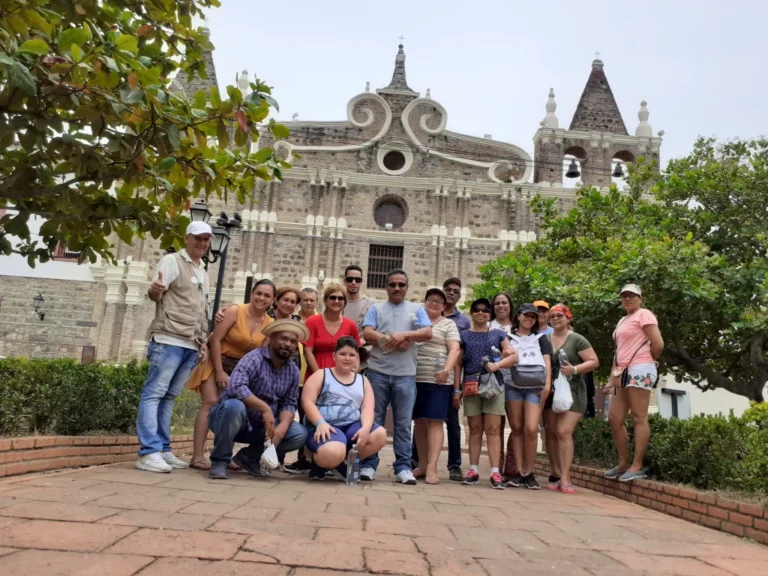
The Plaza Mayor Simón Bolívar is where the town begins, a square of shade trees, benches and a fountain with the cathedral on its uphill side. The Catedral Basílica Metropolitana de la Inmaculada Concepción was built between 1797 and 1837, by the heritage network’s page, and its tower stands 45 meters. Its parish page gives the address as Calle 10 No. 9-76, the phone as 850 86 57 with a mobile on 316 101 72 82, and Mass at seven in the morning from Monday to Thursday, at seven in the morning and seven in the evening on Fridays and Saturdays, and at eight, eleven, six and seven on Sundays; the parish office is open from nine to twelve and two to five on weekdays and nine to twelve on Saturdays. Read the next section before you rely on any of it this year.
Six more churches sit within a few blocks. The Templo de Santa Bárbara, built in 1728 by the heritage network’s date, is the oldest and stands on its own plazuela; the churches of Jesús Nazareno and Nuestra Señora de Chiquinquirá anchor the other two small squares, and San Pedro Claver completes the Gobernación’s list of the ones a visitor should see, along with the chapels that make up the rest of what its tourism page calls a network of churches and chapels built over a span of a hundred to three hundred years. The Museo de Arte Religioso holds the paintings, sculptures and gold and silver work that came out of them. The archbishop’s seat is on the Plazuela Martínez Pardo at No. 12-11. Walk them in the morning; the plazuelas are the shadiest places in the town and the doors close for lunch.
After the earthquake
On 10 August 2026 an earthquake with its epicenter in Chocó shook the west of Colombia, and Santa Fe de Antioquia is on every list it produced. The Gobernación’s 12 August bulletin counted 90 municipalities with damage in the department, 1,501 homes, 250 schools, 21 hospitals and 49 churches, and named Santa Fe de Antioquia among the thirteen Occidente municipalities reporting damage. By 31 August the count of damaged cathedrals, churches and chapels in Antioquia had risen to 73 in 45 municipalities, and the Catedral Basílica of Santa Fe de Antioquia was on it, by El Colombiano’s list. The Ministry of Culture’s own tally, as Semana reported it on 19 August, put twelve of the fifteen historic centers in the affected zone among the damaged, and Santa Fe de Antioquia and Jericó are named together in it, alongside Jardín, Abejorral, Popayán, Manizales, Salamina, Aguadas, Buga, Cali, Cartago and El Cerrito.
What we do not know is the state of each building today. Neither the archdiocese nor the ministry has published, on a page we could read, whether the cathedral’s interior is open, whether Mass has moved, or which of the six other churches took damage; the parish page above still lists the ordinary schedule. So the house rule is the one we use in Jardín: call the cathedral before you plan the day around its interior, expect scaffolding or tape on at least one façade, and treat the plaza, the streets, the bridge and the museum as the visit. We found no report that the town stopped receiving visitors. We will update this page the day either institution publishes a status.
The Puente de Occidente
The bridge is the reason most people drive out, and it deserves it. Colombia’s submission to UNESCO’s tentative list, dated 27 September 2012, describes a 291-meter suspension bridge over the Cauca between Santa Fe de Antioquia and Sopetrán, with a 3.10-meter roadway and two 1.20-meter sidewalks, four wooden towers 11.28 meters high, and cables each made of 798 imported steel wires; work began in December 1887 and ended in 1895 at a cost of 171,000 pesos, and the file says it was considered the third-largest bridge in the world when it opened. Its engineer, José María Villa, was born in Sopetrán in 1850, studied in the United States, and, by the same file’s account, worked on the Brooklyn Bridge before he came home to build this one. It has been protected as a national monument since Ley 25 of 25 November 1978.
The rule that changed everything is from 2024. After a year of repairs that ran from September 2023 to July 2024 and a second closure in August 2024 when a vehicle damaged it, the Gobernación reopened the bridge on 30 September 2024 under Resolución 2024060391542 for pedestrians, motorcycles and motocarros only, with a 573,000-peso fine for driving a car onto it, because, in the infrastructure secretary’s words as El Colombiano reported them, a 137-year-old structure shows high deformation and vibration under a car’s weight. Every older guide and most tour brochures still show cars on it. They are wrong, and the ban is good news: the walk across, with the boards moving under you and the brown river below, is the best ten minutes of the day, and there is no traffic to share it with. It is a short drive north of the town on the road toward Olaya and Sopetrán; a car or a tour takes you to the near bank, you walk to the far bank and back, and the mototaxis that cross it are part of the show.
The museums and the houses
The Museo Juan del Corral is the town’s museum and one of the Ministry of Culture’s own, in the former colonial mansion of Juan Esteban Martínez with a nineteenth-century addition over its rear, protected as a national Bien de Interés Cultural under Ley 163 of 30 December 1959, by the foundation that led its 1996 restoration studies. It is named for the man who declared Antioquia’s independence in 1813. Our guides walk its seven rooms and its collection of 496 pieces, religious, colonial and pre-Hispanic, on every tour, and the honest note is this: we have not found the museum’s current hours or fee on a page the ministry publishes, and the aggregator sites disagree, so we do not print them; our tour includes the visit, and if you go alone, ask at the door in the morning.
The rest of the town’s interiors are a walk. The Casa Negra, the black house, is now the Casa de la Cultura Julio Vives Guerra, by the heritage network’s page. The Hotel Mariscal Robledo, a house from the seventeenth century by the Gobernación’s tourism page, is worth stepping into for its library even if you sleep elsewhere. And the houses themselves, single-story, whitewashed, with carved wooden window grilles and doors opening onto patios of bougainvillea and mango, are the museum nobody charges for; the owners are used to visitors looking in, and a greeting gets you further than a lens.
Tamarind, and what to eat
Santa Fe de Antioquia’s fruit is the tamarind, and the town has a festival for it in August, by the heritage network’s calendar. You will meet it as pulp, as sweets sold from trays on the plaza, as juice, and in some kitchens as a sauce; buy the pulp to take home, because it travels, and drink the juice with the meal, because it cools. The meal itself is the same Antioquian table as Medellín, bandeja paisa, sancocho, sudado, and the thing to do with it in this climate is to eat it late, in a patio, and not to walk afterwards. Fresh fruit juices are the other reason to sit down: the town grows the fruit the valley buys.
The day we run
Our Santa Fe de Antioquia day is private, with your own guide and car from your Medellín hotel: the drive out through the tunnel, the walk across the Puente de Occidente, the Museo Juan del Corral, the plaza and the three plazuelas of Jesús Nazareno, Santa Bárbara and Chiquinquirá, a traditional lunch in the town, and the drive back, about eight hours in all, with private hotel pickup and drop-off and insurance included and lunch not. It is the right day for anyone who wants the colonial capital and the bridge without the bus, and the wrong day for anyone who cannot do heat: for them we say Jardín, below.
Getting here is the other half of the day, and it is hot from nine in the morning, so the hour matters. Medellín transfers has this route and every other road out of the valley on one page, with the booking widget on it.
Sleeping there, and the pools
You can do the town in a day from Medellín, and most of our guests do. The case for a night is the evening, when the heat goes down a few degrees, the plaza fills with families and the churches are lit, and the case for two is a pool, which is what the valley comes for. Santa Fe de Antioquia and the towns on the same road, San Jerónimo and Sopetrán, are Medellín’s weekend, and the hotels are built around water; the trade-off is that on a Saturday, a holiday weekend or any day between the film festival and the Fiesta de los Diablitos in December, the town is full and the prices know it. A weekday night is a different town. Whatever you book, check it is legally registered: any property in Colombia that rents to tourists must hold a Registro Nacional de Turismo, and the free lookup at rnt.confecamaras.co takes a minute; the rules are in our where-to-stay guide for Medellín.
The risk, stated plainly
The town is safe for a visitor by day, and the day trip is unaffected by anything below, but we owe you the countryside’s numbers, as we do for Jardín. By the national police’s open data, updated on 18 August 2026, the municipality of Santa Fe de Antioquia recorded 19 homicides in 2023, seven in 2024, nine in 2025 and five between January and 10 May 2026. The 2023 figure has a story: in a single August week that year seven people were killed in what the press reported as a Clan del Golfo reprisal over a gold theft, one of the episodes that made the department’s news that year. Of the nine in 2025, eight were in the rural zone and the police classify four as fights, two as sicariato and three as killings with signs of torture; all five of the 2026 cases, four rural and one urban, are classified as attacks by armed groups. Theft from people, the crime that reaches visitors, was 110 cases in 2023, 64 in 2024, 79 in 2025 and 41 to the end of July 2026, in a municipality of 28,000 people that fills up on a holiday weekend.
What that means for you is what it means in every heritage town in Antioquia. The violence is targeted and mostly rural, we found no report of a visitor being targeted, and the town, the bridge, the museum and the road are a normal day. At night, stay on the plaza and the lit streets, do not walk the rural roads or the riverbank after dark, and take a car or a mototaxi arranged by the hotel rather than a stranger’s offer. The current United States advisory for Colombia, updated on 31 March 2026, is Level 3 for the country and does not put Antioquia at Level 4; the United Kingdom’s advice, updated on 3 September 2026, names only Urabá and Bajo Cauca in this department. The habits that matter are the city ones: phone in the pocket in the plaza on a Sunday, a copy of the passport, and a drink you watched being poured. Our Medellín safety guide has the whole argument.
The calendar
Four dates shape the town’s year. In January the Fiestas del Río Tonusco open it; Holy Week fills it, with processions through the seven churches that the Gobernación counts among the town’s main events; August is the Fiestas del Tamarindo; and December is both the film festival and the Fiesta de los Diablitos. The Festival de Cine de Santa Fe de Antioquia has run since 2000 by the Gobernación’s account, and its twenty-sixth edition ran from 5 to 8 December 2025; the 2026 dates are on the festival’s own site when it publishes them. The Fiesta de los Diablitos, one of the town’s oldest celebrations, runs through the last days of December, with masked devils in the streets, parades and horse processions; the 2025 edition ran from 22 to 31 December by the event listings, and the corporation that runs it says only “every December” on its own page, so check before you book the last week of the year. The Festival Nacional Antioquia le Canta a Colombia, a folk-music competition, has run since 1976.
One smaller rule. On a holiday Monday the return to Medellín in the late afternoon is slow, because the whole valley is coming home through the same tunnel; leave earlier or later than everyone else.
Jardín or Santa Fe, or Guatapé
These are the three days out of Medellín that we run, and they are three different countries. Guatapé is the reservoir and the rock, 740 steps and a view, cool, green, crowded and close; our Guatapé guide has it. Jardín is the coffee town three hours south, a few hundred meters higher than Medellín and cool enough for a jacket at night, with a working coffee farm and the plaza we think is the most beautiful in the department; our Jardín guide has it, including what the earthquake did to its basilica. Santa Fe de Antioquia is the hot one, the old one and the closest of the two heritage towns, an hour away with a tunnel and a bridge, for someone who wants the sixteenth century and a pool rather than the coffee and the cold. If you have one day, our answer depends on you: Guatapé for the photograph, Jardín for the coffee and the countryside, Santa Fe for the history and the heat. If you have two, Santa Fe and Jardín together are the two halves of Antioquia, the river and the mountain.
Questions travelers ask
How far is Santa Fe de Antioquia from Medellín?
57 kilometers by the Alcaldía, 56.2 by the Gobernación, an hour and a quarter of driving through the Túnel de Occidente, closer to two hours door to door from an El Poblado hotel in the morning. The bus from the Terminal del Norte costs 23,000 pesos on the hourly premium service.
Can you drive across the Puente de Occidente?
No, and not since 30 September 2024. Cars are banned by a Gobernación resolution with a 573,000-peso fine; pedestrians, motorcycles and motocarros cross. Walk it.
How hot is it?
Daily maximums average 34 degrees across the year and 36 in February, and the nights stay above 20, by IDEAM’s normals for the municipality. It is a hat, water and a roof at midday, every month.
Is the cathedral open after the earthquake?
We do not know, and we will not guess. The cathedral is on the list of 73 churches damaged in Antioquia and the historic center is on the ministry’s list of damaged centers; the parish page still shows the normal Mass times. Call 850 86 57 before you plan around the interior.
Is Santa Fe de Antioquia safe?
By day, for a visitor, yes, with the ordinary habits. The countryside has a real problem with armed groups, and the police classify all five homicides of early 2026 that way; none of it reaches the plaza, the bridge or the road on a day trip. At night, stay on the lit streets and take the hotel’s car.
Santa Fe de Antioquia or Jardín?
Santa Fe for the sixteenth century, the bridge, the heat and the short road; Jardín for the coffee farm, the cloud forest and the cool. Both if you have two days; they are opposite ends of the department’s climate.
How much does the day cost?
Our private day is from 123 US dollars per person for two travelers, with the guide, the car, hotel pickup and insurance, and lunch paid on the day. Self-drive, count the toll both ways, about 50,000 pesos in 2026, plus fuel and parking, and the museum fee at the door.
Plan it with us
We run Santa Fe de Antioquia as a private day from any Medellín hotel, and we run Jardín and Guatapé the same way, so tell us how many days you have and what kind of Antioquia you want and we will build them, or start from our Colombia itinerary if the rest of the trip is still open. Write to us on WhatsApp with your dates, or see everything we run from the city on our Medellín tours page.
Sources
Alcaldía de Santa Fe de Antioquia: the municipality’s information page (area, altitude, temperature, distance, nicknames). Gobernación de Antioquia: the corregimientos page for the municipality (founding, capital until 1826, population, corregimientos, seven churches, distance and time) and the Antioquia es Mágica tourism page (churches, museums, Hotel Mariscal Robledo, festivals); its 12 August 2026 earthquake bulletin. Red Turística de Pueblos Patrimonio: the town’s page (Pueblo Patrimonio since 2010, the 1960 declaration, the cathedral’s dates and tower, Santa Bárbara 1728, the Casa Negra, the festival months). Conferencia Episcopal de Colombia: the archdiocese’s history. Arquidiócesis de Santa Fe de Antioquia: the cathedral’s address, phone and Mass schedule. UNESCO World Heritage Centre: the Puente de Occidente tentative-list file of 27 September 2012, quoted for the bridge’s figures and the engineer’s biography as the file states them. Fundación Ferrocarril de Antioquia: the Museo Juan del Corral’s house and its 1959 protection. IDEAM 1991 to 2020 climatological normals for the Hacienda Cotové station, via datos.gov.co. Policía Nacional and Ministerio de Defensa open data on datos.gov.co, homicides and theft from people, rows updated 18 August 2026. Agencia Nacional de Infraestructura on the Túnel de Occidente; Terminales de Transporte de Medellín, destinations page. United States Department of State advisory of 31 March 2026 and the United Kingdom’s Colombia advice of 3 September 2026. The vehicle ban on the bridge and the 2024 closures, the 2026 toll, the 2023 killings, the earthquake church count and the ministry’s list of damaged historic centers are as reported by El Colombiano, Semana and the press round-ups named in the text, press rather than gazette, and marked as such. The Fiesta de los Diablitos dates are from event listings and the corporation’s own page. Tour facts are read from our own tour page on the day of publication.