September 9, 2026
Yes, Medellín is safe to visit, and the people who tell you otherwise are usually describing a city that stopped existing thirty years ago. That answer needs the rest of this page, because the risks that do reach visitors are specific, avoidable and almost never the ones people worry about on the plane. We live and run tours here, in El Poblado, Laureles, downtown and Comuna 13, every day of the year. This is what the numbers say in 2026, what happens to travelers, which neighborhoods behave how, and the short list of rules that keeps our guests out of every story you have read.
The city in full, from the metro fares to the calendar, is in our Medellín city guide.
The short version
The city’s homicide rate is now lower than Bogotá’s and far below the national average, and the violence that remains is between armed groups, not aimed at tourists. What reaches visitors is theft of phones, and, for a small number of people every year, being drugged and robbed after a night out or a date arranged online. Both are avoidable with habits, not fear. Stay in El Poblado, Laureles or Envigado, keep your phone out of your hand on the street, use ride apps or a driver you know at night, never leave a drink or bring a stranger to your room, and treat downtown as a daytime place. Do that and Medellín is as safe as any large city you have enjoyed.
What the numbers say
Medellín recorded 325 homicides in 2025, up slightly from the 310 of 2024, which had been the city’s lowest annual total since 1976, according to the city’s security information system; the running rate so far in 2026 is 9.85 per 100,000 residents. Bogotá’s rate is 14.8 and Colombia’s national rate about 25.9. In May 2026 the city registered 14 homicides in the whole month, with 22 days on which nobody was killed, the quietest month since records began in 1977. Almost all of that violence happens inside disputes between criminal groups in neighborhoods visitors have no reason to enter; it is not random and it is not directed at foreigners. The United States keeps Colombia as a whole at Level 3, “reconsider travel,” in its advisory updated on March 31, 2026, with Level 4 reserved for Arauca, Cauca outside Popayán, Valle del Cauca outside Cali, Norte de Santander and the ten kilometers along the Venezuelan border. Medellín and the rest of Antioquia are not in that group. Read the advisory for what it is: a country-level document that lists everything that can happen anywhere, not a description of a Tuesday in Laureles.
The risks that reach visitors
Drugging. This is the risk that matters most. On January 10, 2024, the United States Embassy issued an alert after eight of its citizens died in Medellín between November 1 and December 31, 2023, in cases of involuntary drugging or suspected homicide, many of them after meetings arranged through dating apps; the nightlife around Parque Lleras is where the same pattern shows up without the app. The pattern is always the same: a drink or a date, a substance that leaves you compliant or unconscious, and a hotel room or apartment emptied of everything, sometimes with the victim’s accounts drained before morning. The rules that defeat it are short. Meet dates in public places and stay in public places. Tell someone where you are and who you are with. Never leave a drink unattended and do not accept one you did not see poured. Do not bring someone you met that night back to your accommodation, and be careful with a “new friend” who is suddenly keen to come up. If you are robbed, do not resist.
The National Police counted 537 drugging robberies in Medellín between January and July 2026, scopolamine cases in the local shorthand, up from 289 in the same months of 2025, and 87 percent of the victims were men. The most common setting was not a bar but an apartment in a gated building or a private home, 107 cases, ahead of the street, 89, bars, 71, hotels and lodgings, 49, and the streets around nightclubs, 37; weekends account for 45 percent of the cases. The rule follows from the list: the danger is who you let through the door, not the neighborhood.
Phone theft. The everyday crime of every Colombian city. A phone held out in the street, on a café terrace by the sidewalk, or at a metro door is a target for a hand from a passing motorbike or a runner. Keep it in a front pocket or a zipped bag, use it against a wall or inside a shop, and do not walk downtown or through Comuna 13 with it in your hand. Carry a copy of your passport, not the passport itself.
Cards and cash. Use ATMs inside banks, malls and supermarkets in daylight, not on the street at night, and split your cards between two places. Most restaurants and shops in El Poblado and Laureles take cards; the carts and small shops do not, so carry small notes. What locals do at the ATM in Bogotá applies word for word here.
Transport. Ride apps are fine inside the city by day and night, even though they sit in a legal grey zone; at the airport they are not authorized, which is why our airport guide explains the flat-rate taxi and the pre-booked transfer instead. Do not flag a taxi on a dark street late at night; order the car. Do not rent a motorbike or get on one as a passenger; the same advisory forbids its own staff from doing so, for good reason.
Neighborhoods
El Poblado. Where most visitors stay, and safe by day and evening around Provenza, Manila and Astorga, with police, cameras and crowds. Around Parque Lleras after ten at night it becomes the most transactional corner of the city, and it is where the drugging cases concentrate. Enjoy it with the rules above, and pick a hotel two streets away if you like sleep.
Laureles and Estadio. Calmer, flatter, more residential, with the bars of La 70 and a walkable grid. The neighborhood we send people to who want the city without the scene.
Envigado and Sabaneta. Separate municipalities south of El Poblado, quiet, family-oriented, easy by metro.
El Centro. Downtown is the most interesting square kilometer in the city and a daytime place: go with the crowds to Plaza Botero and the Museo de Antioquia, keep the phone away, and leave before dark. It is not dangerous at noon; it is empty and unlit at nine.
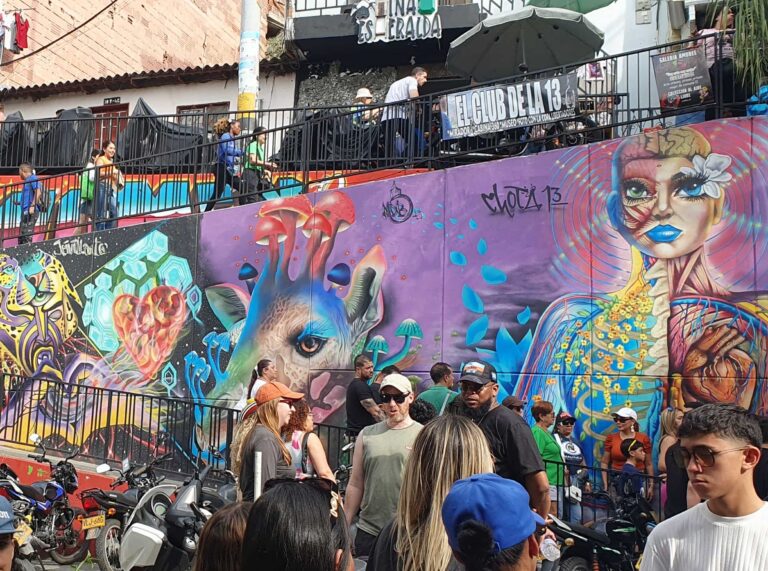
Comuna 13. Ten thousand visitors a day walk the escalator route without incident. Go in the morning, ideally with a guide from the neighborhood, and stay on the visited streets; our Comuna 13 guide has the details.
Everywhere else. The Metrocable lines carry you over hillside neighborhoods that are perfectly safe to see from a cabin by day and that you have no reason to walk through alone, as is true of the outer districts of any city. The point is not fear; it is that the tourist city and the working city overlap in some places and not in others.
If you are choosing between them, our guide to where to stay in Medellín compares the same neighborhoods for noise, hills, metro access and the ride from the airport.
The night has its own rules, and the risk that reaches visitors here is a drink, not a street. We set that out with the Embassy’s own figures in our Medellín nightlife guide.
Getting around safely
The metro is clean, busy and safe, and the rule on it is the phone rule. The Metrocable lines are public transport and fine by day. Walking is fine in El Poblado, Laureles and Envigado in daylight and early evening; after eleven, order a car for anything more than a few blocks, which is what residents do. At night, and always from the airport, a car you booked beats a car you flagged. Our tours run with hotel pickup and a guide from start to finish, and our transfers are operated by Safe Transfers by Cielo.Travel, our transfer company, with verified drivers and your flight tracked, which removes the question entirely.
Book a driver instead of deciding on the street
The advice above is mostly about not improvising. A private car is the version of that you can arrange before you land: same driver, fixed price, no negotiation at the kerb.
We also run a Medellín city tour if you would rather see it with a guide.
Health, water and the everyday things
The tap water is safe to drink. EPM, the city's public utility, reports a water-quality risk index of 1.06 percent for 2024 against a national threshold of five, and its own advice is to drink it from the tap. The altitude, about 1,500 meters, is too low to trouble anyone. The sun is stronger than it feels, so sunscreen matters, and repellent matters on the hot, low day trips to Santa Fe de Antioquia, not in the city. Colombia's emergency number is 123 for police, ambulance and fire, and our guide to emergency numbers lists the rest; the numbers are national. Buy travel insurance that covers private clinics, which is where you would be treated. And learn one phrase before you land: no dar papaya, which means do not make yourself the easy target, and is the whole of Colombian street wisdom in three words.
Solo travelers, women, families, LGBTQ travelers
Solo travelers are common here and do fine with the rules above; the drugging risk is the one to take personally, because it targets people who are alone. Women get the same catcalling as in any Latin American city and, in the neighborhoods above, no more than that; the night rules are the ones that matter. Families are welcome everywhere on this list, including Comuna 13 in the morning and the metro at any hour, and the city is unusually good with children. Medellín has one of Colombia's most open LGBTQ scenes, centered in El Poblado and around Laureles, and public affection in those neighborhoods draws no attention; downtown after dark is the same daytime-only rule for everyone.
What we do differently, and what we cannot promise
We cannot make a city risk-free. What we do is remove the moments where visitors get hurt: nobody in our care is flagging a taxi at one in the morning, walking downtown at dusk looking for a bus, or improvising the ride from the airport. A guide who lives here, a driver who is expected, and a plan that starts early and ends before the risky hours cover most of it. The rest is the short list above, which we repeat to every guest and which works.
Questions travelers ask
Is Medellín safe for tourists in 2026?
Yes. The homicide rate is below Bogotá's and far below the national average, and the violence that remains is between armed groups, away from where visitors go. The risks that reach tourists are phone theft and drugging around nightlife and dating apps, both avoidable with the habits on this page.
Is El Poblado safe at night?
Around Provenza and the quieter streets, yes. Around Parque Lleras after ten it is loud and transactional, and it is where drink-spiking cases concentrate. Keep your drink in sight, meet dates in public, and take a car home rather than a walk.
Is it safe to walk around Medellín?
By day, in El Poblado, Laureles, Envigado, downtown with the crowds and Comuna 13 on the visited streets, yes. At night, walk short distances in the residential neighborhoods and order a car for anything longer. Do not walk downtown after dark.
Is the metro safe?
Yes, and it is the best way to move around the city. Keep your phone in your pocket on the platforms and at the doors, and expect crowds at rush hour.
Can I use Uber in Medellín?
In the city, yes; the apps work well despite their legal grey zone. At the airport they are not authorized and drivers meet you in a distant parking lot, so use the flat-rate taxi or a pre-booked transfer there.
Can I drink the tap water in Medellín?
Yes. The public utility publishes its quality index every year and it is well inside the safe range; locals drink from the tap.
Elsewhere in Colombia
Medellín’s risk profile is unusual: the alerts here are about what goes into a drink, not about what happens on the street. For how that sits against the country as a whole, and what the two foreign governments say, see is Colombia safe. Cali is the city where those advisories touch an itinerary, and Cartagena is the opposite problem again — the hustle rather than the danger.
Plan it with us
Every tour we run in Medellín comes with hotel pickup and a guide who lives here, and our transfers are operated by Safe Transfers by Cielo.Travel. If you want the city with the guesswork removed, write to us on WhatsApp with your dates, or start with our guide to things to do in Medellín and our Medellín tours page.