September 12, 2026
San Basilio de Palenque is a village of about 3,500 people in the foothills of the Montes de María, an hour and a half southeast of Cartagena, founded in the seventeenth century by Africans who escaped the slave port and held their freedom by arms until the Crown recognized it. It is the only one of the walled refuges called palenques to have survived, it speaks the only creole language in Latin America built on Spanish words and Bantu grammar, and UNESCO proclaimed its cultural space a masterpiece of the heritage of humanity in 2005. It is also, in our experience, the day trip out of Cartagena that fewest visitors know exists. We run it as a private day with a guide from the town, so this is the guide we give our own travelers before they book: what Palenque is and what the documents actually say about how it became free, the language and the way the town organizes itself, its champion boxer, what the visit is like hour by hour, how to be a good guest, when to go, and whether it is worth one of your days.
The short version
Palenque is a living town, not a museum, and the visit is four hours walking it with someone who lives there: the plaza with the monument to Benkos Biohó, the streets of small, colorful houses, the drums, the language, the traditional medicine, a homemade lunch of fish and coconut rice, and the sweets the palenqueras sell on the streets of Cartagena. It is 55 kilometers southeast of the city by Colombia Travel’s figure, 70 by the Instituto Caro y Cuervo’s, and about an hour and a half by road, in the municipality of Mahates in Bolívar. Go with a local guide, ask before every photograph, agree tips before you accept a service, buy the sweets, and expect the heat of the plain. The Festival de Tambores in mid-October is the week the town fills with drums. It is worth a day if you want the one place near Cartagena where the history of the port is told by the descendants of the people it was done to; it is not a beach, a spa or a shopping trip.
What Palenque is
A palenque, in the Spanish of the colony, was a fortified settlement of escaped slaves, and the hills and swamps behind Cartagena held many of them in the seventeenth century, refuges for the people who escaped the city’s galleys, mines and haciendas, in the Instituto Caro y Cuervo’s summary. UNESCO’s description of the cultural space says it plainly: Palenque de San Basilio was one of the walled communities called palenques, founded by escaped slaves as a refuge, and of the many palenques that existed, only San Basilio has survived to the present day. Today it is a corregimiento of the municipality of Mahates, in the department of Bolívar, in a valley at the foot of the Montes de María about a hundred meters above sea level, with about 3,500 inhabitants by UNESCO’s file and the Ministry of Culture’s safeguarding plan (435 families in 421 houses when the plan was written; the ministry’s own page says 3,700 and the Caro y Cuervo institute between 3,000 and 5,000) and some 30,000 Palenqueros in all, counting the families in Cartagena, Barranquilla and Venezuela. Colombia Travel puts it 55 kilometers southeast of Cartagena and the Instituto Caro y Cuervo 70; by the coordinates it is 52 in a straight line from the Puerta del Reloj, and the road takes about an hour and a half.
How it became free, by the documents
The name everyone says is Benkos Biohó, and the dates the Banco de la República’s encyclopedia gives him are these: brought from West Africa on a slave galleon at the end of the sixteenth century, he escaped from the galleys in 1599; by 1603 he and other Africans had built a large palenque on the shores of the Ciénaga de la Matuna; in 1605, after a failed attack, the Spanish authorities recognized his leadership, left his settlements alone and let his people enter Cartagena freely; and in 1619 he was captured in the city and on March 16, 1621 hanged in one of its plazas. The Ministry of Culture describes Palenque de San Basilio as a place of Africa in Colombia for its part in the seventeenth-century cimarrón uprising that Biohó led, and his statue, arm raised and mouth open in a shout, stands in the plaza. The freedom itself has two official accounts, and they do not give the same date. The Instituto Caro y Cuervo, the state’s language institute, says the governor Gerónimo Suazo was forced to sign a peace capitulation with the new town as early as 1603 and that on August 23, 1691 the king of Spain issued a royal decree granting the palenqueros of the Sierra de María their freedom, which in the institute’s words made Palenque de San Basilio the first free town of the Americas. The ministry’s safeguarding plan tells it through the earliest written account of the town, by the bishop of Cartagena Diego de Peredo in 1772: San Basilio began with many fugitive slaves who settled in the mountains and could not be brought back to servitude even by force of arms, with much blood spilled, until at the beginning of that century Bishop Antonio María Cassiani, with the governor’s agreement, obtained their submission in exchange for a general pardon and the enjoyment of their liberties, on the condition that they admit no more fugitive slaves; and, the bishop noted, they spoke among themselves a particular language of their own. So the title of first free town of the Americas rests on the decree of 1691 for the institute, the town and the tourism boards, while the ministry’s plan tells the story through the agreement of the early 1700s without using the phrase, and we tell you both. UNESCO proclaimed the Cultural Space of Palenque de San Basilio a Masterpiece of the Oral and Intangible Heritage of Humanity on November 25, 2005, inscribed it on the Representative List in 2008, and Colombia put it on its own national list in 2009.
The language
Palenquero is the reason linguists come here. The Instituto Caro y Cuervo describes it as one of only two creoles in the world built on a Spanish lexicon, the other being the Papiamento of Curaçao, Aruba and Bonaire, and as a language whose African elements come from the Bantu family, in particular from Kikongo and Kimbundu. UNESCO’s file says the same in one line: the only creole language in Latin America with a Spanish lexical basis and the grammatical characteristics of Bantu languages. The institute is also honest about its condition: until very recently Palenquero was stigmatized by the rest of the country as badly spoken Spanish, which turned the town itself against it, so that Spanish replaced it in most settings and it came to be spoken fluently mainly by the old, while the young, schooled in Spanish, understood it without speaking it; since the 1980s, ethno-education projects inside the community have set out to reverse that, and the town now treats the language as the symbol of its identity. On the visit you will hear it, and your guide from the town will teach you a few words; do not expect to understand a conversation.
How the town lives
The Ministry of Culture’s description of the cultural space is a list of things you can see in a day if someone shows you where to look. The town is organized in extended family networks, in age groups called ma-kuagro, whose membership carries rights and duties toward the other members, and in other bodies called juntas. Its funeral rite, the lumbalú, and its traditional medicine are, in UNESCO’s words, evidence of the distinct spiritual and cultural systems framing life and death in the community. Its music, by the ministry’s list, is the lumbalú, the work songs and the wake songs, the décimas, the sextet music, the bullerengue sentao, the cumbia and the mapalé, with the son palenquero or son de negro that UNESCO names for the collective celebrations; the drums are the heart of all of it, and the music, the dance and the traditional medicine are on the program of the visit. The economy is poor and the Instituto Caro y Cuervo says so: a fifth of the people farm yuca, maize, yam, rice, watermelon, melon, beans and peanuts, a sixth mix farming with small livestock, and more than a quarter live from informal selling of sweets, cheese, corn bollos and meat, which is the trade that puts the palenqueras on the streets of Cartagena; access to water and electricity is limited and there is no sewerage. The women in bright dresses with bowls of fruit on their heads in the walled city are from these families, and the sweets they sell come from kitchens like these; on the visit you eat them after lunch.
Kid Pambelé
Colombia’s first world boxing champion was born here. Antonio Cervantes, Kid Pambelé, born in San Basilio de Palenque on December 23, 1945, won the World Boxing Association’s junior welterweight title on October 28, 1972, in Panama, at the Nueva Panamá gymnasium, against the Panamanian Alfonso “Peppermint” Frazer; defended it ten times before losing it in 1976 to the Puerto Rican Wilfredo Benítez; won it back a year later in Maracaibo and defended it six more times until July 1980, by the Banco de la República’s biography. The town has a monument to him, and the visit includes it with Biohó’s.
The visit, hour by hour
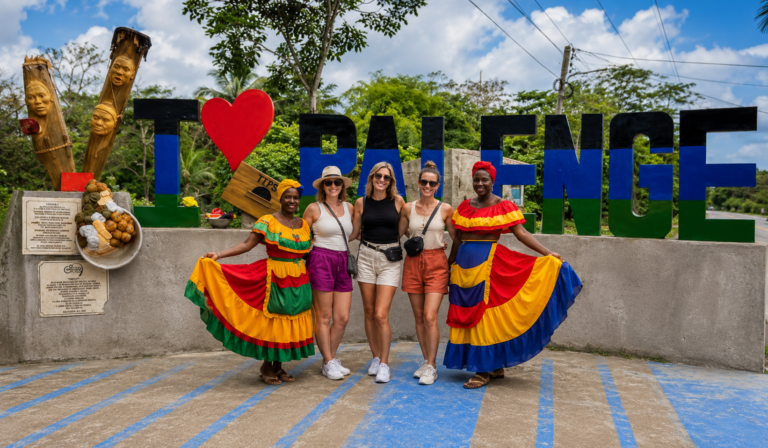
Our Palenque day is seven hours and private. Your guide picks you up at your hotel in Cartagena and drives about an hour and a half inland to the town. In Palenque a guide from the town joins you, and the next four hours are on foot: the plaza and the monument to Benkos Biohó, the monument to Kid Pambelé, the streets of small, colorful houses, residents who share their traditions firsthand, and their music, dance and traditional medicine, at the pace the people you meet set rather than a schedule. At midday a family serves lunch in their home, fresh fish, coconut rice, salad and fried green plantains, followed by the traditional sweets the town is known for across Colombia. The drive back is about an hour, and the driver leaves you at your hotel. Included: our private English-speaking guide, the local Palenque guide, private transport with hotel pickup and drop-off, the homemade lunch and all-risk insurance; not included: breakfast and whatever you buy in the town, which you should. From 172 US dollars per person for two travelers.
How to be a good guest
Palenque is a town where people live, not a site, and the difference between a good visit and a bad one is entirely in how you behave in it. The local guide is not optional for us: it is the town’s own people who decide what is shown, who is introduced and what is explained, and the guide’s fee is part of what the visit gives back. Ask before every photograph of a person, and accept a no; if someone poses for you, in the plaza or in the walled city, the photograph is a transaction and the tip is agreed first and paid gladly. Buy the sweets and whatever else is made in the town. Do not walk into a house, a school or a workshop uninvited. Listen more than you talk: the people who explain the language and the drums to you are explaining their own family, and the visit is a conversation, not a performance. Dress for the heat and for a village, not for a beach. And if the visit moves you, which it does most people, the honest response is to say so to the person in front of you, not to the camera.
When to go, and the festival
Any dry morning is good: the plain south of Cartagena is hot all year, the dry months from December to April are the sunny, dusty ones, and October and November are the two wettest months of the year on this coast, with their storms in the afternoon, by the IDEAM figures in our Cartagena weather guide. The exception worth planning around is the Festival de Tambores y Expresiones Culturales de Palenque, held every year in mid-October and born in 1985: workshops in percussion, dance, hairstyling and the Palenquero language, talks on the culture and its traditional medicine, and concerts, by the programs Colombia Travel and Fontur publish. It falls in the wettest month, so pack for an afternoon storm. The 2025 edition ran in the second week of October; Colombia Travel’s own page gives it as October 9 to 12 in the text and October 10 to 13 in the header, which tells you how firm published dates are, so we confirm the year’s dates before you book. Go early in the day in any month: the four hours in the town are on foot, and the heat builds through the morning.
Getting there without us
By car it is about an hour and a half from Cartagena, inland to the southeast. If you go on your own, arrange a guide from the town when you arrive rather than walking around unaccompanied; the community’s guides are how the visit is meant to work, and it is also how you find the lunch, the sweets and the drums. We do not recommend improvising the trip by public transport with a same-day return. What our day adds is the door-to-door car, the two guides, the lunch already arranged in a family’s home and a driver who knows the road in the rain.
Is it worth it?
Yes, and more than most things on this coast, if you are the kind of traveler who wants to understand where you are. Cartagena was one of the slave ports of the Spanish Crown, and Palenque is the one place within reach of the city where that history is told by the descendants of the people who escaped it, in a language that survived three centuries in a valley, with drums that came across the ocean in memory. It is not pretty in the way the walled city is pretty; it is a poor town of small painted houses on hot streets, and a visitor who expects a folkloric village will be disappointed and will, worse, be seen to be. What we can promise is that nothing about it is staged, that the people you meet are telling you about their own town, and that the lunch is cooked in the house where you eat it.
Palenque, El Totumo or the islands: which day
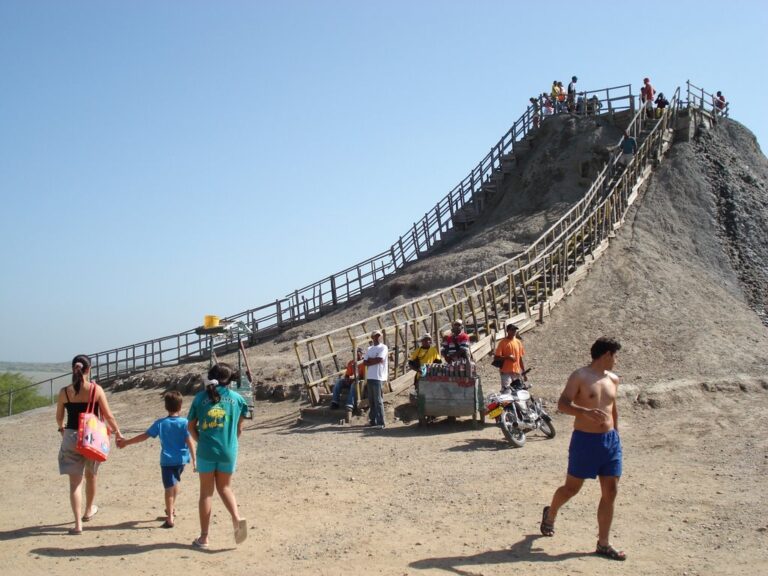
With one day out of Cartagena, most people should take the water, the Rosario Islands on a private boat or, with children, Playa Tranquila on Barú. With two, the choice is between Palenque, the day with the most to say, and El Totumo with Manzanillo del Mar, which costs less, starts earlier and ends earlier; for most travelers we say Palenque, for a family with small children the volcano, and with three days you do both. Palenque and El Totumo cannot be combined in one day with any dignity: they are in different directions from the city and each deserves its hours. The city as a whole, from what it is to how many days it needs, is in our Cartagena travel guide, and every tour and day trip we run, with the 2026 prices, is in our guide to things to do in Cartagena.
Questions travelers ask
What is San Basilio de Palenque?
A village of about 3,500 people an hour and a half southeast of Cartagena, in the municipality of Mahates, Bolívar, founded in the seventeenth century by Africans who escaped slavery in the port; the only surviving palenque of the many that existed, the home of the Palenquero creole language, and a cultural space UNESCO proclaimed a masterpiece of the heritage of humanity in 2005.
Why is Palenque called the first free town in the Americas?
Because its people held their freedom by arms from the seventeenth century until the Crown recognized it: by a royal decree of August 23, 1691, according to the Instituto Caro y Cuervo, which uses the title, or by an agreement with the bishop of Cartagena in the first years of the eighteenth century, with a general pardon and the enjoyment of their liberties, according to the earliest written account of the town, from 1772, which the Ministry of Culture’s safeguarding plan follows without using the phrase.
What language do they speak in Palenque?
Spanish and Palenquero, a creole built on Spanish words with the grammar of Bantu languages such as Kikongo and Kimbundu, one of two Spanish-based creoles in the world by the Instituto Caro y Cuervo. It was stigmatized until recently and is spoken fluently mainly by the older generation, with ethno-education projects teaching it again since the 1980s.
How far is Palenque from Cartagena?
About an hour and a half by car each way, to the southeast: 55 kilometers by Colombia Travel’s figure, 70 by the Instituto Caro y Cuervo’s, and 52 in a straight line from the clock tower.
Can you visit Palenque on your own?
Yes, by car, and you should still take a guide from the town when you arrive: the community’s guides are how the visit works, and the lunch, the sweets and the drums come through them. Our private day adds the door-to-door car, our own guide alongside the local one, the lunch arranged in a family’s home and the insurance.
When is the Palenque drum festival?
Mid-October every year since 1985; the 2025 edition ran in the second week of October. Drums, dance, workshops in percussion, hairstyling and the Palenquero language, talks and concerts; ask us for the 2026 dates.
Is Palenque worth visiting?
Yes, for anyone who wants the history of Cartagena told by the descendants of the people who escaped its slave port, in a living town rather than a museum. Not for a beach, a spa or a folkloric show, and not as the one day out of the city if the islands are still on your list.
Plan it with us
Our Palenque day is private, with a guide from the town, hotel pickup in Cartagena, the lunch in a family’s home and the insurance included, and it pairs with a city morning the day before or a beach day after. The other days out of the city we run, the private boat to the Rosario Islands, the day at Playa Tranquila and El Totumo with Manzanillo del Mar, are on our Cartagena tours page. Write to us on WhatsApp with your dates and your hotel, or start with the rest of our Colombia guides.
Sources
The facts on this page were checked on September 12, 2026 against the following sources: UNESCO’s file on the Cultural Space of Palenque de San Basilio for the palenques, the population, the language, the ma-kuagro, the rites and the music; the Ministry of Culture’s page on the cultural space and its safeguarding plan for the location, the population, Bishop Peredo’s 1772 account, the 2005 proclamation and the 2008 and 2009 listings; the Banco de la República’s encyclopedia entry on Benkos Biohó and its entry on Antonio Cervantes; the Instituto Caro y Cuervo’s page on the Palenquero creole for the language, the 1603 capitulation, the royal decree of 1691, the 70-kilometer figure and the economic data; Colombia Travel and Fontur’s festival calendar for the 55-kilometer figure, the festival’s dates, origin and program and the “first free town” phrase; our own tour page for the day’s program, inclusions and price, read today; and our Cartagena weather guide for the climate. Straight-line distances are calculated from coordinates.