September 12, 2026
The short version
Medellín’s night is not one place. It is four, and they are not interchangeable. El Poblado, and inside it the few blocks of Provenza and the Parque Lleras, is where most visitors go and where the city has spent the last two years tightening the rules. Laureles, on the other side of the river, is where people who live here go, and La 70 and La 33 are its two spines. Envigado and Sabaneta are separate municipalities at the south end of the valley with their own older, more paisa version of a night out. Manila and Ciudad del Río are the quiet middle, for a long dinner rather than a long night.
We are based in Colombia and we run tours in Medellín every week, which means we collect guests from hotels in all four of those places and put them back at the door afterwards. This is the guide we give them, and it sits alongside our Medellín guide: where each area actually is and who it suits, what time things start and end and why that answer keeps changing, what the drink is, what the risk genuinely is rather than the version on either the tourism posters or the true-crime documentaries, and how you get home when the metro has stopped.
If you read one paragraph, read this one. Nothing starts before eleven. The metro stops at eleven. Those two facts define the whole evening, so decide how you are getting home before you have the first drink, never leave a drink unattended or accept one you did not watch being poured, and do not take a stranger you met tonight back to where you are sleeping. That last sentence is the one the United States Embassy in Colombia has been repeating since 2023, and it is the one that keeps getting ignored.
The valley, and how it decides your night
Medellín sits at 1,479 meters, with an average temperature of 24 degrees, by the Alcaldía’s own figures. In practice that means the night is warm, every night, all year. Nobody carries a coat. Rooftops work in February and in October. It is one of the few cities at this latitude where an outdoor bar is a reliable plan rather than a gamble on the forecast; the month-by-month numbers are in our weather guide.
The valley also explains the geography. The river and the metro run down the middle of it, north to south. El Poblado is the southeastern hillside, Laureles the western flat, Envigado and Sabaneta the far south. Crossing the valley is a short car ride on a quiet night and a long one on a Friday. That is the whole trade: you can sleep in one of them and drink in another, but you will pay for it in cars, and the last metro is earlier than you think.
El Poblado: Provenza and the Parque Lleras
El Poblado is the hillside of embassies, business hotels and the highest rents in the city. Its nightlife is concentrated into a very small area: the Parque Lleras and the streets immediately around it, and the strip of Provenza running off it, which over the last decade turned from a residential street of low houses into a continuous row of bars, restaurants and rooftops.
What it is good for: it is walkable, it is dense, it has the widest range of anything in the city between a natural-wine bar and a reggaeton club, most staff speak some English, and you can change your mind three times in an hour without getting in a car. If you have two nights in Medellín and you want the version everyone describes, this is it.
What is wrong with it: it is the most expensive part of the city and the least Colombian-feeling, it is where the city’s problems with foreign visitors are concentrated, and it has been the subject of repeated municipal intervention since 2024. In April 2024 the mayor imposed measures across the Parque Lleras, Provenza, Calle 10 and the Parque de El Poblado suspending the solicitation of sexual services in public space, and a parallel pilot that closed alcohol-serving establishments around the Parque Lleras at one in the morning. The closing hour has moved several times since. The street is also noisier than the photographs suggest, and the blocks change character quickly once you leave the lit core.
Our house position, which we give our own guests: El Poblado is a good first night and a bad only night. Go, see it, then spend the second night somewhere people live. Which of these to actually sleep in is a different question, and it is the one our where-to-stay guide answers.
Laureles: La 70 and La 33
Laureles is the flat, tree-lined grid on the western side of the river, and it is where a paisa who is going out on a Thursday actually goes. It has two spines. La 70, formally Carrera 70, is a wide pedestrian-friendly avenue of open-fronted bars, fried food, football on screens and, on a good night, live music and dancing that spills onto the pavement. La 33 is the parallel option, a little smarter, more restaurant-led, more couples and less crowd.
What it is good for: it is noticeably cheaper than Provenza, the crowd is overwhelmingly Colombian, and it is a version of the city that does not feel staged. If you want to learn to dance badly in public, this is where to do it.
What is wrong with it: less English, fewer late-night options once the main strips thin out, and it is spread over a bigger area, so you will walk more or take short car rides between places. It is also genuinely loud on La 70, which matters if you are sleeping nearby.
Envigado and Sabaneta, which are not Medellín
This trips people up on a map. Envigado and Sabaneta are separate municipalities of the Valle de Aburrá, not neighborhoods of Medellín, with their own mayors and their own rules. They sit at the southern end of the valley, both on the metro’s Line A.
Their night is the oldest-feeling one in the valley: the main square, a church on one side, and a ring of bars around it where people drink aguardiente at plastic tables and the music is not reggaeton. Sabaneta’s park on a Friday is the closest thing the metropolitan area has to a village fiesta that happens every week. Envigado has more restaurants and a small but serious bar scene of its own.
What is wrong with it: it is a long way from El Poblado once the traffic is against you, the metro has stopped by the time you want to leave, and almost nobody there is working in English. Go if you have three or more nights, not if you have two.
Manila, Ciudad del Río and the quiet middle
Manila is the pocket of El Poblado west of Avenida El Poblado, a few blocks of converted houses that mostly do food and wine rather than volume. Ciudad del Río, around the Museo de Arte Moderno, is newer, flatter and built around a park. Neither is a nightlife district in the sense the other three are. Both are the right answer if what you actually want is a four-hour dinner with a bar attached and a taxi home at midnight.
The centre, and why we do not send you there at night
Downtown Medellín, around the Plaza Botero and the Parque Berrío, is one of the best half-days in Colombia and we run a walking tour through it, alongside the rest of what is worth your time here. It is also a daytime place. The house rule on both our safety guide and this one is the same: treat the centre as a daytime destination, and do not go looking for a bar there after dark unless you are with someone who lives in the city and has a specific place in mind.
What time anything starts, and what time it ends
Start late. Restaurants fill from about eight, bars from about ten, and a club before midnight is an empty club. A Colombian Friday that begins at seven with dinner is still a Friday that ends at four.
The ending is more complicated, and anyone who gives you a single confident closing hour for Medellín is guessing. Here is how the system actually works, because understanding it is more useful than memorizing a number that will change.
The city classifies areas by mixtura under its territorial plan: high, medium and low. Nightlife hours follow that classification rather than the individual venue, and the Alcaldía has named Provenza, the Parque Lleras, La 33, La 70 and La 68 in Castilla as its high-mixtura zones. On top of that baseline, the city has run a programme called Medellín Convive la Noche, whose rules sit in Decreto 1070 de 2021, under which establishments meeting certain conditions could apply for extended hours.
On 20 August 2026 the Juzgado Dieciséis Administrativo Oral de Medellín provisionally suspended part of that decree, on the grounds that the way it delegated the power to admit and remove establishments from the programme may breach the principle of legality. The extension programme stopped. Three days later the Alcaldía said it would issue a replacement decree within days and would consult the trade first; the trade body Asobares Antioquia has proposed four in the morning for high-mixtura zones and two for medium, as reported in the Colombian press rather than in any official gazette. At the time of writing no replacement decree has been published.
Separately from all of that, the city routinely extends hours for specific dates. It did so for the Feria de las Flores in August 2026 and has done so at Christmas in previous years.
So the honest answer is this: on a normal weekend in the second half of 2026, expect the main strips of El Poblado and Laureles to be closing somewhere between two and four in the morning, expect that to be different in a quiet residential pocket, and expect it to be different again during the Feria or over Christmas. Ask the venue. They know tonight’s answer, and we do not pretend to know it a month in advance.
What you are drinking
Aguardiente is the answer, and in Antioquia it is Aguardiente Antioqueño, made by the Fábrica de Licores y Alcoholes de Antioquia. The FLA is not a private brand: it was founded on 1 January 1920, it is wholly public, it belongs to the Gobernación de Antioquia, and in 2020 it was converted into a state industrial and commercial enterprise. The department’s liquor monopoly is a real institution with a hundred-year balance sheet, and Antioqueño is its flagship. It comes sweetened and in a Sin Azúcar version, which is what most people here drink now.
It arrives as a bottle on the table with a bucket of ice and small glasses, not as a cocktail, and the bottle is shared. Ron Medellín, also the FLA’s, is the other half of that shelf. Beer means Club Colombia, Águila or Poker in most places, and Medellín has a real craft-beer scene concentrated in Laureles and Envigado.
One practical note that matters more here than most places: because aguardiente is served from a shared bottle poured by whoever is nearest, the ordinary advice about watching your own drink being poured is harder to follow. Pour your own.
Tejo, and why we take people to it
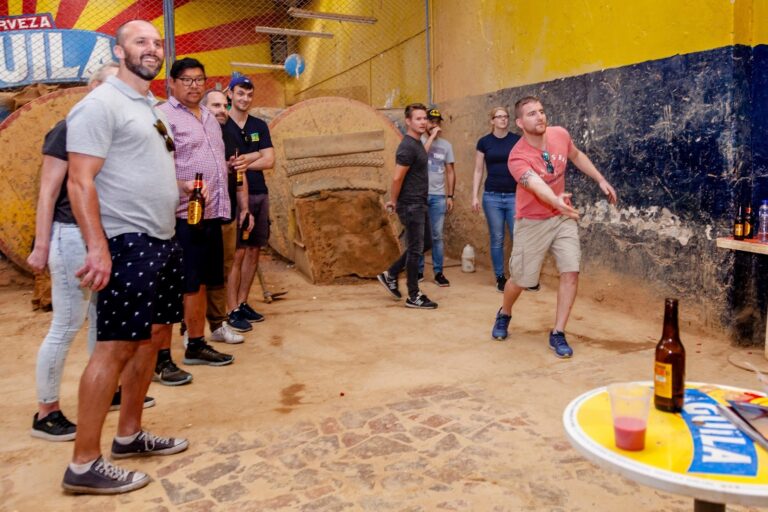
Tejo is Colombia’s national sport, by Ley 613 de 2000, and it is the only sport we know of whose object is to throw a metal disc at a target packed with gunpowder until something explodes. It is played in a long shed, standing up, with beer, and it is loud. It is also the single best way for a visitor to spend an evening in this city with Colombians rather than near them, because the game does the work that language usually has to.
Most travelers never find it, because the good courts are not in El Poblado and the ones that are tend to be tourist reproductions. That is the gap our own tejo and beer evening exists to fill.
The risk, stated plainly
This is the part most nightlife guides leave out, so we will be direct about it. The daytime version, with the city’s own crime figures by comuna, is in our guide to whether Medellín is safe.
The specific danger in Medellín at night is not being mugged in the street. It is being drugged. The United States Embassy in Colombia issued a security alert on 9 June 2023 about a rise in crimes involving sedatives, naming scopolamine, which Colombians call burundanga, along with benzodiazepines and zolpidem, delivered in liquid, spray or powder form in food and drink, and noting that scopolamine is odorless and tasteless and can leave a person unconscious for more than a day. It named Medellín, Cartagena and Bogotá.
On 10 January 2024 the same Embassy issued a second alert, this one specifically about dating applications. It reported eight suspicious deaths of private United States citizens in Medellín between 1 November and 31 December 2023, involving involuntary drugging overdoses or suspected homicides, several connected to dating-app meetings. In the same alert it reported that thefts against foreign visitors had risen 200 percent in the third trimester of 2023 and that violent deaths of foreign visitors had risen 29 percent, with most of those victims being United States citizens.
Those are not our numbers and we are not going to soften them. They also are not the whole picture: the current United States travel advisory for Colombia, published on 31 March 2026, sits at Level 3, Reconsider Travel, and singles out Arauca, Cauca outside Popayán, Valle del Cauca outside Cali and Norte de Santander at Level 4. Antioquia and Medellín are not named at that level.
What that combination means in practice is narrower and more useful than “Medellín is dangerous.” It means the thing that hurts visitors here is a specific, repeatable sequence: a stranger met tonight, a drink you did not watch, and a room they now know the address of. Break any link in that chain and the risk falls off a cliff.
The Embassy’s own advice, which we repeat to our guests word for word: do not go to bars or nightclubs alone or leave with strangers, do not leave food or drinks unattended, do not accept food or drinks from strangers, and if you are meeting someone from an application, tell somebody who you are meeting, where you are going and the details of the account. We add three of our own: pour your own aguardiente, do not flag a taxi on a dark street at one in the morning, and never bring someone you met tonight to where you are sleeping.
What the city is actually doing about it
Medellín is not ignoring this, and the enforcement is real enough to be worth knowing about as a guest.
In May 2026 the Alcaldía published a Plan Distrital de Seguridad Turística 2026-2030, a four-year roadmap for tourist safety and the prevention of the commercial sexual exploitation of children and adolescents. The figures it published are blunt: of 125 hotels inspected during 2025, 62 were suspended, and of 135 tourist dwellings checked, 51 were found in breach. In 2026 to the date of that publication, 34 control operations had inspected 97 establishments. The plan promises more interinstitutional operations, data monitoring and clear response protocols, and the city developed a good-practice guide for preventing child sexual exploitation in residential tourist properties with the Fundación Renacer.
It is worth saying the obvious thing plainly, because Medellín has spent a decade being marketed to the wrong visitors. The commercial sexual exploitation of minors is a crime, the city is prosecuting it, hotels and apartments are being closed for it, and no legitimate operator in this city will help you anywhere near it. We will not.
The same enforcement has a practical consequence for an ordinary traveler: check that wherever you are sleeping holds a Registro Nacional de Turismo. It is obligatory for any property in Colombia that rents to tourists, under Ley 300 de 1996 as modified by Ley 1558 de 2012, with Ley 2068 de 2020 requiring it before any tourist service is provided. You can check a number free and without an account at rnt.confecamaras.co, and the same check is worth doing in Bogotá. In Medellín specifically, the Alcaldía also requires authorisation in the building’s propiedad horizontal rules, and a property without that is one of the ones that gets closed.
Getting home
The metro is the thing that catches people out. Medellín’s metro runs from 4:30 in the morning to 11:00 at night Monday to Saturday, and from 5:00 to 10:00 on Sundays and holidays. It is excellent, it is cheap, and it is closed before your night is. Do not plan on it for the return leg.
That leaves cars. Ride-hailing applications work well across the city by day and night, even though they sit in a legal grey zone in Colombia; at the airport they are not authorised, which is a separate matter covered in our airport guide. Registered taxis are everywhere. The rule that matters is not which of the two you choose but how you get in: order the car from inside the venue and walk out to it. Do not flag a taxi on a dark street at one in the morning. If you are with us, that is not a decision you have to make, because getting you back to your door is part of what we are running.
The calendar
Two periods change the city’s nights completely.
The Feria de las Flores runs at the start of August. The 2026 edition ran from 31 July to 9 August and closed with the sixty-ninth Desfile de Silleteros on 9 August; the Alcaldía counted about five million people and 120 free events across the ten days. The city extended nightlife hours for it. It is the best and the most crowded week of the year to be here, and hotels price accordingly. Do not assume the 2027 dates until the Alcaldía publishes them.
Christmas is the other one. The Alcaldía has the Festival de Navidad running from 27 November to 13 December this year, and the alumbrados along the river turn the city into something worth planning a trip around. Hours have been extended in past Decembers.
Three smaller ones worth knowing: the tango festival, which ran from 3 to 8 June this year, the Fiesta del Libro from 11 to 20 September, and Altavoz, the city’s free rock and alternative music festival, from 10 to 12 October.
What we would do, by how many nights you have
One night: dinner in Manila or Provenza, then the Parque Lleras and Provenza on foot. See the thing everyone describes, keep it to the lit blocks, order the car home.
Two nights: night one as above. Night two in Laureles, on La 70 if you want noise and dancing and La 33 if you want to hear the person opposite you. Take a car across the valley and take one back.
Three or more: add tejo, which we would put on the first or second night rather than the last because it is the one that makes the rest of the trip make sense, and give one evening to Envigado or Sabaneta around the main square. Give the days to Comuna 13 and Guatapé.
What we would not do: try to do El Poblado, Laureles and Envigado in one night. The valley is wider than it looks on the map and you will spend the evening in cars.
Questions travelers ask
Is Medellín safe at night?
In El Poblado, Laureles, Envigado and Sabaneta, yes, with the specific caveat above about drinks and strangers, which is the thing that actually harms visitors here. The centre is a daytime place. The current United States advisory for Colombia is Level 3 overall and does not single out Antioquia at its highest level.
What time do bars close in Medellín?
There is no single answer right now. Hours are set by decree and follow the city’s high, medium and low mixtura zoning; the programme that granted extensions, created by Decreto 1070 de 2021, was partly suspended by a Medellín administrative court on 20 August 2026 and the Alcaldía has said a replacement decree is coming. On a normal weekend, expect the main strips to close between two and four. Ask the venue.
Is the Parque Lleras still worth going to?
Yes, for a night. It is the densest and most varied few blocks in the city and it is walkable. It is also the most expensive, the most policed and the least local. One night there, then go somewhere people live.
El Poblado or Laureles for a night out?
El Poblado for range, English and walkability. Laureles for price, atmosphere and a Colombian crowd. If you are staying a week, do both; if you are staying two nights, do one of each.
Can I use ride-hailing apps at night?
In the city, yes, day and night, despite the legal grey zone they sit in. Order the car from inside the venue rather than flagging one on the street. At the airport they are not authorised and you want the flat-rate taxi or a booked transfer.
Is the metro open late?
No. It runs 4:30 to 23:00 Monday to Saturday and 5:00 to 22:00 on Sundays and holidays. Plan the ride home before you go out.
What is tejo and can I play it?
It is Colombia’s national sport under Ley 613 de 2000: you throw a metal disc at gunpowder charges and try to make them explode, standing up, with beer. Yes, anyone can play it, and it is the best evening in the city for a visitor who wants to be with Colombians rather than beside them.
Is Medellín good for solo travelers at night?
It can be, in the areas above, but the Embassy’s advice is explicit about not going to bars alone and not leaving with strangers, and the 2024 alert was specifically about people who met someone online. If you are travelling alone, a group activity on the first night is worth more than an extra bar.
Plan it with us
We run tours in Medellín every week and we know which courts, streets and blocks are worth an evening and which are a photograph. Tell us what kind of night you want and how many you have, and we will build it, including the ride back, or start from our Colombia itinerary if the rest of the trip is still open. Write to us on WhatsApp with your dates, or see everything we run in the city on our Medellín tours page.

Sources
Alcaldía de Medellín: datos generales, the April 2024 measures in El Poblado, the high-mixtura zones and the extended-hours pilots, the Plan Distrital de Seguridad Turística 2026-2030, and the 2026 events calendar. Metro de Medellín: operating hours and 2026 fares. Fábrica de Licores y Alcoholes de Antioquia: its own history page. United States Embassy in Colombia: the security alert of 9 June 2023 on crimes involving sedatives, the security alert of 10 January 2024 on online dating applications, and the Colombia travel advisory of 31 March 2026. Ley 613 de 2000 for tejo; Ley 300 de 1996, Ley 1558 de 2012, Ley 2068 de 2020 and Decreto 1836 de 2021 for the Registro Nacional de Turismo, with the public lookup at rnt.confecamaras.co. The suspension of part of Decreto 1070 de 2021 by the Juzgado Dieciséis Administrativo Oral de Medellín on 20 August 2026, and the Alcaldía’s response three days later, are reported in the Colombian press; we have not found the ruling published in the Gaceta and have said so rather than state a closing hour we cannot source.