
September 12, 2026
Where you sleep in Cartagena decides what kind of trip you have, because the city is really four or five small cities a taxi ride apart: a colonial center inside walls, a neighborhood of one-story houses and bars just outside them, a peninsula of towers on a beach across the bay, a quiet residential island behind the fort, a seafront running north to the airport and, beyond it, a fishing village and a strip of resort hotels on the road to Barranquilla. We put guests in cars from the airport every week and pick them up from hotels in every one of these neighborhoods for our tours, so we know which door opens onto what. This is the honest map: what each neighborhood is, who it suits, how far it is from the clock tower and the airport by the coordinates, what the fixed taxi fare is under the 2026 tariff, what the nights sound like, and the two rules to check before you book anywhere, the registration the law requires of every lodging and the tax exemption most foreign visitors are entitled to. We name no hotels on this page and take no commission from any.
The short version
For the colonial city at the door, the walled center: the Centro for the plazas and the restaurants, San Diego for the same streets with quieter nights. For the nights themselves, hostels and cheaper boutique hotels, Getsemaní, five minutes from the gate on foot. For a pool, a beach in front of the hotel and families, Bocagrande and Castillogrande, ten minutes by taxi from the center and now with a wider beach after the coastal works. For a quiet residential base with the fort and the marina next door, Manga. For the airport at your door and the cheapest fixed taxi fare into the center, the seafront of Marbella, El Cabrero and Crespo. For a resort with the city as a day trip, the Zona Norte beyond La Boquilla. For a night with the sea at your feet and nothing else, Barú or the islands, with the park’s rules and a boat to come back on. Whatever you choose, check that the lodging has a Registro Nacional de Turismo, because the law requires one of every hotel, hostel and short-term rental in Colombia, and ask whether the rate for a foreign visitor is exempt from the 19 percent IVA, because for most it can be.
How Cartagena is laid out, with the distances and the taxi zones
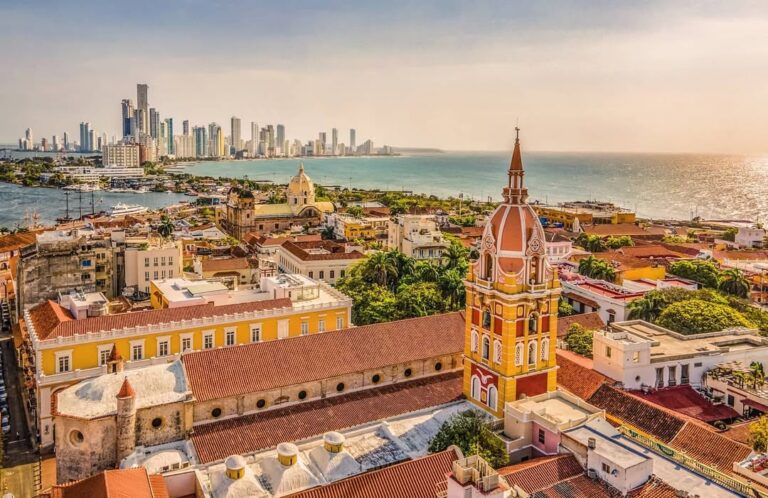
Everything a visitor needs sits on the water. The walled center is on a point between the Caribbean and the Bahía de las Ánimas, with the Puerta del Reloj, the clock-tower gate, as its front door; Getsemaní is the neighborhood right behind the gate, 500 meters from it to the Plaza de la Trinidad. South across the bay, the peninsula of Bocagrande runs out into the sea for three kilometers: Bocagrande itself, 2.2 kilometers from the gate in a straight line, then Castillogrande on the bay side at 3.2 and El Laguito at the tip at 3.3. East, behind the Castillo de San Felipe, the island of Manga is 2 kilometers from the gate and Pie de la Popa, at the foot of the hill, about the same. North, the seafront neighborhoods run in a line toward the airport: El Cabrero 1.2 kilometers from the gate, Marbella 2.6, Crespo 4.2 with the airport inside it, 4.4 kilometers from the gate. Beyond the airport, across the mouth of the Ciénaga de la Virgen, La Boquilla is 8.4 kilometers from the gate and the Zona Norte hotels around Manzanillo del Mar about 11.6. Barú’s Playa Blanca is 25 kilometers away by the coordinates and an hour by road or by boat, and the Rosario Islands an hour by boat.
The taxi tariff follows the same geography. Under the district’s 2026 decree the fixed fare from the official stands at the airport is 20,200 pesos to Getsemaní, Marbella, El Cabrero, Torices and Crespo; 24,300 to the Muelle de la Bodeguita by the clock tower, to La Boquilla and to the Zona Norte hotels around Los Morros and Cielo Mar; 28,500 to Manga and Pie de la Popa; 30,800 to El Prado and La Quinta; and 34,400 to Bocagrande, Castillogrande and El Laguito, with 1,100 more at night from 7 p.m. to 5 a.m. The table has no zone called Centro, so a hotel inside the walls falls between the Getsemaní and Bodeguita lines and the dispatcher will name one of the two. Our airport guide has the whole tariff, the bus and the private transfer side by side.
Inside the walls: the Centro and San Diego
The walled center is where the cathedral, the Inquisition’s palace, the museums, most of the restaurants and most of the boutique hotels are, in colonial houses built around a patio, with a balcony over the street and, in the better ones, a small pool where the well used to be. It is the most expensive place to sleep in Cartagena and the one most people picture. It divides in two. The Centro, the original town around the Plaza de Bolívar, has the plazas, the restaurant tables, the carriages and the noise until late; San Diego, the northern half toward Las Bóvedas, has the same architecture on quieter streets with the sea wall at the end of the block, and it is where we would put a couple who want the center and their sleep. The whole enclosure is about a kilometer across, so nothing is more than fifteen minutes from your door on foot, and the walls, the plazas and the museums are in our Walled City guide plaza by plaza with their 2026 hours and prices. Two honest notes. The colonial houses have thick walls and thin windows, so a room on the street side of a Centro house hears the street; ask for a room on the patio. And the low streets flood for an hour in the afternoon storms of October, the wettest month by IDEAM’s numbers in our weather guide, which is a reason to bring the shoes you do not mind getting wet rather than a reason not to come.
Getsemaní
One gate away, Getsemaní is the neighborhood of the nights: one-story houses, painted walls, the Plaza de la Trinidad that fills every evening, the salsa bars on the Calle de la Media Luna and the Arsenal, and the hostels, the guesthouses around a patio and a growing number of boutique hotels, at prices below the walled center’s. It is the right choice for anyone who wants to walk home from the bars, for solo travelers who want company, and for anyone who wants the colonial city at a price that leaves money for the boats. The trade is the noise: the plaza and the bars run until late, and a room over the Media Luna is not a room for sleeping before two. The neighborhood, its plaza, its murals and the rules for its nights are in our Getsemaní guide; the rule that matters for a hotel choice is in that guide and in our safety guide: a taxi rather than a walk to any hotel outside the neighborhood after the bars close, and never a walk along the lagoons.
Bocagrande, Castillogrande and El Laguito
Bocagrande is the other Cartagena: a peninsula of apartment towers and hotels along a beach, the city’s Miami, 2.2 kilometers from the clock tower and ten minutes by taxi, with the shopping mall, the chain hotels, the pools and the sea in front. It is the choice for families who want a pool and a swim from the hotel, for anyone who wants a modern room with a balcony over the water, and for anyone who finds the colonial center hot and close at night, which it is. The beach is grey-brown sand with warm water and a lot of vendors, fine for a late-afternoon swim rather than the day, and it has been getting wider: the Proyecto de Protección Costera of the national risk agency and the district has been rebuilding the strip sector by sector, with the new Playa 3, 200 meters of beach thirty meters wider than before, delivered in August 2025 with the project at 92 percent, the works moving to the 400 meters of Playa 1 from September 1, 2025, and Playa 2, 360 meters long and more than 50 meters wide, delivered on September 6, 2026, with the first phase at 93 percent, so expect a fenced stretch somewhere on the seafront until the last sector is signed off. Castillogrande, on the bay side of the peninsula, is residential, quieter and calmer in the water, and the one of the three we would choose; El Laguito, at the tip, is the towers around a small lagoon. All three are quiet at night, with beach vendors by day and a police presence on the seafront, by our safety guide, and they are the far end of the airport tariff at 34,400 pesos. The center is a taxi ride for every dinner, which is the real cost of Bocagrande. The peninsula in full, from the name to the beach after the 2026 works and the works on the bay side, is in our Bocagrande guide.
Manga and Pie de la Popa
Manga is the island behind the Castillo de San Felipe, residential, leafy and quiet, with the marina and, at its tip, the Fuerte de San Sebastián del Pastelillo, the fort the viceroy ordered in 1743 after Vernon’s attack, which houses the Club de Pesca and its restaurant today. There are fewer hotels here and they are the kind people come back to: apartments and small hotels on quiet streets, 2 kilometers from the gate, 28,500 pesos from the airport, a ten-minute taxi to the center and a walk to the Castillo. Pie de la Popa, at the foot of the hill of La Popa on the mainland side, is the same distance and the same idea with less charm and the Bazurto market at its edge, which is extraordinary in the morning with a guide and not a place to wander alone with a camera. Both are fine by day and are places to take a taxi at night rather than walk, and the hill of La Popa itself is a place to go by car, never on foot, by our safety guide.
Marbella, El Cabrero and Crespo: the seafront to the airport
North of the walls the Avenida Santander runs along the sea past three neighborhoods most visitors only see from a taxi window. El Cabrero, 1.2 kilometers from the gate, is the closest, a small neighborhood with the Casa Museo Rafael Núñez, the wooden Caribbean house where Rafael Núñez, four times president of Colombia, lived, one of the few houses of its kind left in the city by the Instituto Cervantes’ guide; he left the presidency in 1888 to come home to Cartagena and died here in 1894. Marbella, at 2.6 kilometers, is the long beach and the apartment blocks facing it, and Crespo, at 4.2, is the neighborhood the airport sits in, with the runway behind the houses. They are the cheapest fixed taxi zone from the airport, 20,200 pesos, and Crespo is a walk from the terminal; the beach is the city’s, grey and long and with the waves and the salt wind from December to March, and the hotels are apartment-style and quieter than anything in the center. This is where we would put a late arrival or an early departure, and anyone who wants to spend on the boats rather than the room; the center is a ten-minute taxi ride away.
La Boquilla and the Zona Norte
Past the airport, across the mouth of the Ciénaga de la Virgen, La Boquilla is a fishing village with the cleanest beach inside the city limits, Playa Azul, the only one in Cartagena with a Blue Flag, and the mangrove canals behind it, where the fishermen take visitors by canoe. The hotels and hostels here are small and local; go by car and come back before dark, by our safety guide. Beyond it, along the road toward Barranquilla, the Zona Norte is the resort strip: large hotels on the beach around Manzanillo del Mar, Los Morros and Cielo Mar, 11 to 12 kilometers from the clock tower, with pools and a long beach that is calm and local by day. It is the choice for a beach holiday with Cartagena as the excursion rather than the base; the center is a taxi ride of half an hour or so each way, and the airport tariff to the Los Morros and Cielo Mar hotels is 24,300 pesos.
Barú, Tierra Bomba and the islands
Sleeping on the water is a different trip. Playa Blanca on Barú, the famous white strip an hour from the city by road or by boat, has simple lodging along the sand, busy on weekends and holidays and quiet on weekday nights when the day boats have gone, and it sits inside the Corales del Rosario y de San Bernardo National Natural Park, so it comes with the park’s rules and, since March 2026, its mandatory visitor accident insurance. The Rosario Islands, an hour by boat, have the island hotels, on Isla Grande above all, reached by launch from the Bodeguita pier or the marinas and priced for the transfer as well as the room; and Tierra Bomba, the island across the mouth of the bay, is ten to twenty minutes by launch from Bocagrande or Castillogrande, with the beach clubs of Punta Arena facing the city. Our beaches guide and our Rosario Islands guide have the water, the park fees and the days; the rule for a hotel out here is that the last boat is the last boat, and that everything you did not bring costs more on an island.

Before you book: the registration, the tax and the seasons
Every hotel, hostel, guesthouse and short-term rental in Colombia must hold a Registro Nacional de Turismo before it takes a guest: Ley 300 de 1996, article 61, as modified by Ley 1558 de 2012, created the registry and lists tourist lodging of every kind, tourist homes included, among the providers who must be in it, and Ley 2068 de 2020, article 3, says the registration must come before the first service is sold; the penalty for trading without one is closure of the establishment by the mayor, with the Ministry’s own sanctions on top. You can check any property yourself, without a login, at the Confecámaras registry (rnt.confecamaras.co, “Consulta de RNT”), by name or by number; a listing that will not give you its RNT number is the one to skip, and it is the first thing we check before we send a guest anywhere.
The second rule is worth 19 percent. Colombia’s tax code, article 481 of the Estatuto Tributario, exempts from IVA the tourist services sold to non-residents and used in Colombia when they originate in packages sold by operators or hotels registered in the RNT, and the DIAN’s Concepto 3522 of March 25, 2025 confirms that the exemption applies to the hotel’s services whether the guest or an agency pays, and sets the proof: the original passport and the documents that show the entry was not to settle, which for travelers who came in through the Biomig gates without a stamp means the Certificado de Movimientos Migratorios from Migración Colombia. Many hotels apply it at check-in on sight of the passport; the thing to do is ask, when you book, whether the rate for a non-resident is IVA exempt and what they need to see, because a hotel that does not apply it is charging you a fifth more than the one next door. The exemption is for non-residents; a Colombian resident pays the tax.
The seasons decide the price. The district’s own high-season calendar, published for the carriages and true for the hotels, is December 15 to January 15, Holy Week, July and August, the recess week in the second week of October and the independence fiestas of the first half of November; add the Cartagena Festival Internacional de Música, January 9 to 17, 2027, the Hay Festival, January 28 to 31, 2027, and the film festival FICCI, April 6 to 11, 2027, when the walled center’s hotels fill months ahead. The rainy months, May to November with October the wettest, are the cheap ones, and the rain is an afternoon storm rather than a day; the month-by-month table is in our weather guide.
Which neighborhood for which trip
A first visit of three or four days with the city as the point: the walled center, San Diego if you sleep lightly, or Getsemaní if the budget or the nights say so. A family with children and a week: Bocagrande or Castillogrande for the pool and the beach, with the center as two mornings and the islands as a day. A couple who want the colonial city and quiet: San Diego, or Manga with a taxi for dinner. A group here for the nights: Getsemaní, and a room away from the Media Luna. A beach holiday that happens to be near Cartagena: the Zona Norte, or Barú for a night or two on the water. A layover or a dawn flight: Crespo or Marbella, a walk or a five-minute taxi from the terminal. A cruise day: the terminal is 3.2 kilometers from the historic center by the port’s own figure, on the Manga side of the bay, and the walled center is a ten-minute taxi ride, which is the whole geography of the day. In every case the tours we run pick up at the hotel in the Old City, Getsemaní, Bocagrande, Castillogrande and El Laguito as standard and elsewhere in the city by arrangement, and the private transfer from the airport goes to any door.
From the airport to each neighborhood
These are the straight-line distances from the terminal by the coordinates and the fixed fare from the official taxi stands under the 2026 tariff; the private transfer with the driver waiting inside the terminal, which we book for our guests through Safe Transfers, our transfer company, starts at 49 US dollars to any of them.
| Neighborhood | From the airport | From the clock tower | Fixed taxi fare from the airport |
|---|---|---|---|
| Crespo | The same neighborhood | 4.2 km | 20,200 pesos |
| Marbella and El Cabrero | 1.8 to 3.3 km | 2.6 and 1.2 km | 20,200 pesos |
| Getsemaní | 4.2 km | 0.5 km | 20,200 pesos |
| The walled center | 4.4 km | Inside | 20,200 or 24,300, by the line the dispatcher names |
| Manga and Pie de la Popa | 3.6 to 4.3 km | 2 km | 28,500 pesos |
| Bocagrande, Castillogrande and El Laguito | 6.1 to 7.4 km | 2.2 to 3.3 km | 34,400 pesos |
| La Boquilla | 4.1 km | 8.4 km | 24,300 pesos |
| Zona Norte, Los Morros and Cielo Mar | About 8 km | About 11.6 km | 24,300 pesos |
Every fare carries 1,100 pesos more from 7 p.m. to 5 a.m. Ride apps work in the city and pick up outside the terminal; the Transcaribe T102 bus stops a street from the terminal for 3,900 pesos with a card and serves the seafront and the center, not the peninsula.
What we do differently, and what we cannot promise
We do not sell rooms, which is why this page can say that the walled center is expensive and hot, that Getsemaní is loud, that Bocagrande is a taxi ride from every dinner and that the Zona Norte is a beach holiday rather than a city one; a hotel booking site cannot say any of that. What we do is put guests in the right car from the airport and pick them up from the right door for the boats and the walks, which is how we know the geography. What we cannot promise is a price, which changes with the seasons above and with the festival calendar, or the noise on a given night, which in Getsemaní depends on the plaza and in the Centro on the street. The fares, the distances, the registration rule and the tax rule on this page were checked on September 12, 2026 and will be checked again; when the district changes the tariff, this page changes.
Questions travelers ask
Where is the best place to stay in Cartagena?
For most first visits, inside the walls or in Getsemaní, because the city you came for is at the door and everything is on foot. Families with children and anyone who wants a pool do better in Bocagrande or Castillogrande, ten minutes away by taxi. The other neighborhoods on this page are for a specific reason: the airport, the quiet, the beach.
Is it better to stay in the walled city or in Bocagrande?
The walled city if the point of the trip is the colonial city and you accept the heat, the noise and the prices; Bocagrande if the point is a pool and the beach and you accept a taxi to the center for every dinner. Many people do two nights in each, in that order, and it works.
Is Getsemaní safe to stay in?
Yes, with the rules of the whole historic center: no gold chain in a crowd, the phone in the pocket on the Calle de la Media Luna, and a taxi rather than a walk on the outer streets after the bars close. It is where most visitors spend their evenings, and it is louder than it is dangerous.
Where should I stay in Cartagena for nightlife?
Getsemaní, which has the plaza and the bars, or the Centro of the walled city, which has the restaurants and the rooftops; both are a five-minute walk from each other. Bocagrande has its own bars along the seafront and a taxi ride to the rest.
Where should I stay in Cartagena with kids?
Bocagrande or Castillogrande, for the pool, the beach in front and the modern rooms, with the center as a morning and the Playa Tranquila day, which is the beach we recommend to families, as the day on the water. A Zona Norte resort works too if the city is the excursion rather than the point.
How far is Bocagrande from the walled city?
About 2.2 kilometers in a straight line from the clock tower to the start of the peninsula, ten minutes by taxi, or a fifteen-minute walk along the seafront to the first beaches; Castillogrande and El Laguito, at the far end, are 3.2 and 3.3 kilometers.
Do I need a car in Cartagena?
No. Inside the walls and Getsemaní everything is on foot, every other neighborhood on this page is a fixed-fare or app taxi ride away, and the tours and the boats pick up at the hotel. A rental car inside the walled center is a liability.
Plan it with us
Write to us on WhatsApp with your dates and where you are thinking of staying and we will tell you honestly whether it fits the trip, then build the days around it, or start with our Cartagena tours and our guide to the city. The city as a whole, from what it is to how many days it needs, is in our Cartagena travel guide.
Sources
The facts on this page were checked on September 12, 2026 against the following sources: the Alcaldía de Cartagena’s Decreto 0051 de 2026 for the airport taxi tariff, as read in our airport guide; the Alcaldía’s electric carriages page for the high-season calendar it publishes; the Alcaldía’s notice of August 25, 2025 on the Proyecto de Protección Costera and the delivery of Playa 3; the Instituto Cervantes’ guide to Cartagena de Indias for the Fuerte del Pastelillo and the Casa Núñez; the Puerto de Cartagena for the cruise terminal’s distance; Ley 2068 de 2020 in the Senate’s text and the Cámara de Comercio de Barranquilla’s RNT page, which sets out Ley 300 de 1996 article 61, Ley 1558 de 2012 article 33, who must register and the closure sanction, with the Confecámaras lookup; the DIAN’s Concepto 3522 of March 25, 2025 on the IVA exemption for non-residents under article 481 of the Estatuto Tributario and Decreto 1625 de 2016; the Cartagena Festival Internacional de Música, the Hay Festival and FICCI for their 2027 dates; and our own Cartagena guides to the walled city, Getsemaní, the beaches, the Rosario Islands, the airport, the weather and safety, each sourced in place, for the Blue Flag, the park’s insurance, the police figures and IDEAM’s normals. Distances are calculated from coordinates.