
+ 1.200 verified five-star reviews for Cielo.Travel on Google and TripAdvisor.
Duration
Tour Type
Pricing
Languages
Overview
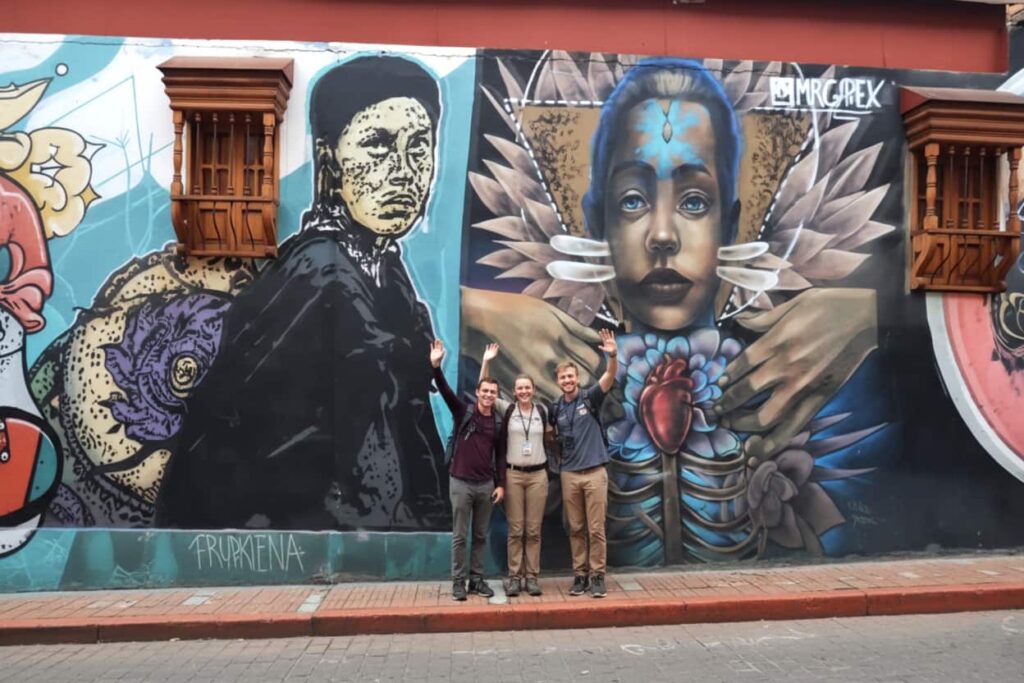
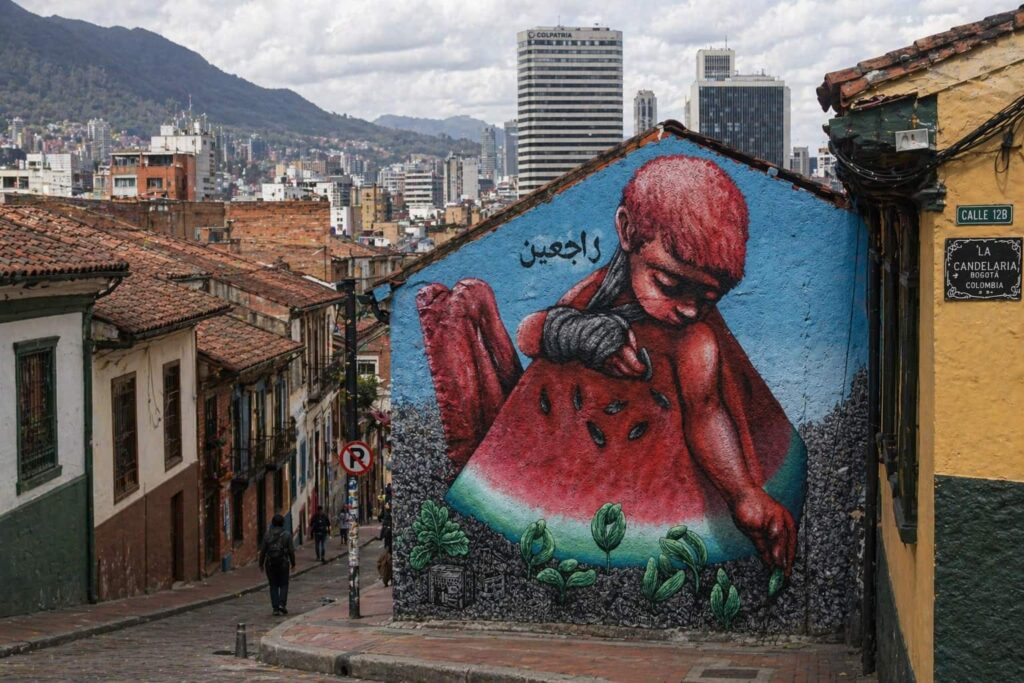
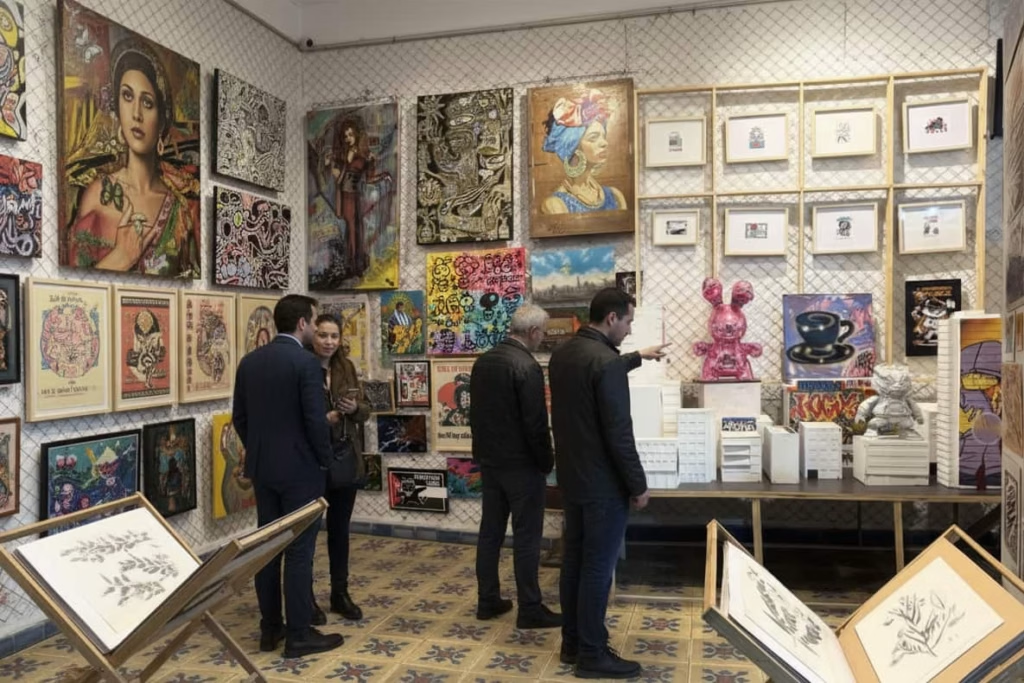
La Candelaria’s murals look like decoration until someone explains what they’re arguing. This private graffiti tour moves through Bogotá’s oldest neighborhood with a guide who knows the artists, the politics, and the history behind every wall — turning what reads as color and scale into a layered account of a country still working through what it is. It’s one of the most honest ways to read this city, and one of the most overlooked.
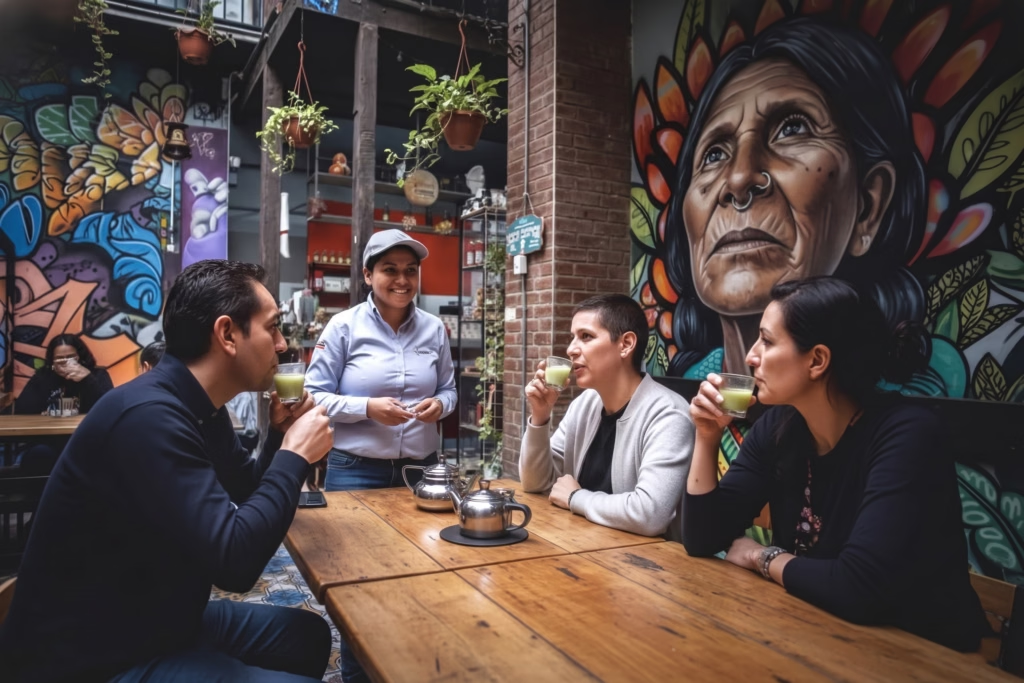
From the founding square at Chorro de Quevedo through the market streets of La Concordia, past the work of artists who paint pre-Columbian ancestry, feminist mythology, and political satire onto 400-year-old colonial walls, the tour ends at Café Herencia with a cup of coca leaf tea and a clearer sense of how contemporary Colombia sees itself. The murals here aren’t incidental to the neighborhood — they’re its most direct conversation with its own past.
Itinerary
Highlights
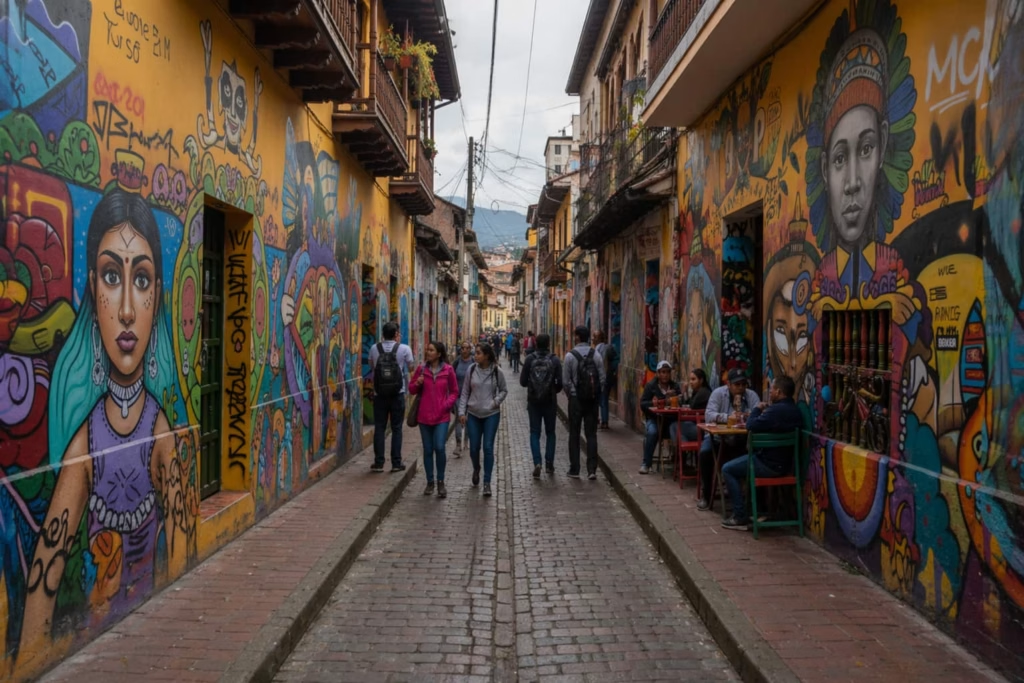
Walk from Chorro de Quevedo — the founding square of Bogotá — through La Candelaria's most concentrated stretch of street art, guided by someone who knows every piece.
Read the murals properly: your guide explains the indigenous ancestry, political history, and local identity encoded in the work of Carlos Trilleras, Wosnan, Ocio 4, and 3 Manos.
Discover the role of female artists in Bogotá's street art scene — the stories of Bastardilla, Vera, Ledania, and others, and what it took for them to claim space in a male-dominated discipline.
Pass through La Concordia market and the Journalists' Park — two neighborhoods that shaped the identity of Bogotá's downtown and fed directly into the themes street artists paint here.
Close the tour at Café Herencia with a traditional coca leaf tea — a coffee shop that actively supports the local artists whose work you've spent the morning exploring.
What's Included
Private English-speaking guide (full 3 hours).
Private hotel pickup and drop-off.
Coca leaf tea tasting at Café Herencia.
What's Excluded
Additional food and drinks.
Personal purchases.
Gratuities (appreciated but not required).
Know before you book
Wear layers you can remove as the day warms up — hoodies, cotton t-shirts, and comfortable sneakers are ideal. Bogotá's weather shifts quickly, so bring a light jacket and sunscreen regardless of the morning forecast.
The tour involves approximately 2 hours of walking on cobblestone streets and uneven urban surfaces. Flat, comfortable shoes are strongly recommended. Avoid heels or dress footwear.
Bogotá sits at 2,640 meters above sea level. If you've just arrived from a lower altitude, take it easy, stay hydrated, and let your guide know if you feel any discomfort.
The tour covers neighborhoods with active street art — some areas are busy and vibrant. Your guide knows the routes well and will keep the experience safe and oriented at all times.
The coca leaf tea at the end of the tour is a traditional Andean preparation, completely legal, and unrelated to cocaine. It's a gentle, mild drink — a cultural experience, not a substance concern.
The tour runs in all weather conditions. Bogotá rain is typically brief — your guide will adapt the pace accordingly.
More Info
Cancellation Window
12 hours before starting date.
Difficulty
Easy
Cancellation policy
Free cancellation up to 12 hours before departure. Cancellations made within 12 hours of the tour start time are non-refundable.
Guest Reviews
Why Book With Cielo
1,200 five-star reviews from real travelers — read them before you book.
Best Price Guarantee — find this tour cheaper elsewhere and we'll match it.
Private transportation door-to-door — no shared shuttles, no waiting around for strangers.
Booking directly with us means your money stays with a Colombian-owned company, not a platform commission.
Our team coordinates everything — pickup timing, the day’s logistics, and the return — so you focus only on the experience.
Other Info
A Bogotá Graffiti Tour: Three Hours Reading La Candelaria’s Walls
A graffiti tour in La Candelaria is one of the most honest ways to read Bogotá — and one of the most overlooked. Most visitors to the neighborhood walk past large, colorful murals covering the sides of colonial buildings and see something visually impressive but opaque. With a guide who knows the work, the artists, and the history they’re responding to, the neighborhood becomes a layered text about a country still working through what it is. The murals here aren’t decoration. They’re arguments — and this tour is designed to make them legible.
The Oldest Walls in the City
La Candelaria is where Bogotá began. Founded in 1538 at Chorro de Quevedo — the small square where the tour starts — it is the oldest part of the city and still one of its most densely inhabited. The colonial architecture has survived remarkably intact, which creates a particular tension that street artists have always found productive: very old walls, very contemporary things painted on them. The same neighborhood covered on the Private Bogotá City Tour for its Gold Museum, its founding plazas, and its 16th-century colonial fabric is also the neighborhood where some of the most politically direct public art in Latin America has been accumulating for decades. The two tours read the same streets from different angles — one through institutional history, one through the arguments that history has generated on the walls above it.
The Artists and What They’re Saying
The artists your guide will show you have individual styles but shared concerns. Carlos Trilleras works with pre-Columbian imagery and the indigenous ancestry that official Colombian history long minimized — the same ancestry whose material culture fills the cases of the Gold Museum a few blocks away, and whose erasure from the national narrative the murals directly address. Wosnan, one of the most recognizable names in the Bogotá scene, deals in political satire and social commentary at a scale that makes it unavoidable. Ocio 4 and 3 Manos bring different approaches to the same questions: what does this city owe its past, and what does it owe the people currently living in it? Seeing these works without someone to decode them is like reading a book in a language you don’t quite speak.
The Women Who Claimed the Walls
The female artists covered in this tour deserve specific attention. Bastardilla was one of the first women to claim significant wall space in La Candelaria — her imagery, drawn from Colombian folklore and feminist mythology, is immediately distinct from everything around it. Vera and Ledania followed, each with their own visual language. Your guide traces not just their work but the resistance they encountered: street art has always been contested, labeled as vandalism by authorities even when its cultural significance is obvious. The women who broke through that resistance did so while navigating a male-dominated space within a male-dominated city. The murals reflect both struggles at once.
The same pattern of community authorship under pressure runs through the murals of Getsemaní in Cartagena — covered on the Cartagena City Tour — where rising property values driven by tourism are pushing out the residents whose families painted the walls. In La Candelaria, the pressure is different but the dynamic is recognizable: artists working in public space, on walls that don’t belong to them, to say things that official channels won’t.
La Concordia and the Journalists’ Park
La Concordia market and the Journalists’ Park are not incidental stops — they’re part of the argument. La Concordia has been a neighborhood of merchants and working-class Bogotanos for generations, and the identity of its residents runs directly through what the nearby muralists paint. The Journalists’ Park takes its name from the newspaper offices that once clustered here, and from the long history of press freedom — and press suppression — in Colombia. These are the places that gave street artists their material. Walking through them with context changes how you see the walls that surround them.
The relationship between journalism and street art in La Candelaria is one of the more specific things your guide explains: both practices occupy the same contested space between expression and suppression, both have operated in this neighborhood for decades, and the proximity is not coincidental. Colombia’s press freedom history — the decades of conflict, the targeting of journalists, the slow and incomplete recovery of public expression — is part of what the murals are responding to, and the Journalists’ Park is where that context becomes geographic rather than abstract.
Café Herencia: Where the Tour Closes
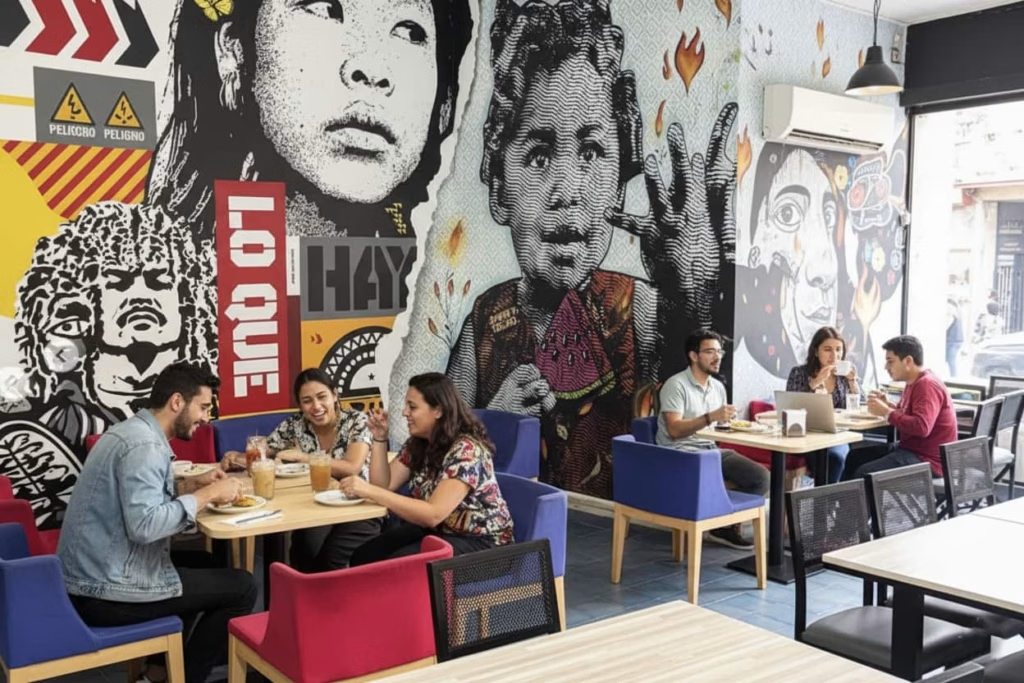
The tour ends at Café Herencia, a coffee shop and active supporter of the local art community — hosting exhibitions, selling prints, and providing a space where the artists whose work you’ve spent the morning reading actually spend time. The coca leaf tea served here is a traditional Andean preparation: mild, slightly grassy, and culturally significant. In Andean tradition, the coca leaf is used for altitude acclimatization, digestion, and ceremony. Tasting it at the end of a tour that has spent three hours tracing how indigenous ancestry shapes contemporary Colombian art is the right way to close.
The coffee at Café Herencia is also worth noting. Colombia’s specialty coffee movement has brought high-quality domestic beans back into local consumption, and a cup here — chosen from a café that supports the community the tour has just moved through — is a different experience from the hotel breakfast version. For travelers who want to go deeper into that story, the Secret Coffee Tour in Quindío covers three farms and three brewing methods in the heart of the Coffee Triangle.
Plan Your Time in Bogotá
The graffiti tour works best as a complement to the city’s other La Candelaria experiences rather than a replacement for them. The Private Bogotá City Tour covers the Gold Museum, Monserrate, Plaza de Bolívar, and the Botero Museum in a full private day — the historical and institutional layer of the same neighborhood this tour covers through its walls. The Food Tour in La Candelaria moves through the same streets via its kitchens and street vendors — the arepa, the almojábana, the obleas, and the chocolate santafereño that have been feeding this neighborhood since the colonial period. The El Paraíso Favela Tour takes the street art conversation to a completely different part of the city — Ciudad Bolívar’s hillside communes, where community-led murals and cultural projects are doing the same work of rewriting the neighborhood’s narrative from the inside. For a day trip out of the city, the Salt Cathedral and Guatavita Tour takes you underground and 45 minutes outside the capital.
Ready to read Bogotá’s walls properly? Book the graffiti tour above and your guide will take care of everything from hotel pickup to the coca leaf tea — all you have to do is look up.
More of Bogotá: our private tours and day trips.
Before you go: our Bogotá guides
Written by the team that runs this tour.
FAQs
Dress in layers you can remove as the day progresses — hoodies, cotton t-shirts, sneakers, sunglasses, and a cap are the most practical choices. Bogotá's weather can shift between warm sunshine and light rain within the same morning, so a light jacket is always a good idea.
Bogotá's weather changes quickly throughout the day — plan for both rain and sun. The tour runs in all weather conditions. Bring a jacket, comfortable shoes, water, and sunscreen, and your guide will adapt the pace if rain comes through.
The tour covers work by Carlos Trilleras, Wosnan, Ocio 4, 3 Manos, Bastardilla, Vera, Ledania, and many others. Your guide contextualizes each piece — who made it, when, and what it's responding to in Bogotá's history and culture.
The tour moves through the La Candelaria neighborhood, starting at Chorro de Quevedo and walking through the graffiti-covered streets, past La Concordia market, and through the Journalists' Park. All stops are within walking distance in Bogotá's historic downtown.
Related Tours

Bogotá Bike Tour: Private Ride Through the Heart of the City
Bogota
Private
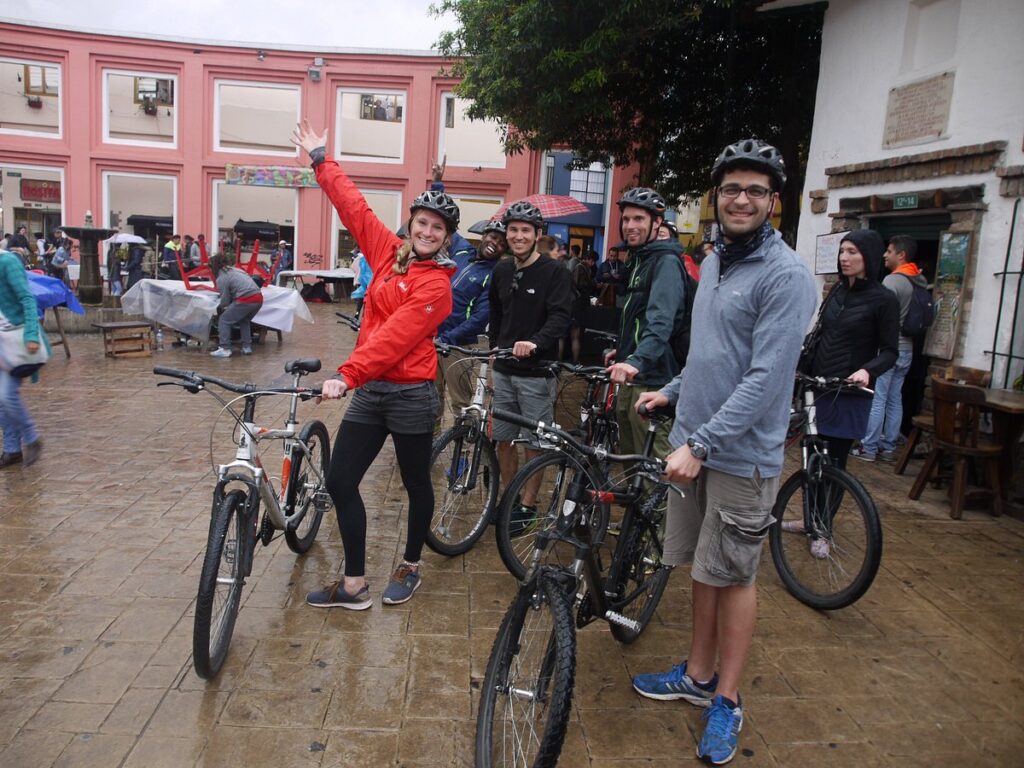
Discover Bogotá on Two Wheels: A Private Bike Tour Through Five Centuries of the City A bike tour in Bogotá…
$$$
4 hours

Tejo Tour Bogota: Private Beer and Colombian Sport Experience
Bogota
Private
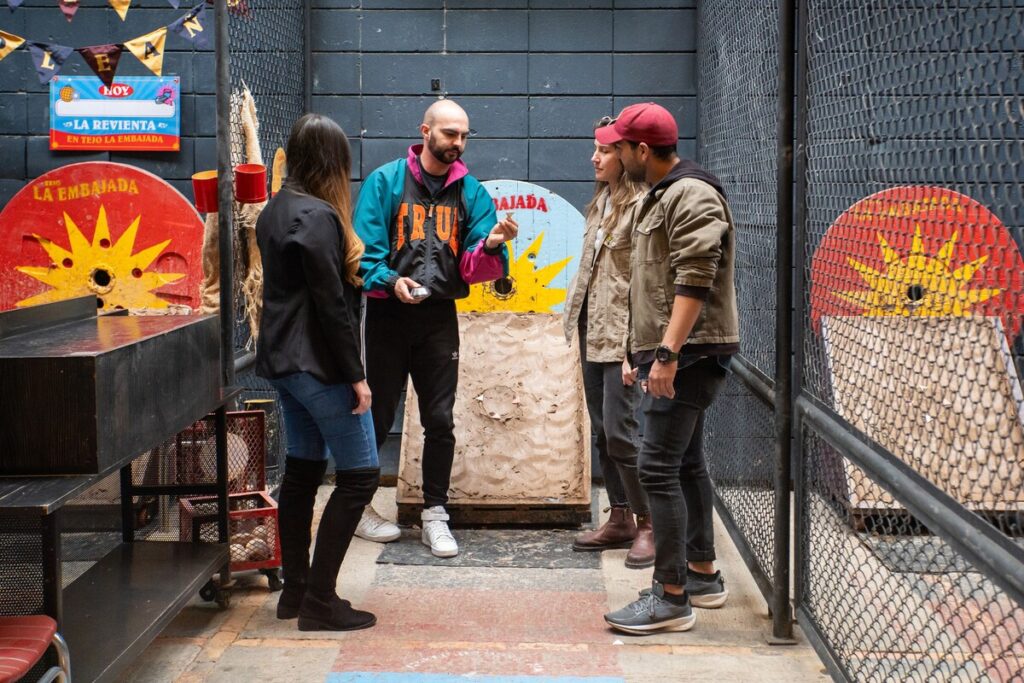
Tejo and Beer in Bogotá: Colombia’s National Sport A tejo tour in Bogotá is the fastest way to go from…
$$$
3 hours
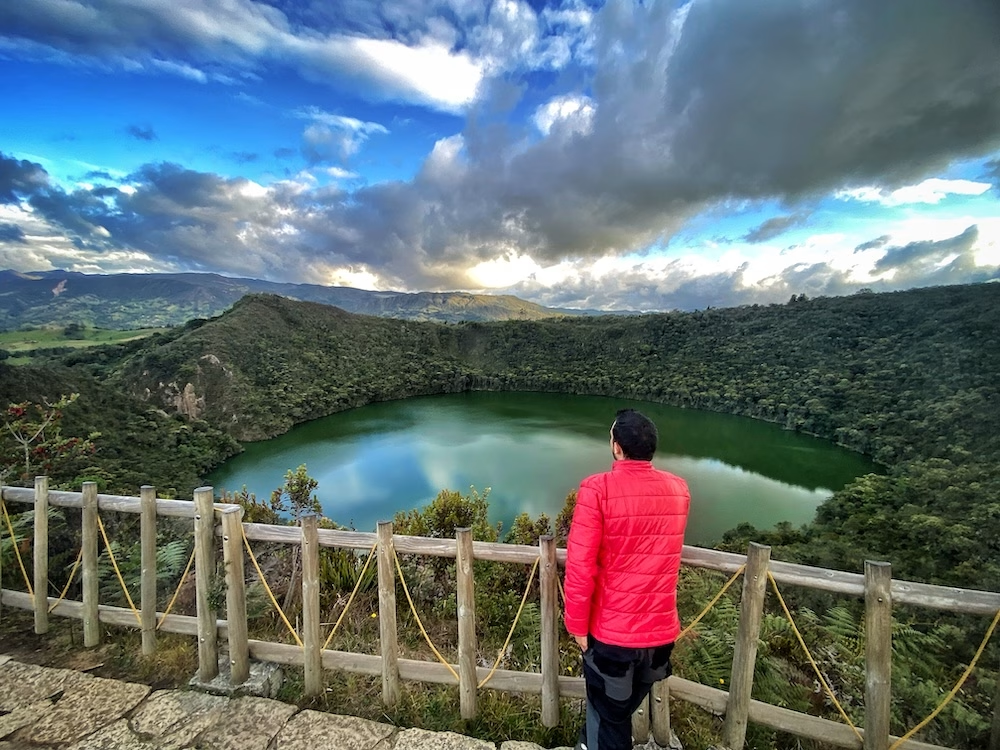

Lake Guatavita Day Trip from Bogotá: El Dorado Legend, Village & Tominé Reservoir
Bogota
Private
A Lake Guatavita Day Trip from Bogotá: Where El Dorado Actually Came From A Lake Guatavita day trip from Bogotá…
$$$
7 hours