
September 10, 2026
Tayrona National Natural Park is the stretch of Caribbean coast where the Sierra Nevada de Santa Marta, the highest coastal mountain range in the world, drops into the sea: 19,300 hectares of forest, coves and reef declared a park in 1964, less than an hour east of Santa Marta, with the beach most people picture when they think of Colombia, Cabo San Juan, at the end of a jungle walk that takes most of a morning. It is also the most rule-bound place you will visit in the country: four gates with different hours, a ticket sold only at the window on the day, compulsory insurance and a safety talk before you go in, three scheduled closures a year for the indigenous peoples of the Sierra, and in 2026 two unscheduled ones on top, one total and one partial. This guide is the version we give our own travelers: what the park is, which gate to use for which beach, how the hike to Cabo San Juan goes, what it costs in 2026, when it is closed, how to get there, and how to build the rest of the Santa Marta days around it.
The short version
Go in at El Zaino, 32 kilometers and about 45 minutes from Santa Marta, and walk from Cañaveral through Arrecifes and La Piscina to Cabo San Juan, about four hours of hiking across the day with two swims in it; that is the park most people come for and the day our Tayrona hike is built around. Buy the ticket at the gate, because there is no online general admission: in 2026 a foreign visitor pays 81,000 pesos in low season and 96,500 in high season, plus the accident insurance the park requires. Do not plan Tayrona for February 1 to 15, June 1 to 15 or October 19 to November 2, when it closes for the Respira Tayrona rests, and do not put it on the last fixed day of a trip, because in 2026 it also closed outside the calendar twice. Swim only where the park says you can, which is not at Arrecifes. From Santa Marta, pair it with Minca in the hills, the old city and a boat day, and read the closure calendar before you book any of it. Our private and shared Tayrona days start at 139 US dollars per person for two travelers, with the entrance and the insurance handled.
What Tayrona is
The park runs along the coast east of Santa Marta where the Sierra Nevada, an isolated massif whose two highest peaks reach 5,775 meters, meets the Caribbean; the tourism portal puts the snow just 42 kilometers from the beaches. Parques Nacionales, the national parks authority, gives the protected area as 19,309 hectares, 12,692 of them on land and the rest at sea, declared on 31 August 1964. In that space the park lists 3,167 hectares of dry tropical forest, humid and cloud forest, mangroves, seagrass beds and 53 species of coral over about nine square kilometers of reef, with roughly 400 bird species, 26 medium and large mammals including six of the seven cat species of Latin America, and about 180 species of fish. UNESCO made the whole Sierra a Biosphere Reserve in 1979.
It is also indigenous territory. The Kogui, Wiwa, Arhuaco and Kankuamo peoples of the Sierra Nevada consider the coast sacred ground, the stone terraces of Pueblito in the hills above Cabo San Juan are a settlement of the Tayrona culture whose better-known city is Ciudad Perdida, and since the closures program began the park stops all tourism three times a year so the four peoples can carry out their ceremonies and the rangers can do restoration and monitoring without visitors. That is the single most important thing to know before you plan: Tayrona is a park with an opening calendar, and the calendar moves.
The four gates and what each one is for
The park publishes four land entrances, and they do not lead to the same places. El Zaino, 32 kilometers from Santa Marta on the Troncal del Caribe and about 45 minutes away, is the main gate and the one for Cañaveral, Arrecifes, La Piscina and Cabo San Juan, the whole classic hike. Calabazo, 20 kilometers and about 35 minutes out, is the gate for the hill trails on the inland side of the park; the March 2026 reopening order kept the Sendero Kogui closed until safety works are done, so ask at the gate which trails beyond the coast are open on the day instead of planning around them. Palangana, reached by a turn-off at kilometer 5 of the Troncal and a side road of about five kilometers, is the gate for the western bays: Neguanje and Playa Cristal, the beach the park’s own list still calls Playa del Muerto, where the park lists swimming, snorkeling, a restaurant and transport, and Gayraca, where the park lists swimming, snorkeling, a restaurant and camping. Bahía Concha, 15 minutes from the city by road, is the beach Santa Marta itself uses, with its own year-round ticket at about half the price of the rest of the park, and since the March 2026 reopening order the access road beyond the gate is for pedestrians and light electric moto-cars only until it is rebuilt, so you leave the car at the entrance. The park also lists sea access from Santa Marta, El Rodadero and Taganga, which is how the boats come in.
The hike to Cabo San Juan
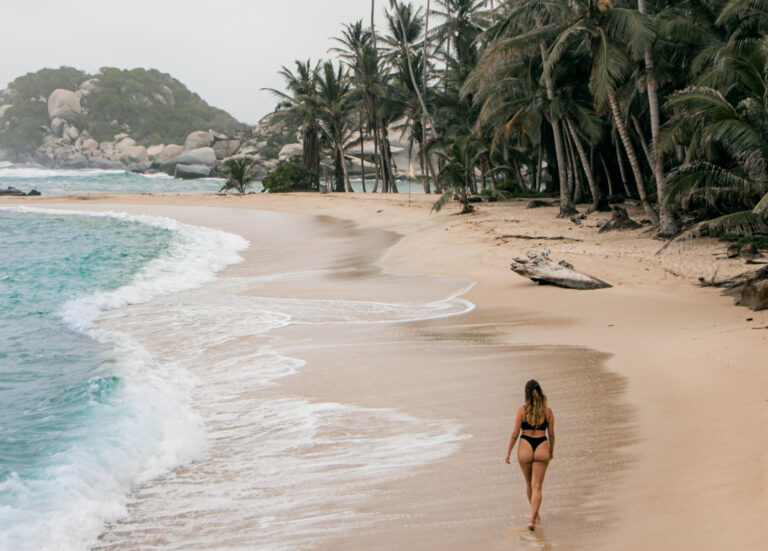
From the El Zaino gate the road continues inside the park to Cañaveral, where the trail starts; on our day the vehicle takes you to the trailhead. The first leg, Cañaveral to Arrecifes, is the interpretive trail the park calls the Ruta del Conocimiento, through the forest, and it delivers you to the park’s largest beach, wild and beautiful and, on the park’s own activities list, not a swimming beach: Arrecifes is for walking, eating, hammocks and camping, and the sea there is the reason. The trail continues along the coast to La Piscina, the first cove on the stretch where the park lists swimming and snorkeling, and then over the headland to Cabo San Juan del Guía, the thatched lookout on a rock between two beaches that is on every photograph of the park. Our tour plans about four hours of walking across the whole day over uneven ground, with the long stop at Cabo for a swim and a Caribbean lunch by the sea before walking back the same way. Wear shoes you can walk in, not sandals; there are horses for hire on the trail for anyone who cannot do the whole distance on foot, and the price for that is agreed on the spot. Cabo San Juan and Arrecifes have hammocks and campsites for those who want to sleep in the park; more on that below. Beyond Cabo, the tourism portal puts Pueblito two to three hours on foot from either Cabo San Juan or Cañaveral, and it is a sacred site, so if a trail there is open, go with respect and with a guide.
Getting here is the other half of the day, and the gate you enter and the hour you reach it decide the rest of it. Santa Marta transfers has this route and every other road along this coast on one page, with the booking widget on it.
Tickets, fees and the insurance
There is no online general admission. The park says it in one sentence: availability depends exclusively on the tickets sold each day at the window, so anything sold to you in advance is a tour, a transfer or an insurance policy, not the entrance. Each attraction has a daily carrying capacity, which is why the queue at El Zaino matters in high season and why the strategy is to arrive early. The 2026 fees the park publishes: a foreign visitor who is not a resident of Colombia pays 81,000 pesos in low season, 96,500 in high season and 43,500 for Bahía Concha at any time of year; Colombians, citizens of the Andean Community countries and foreign residents aged 5 to 25 pay 27,500, 30,500 and 15,000, and those over 25 pay 36,500, 43,000 and 26,000; people born in Santa Marta have their own rates. The published bands start at five years old. High season, by the park’s definition, is December 1 to January 31, June 1 to July 31, Holy Week, the school recess weeks and the long weekends with a Monday holiday. On top of the ticket the park requires an accident policy bought directly from one of its approved insurers, Zurich Colombia Seguros or Allianz Seguros, and it requires every visitor to sit through the induction talk and register before going in; both happen at the gate and both add to the queue. On our tours the entrance and the insurance are included and handled, which is the practical reason people book them.
Hours, and the last entry
Two official sources give different hours, so plan on the tighter one. The park’s page publishes them per gate and per season: in high season El Zaino admits visitors from 7 in the morning until 3 in the afternoon with everyone out by 6, Calabazo from 6 to 1 with exit by 5, Palangana from 7 to 2 with exit by 5, and Bahía Concha from 7 to 2 with exit by 6; in low season El Zaino is listed from 8 to 5, Calabazo 6 to 1, Palangana 8 to 3 and Bahía Concha 7 to 3, all with exit by 5. The authority’s most recent statement on the park, from July 3, 2026, gives a single schedule for all four sectors: open every day from 8 in the morning to 4 in the afternoon, with the last entry at 2. Whichever applies on your day, the arithmetic of the Cabo San Juan hike is the same: to walk in, swim, eat and walk out before the exit hour, you need to be at El Zaino when it opens, which is why our pickups in Santa Marta are early and why the shared version of our day leaves Rodadero at 7:15.
The closures: three you can plan for, and the ones you cannot
Since the Respira Tayrona program the park closes to all tourism three times a year for a spiritual cleansing of the territory led by the four peoples, with the rangers using the weeks without visitors for restoration and monitoring; each rest has its own name in their calendar, Kugkui shikasa in February, Saka Juso in June and Nabbatashi in October. The park’s own dates for 2026 are February 1 to 15, June 1 to 15 and October 19 to November 2. Those are the ones you plan around, and the October one is the next: if your trip touches the second half of October, Tayrona is out and Minca, the old city and the boat are your Santa Marta days.
2026 also produced the other kind. On February 17 the authority ordered a total temporary closure, Resolution 091, after blockades at El Zaino and then Neguanje on February 16, threats against park staff, unauthorized fee collection and irregular entries; the park did not reopen until March 5, under a resolution that kept the Sendero Kogui closed pending safety works, limited the Bahía Concha access road to pedestrians and light electric moto-cars, set up an 18-month recovery plan led by the national disaster agency with restricted zones inside the park, and kept the power to close a sector or the whole park again if staff or visitors are intimidated. Then, when the June rest ended on June 16, the park reopened Bahía Concha, Neguanje and the sea access but kept the Calabazo and Zaino-Cañaveral land entrances closed because of what it called situations affecting mobility on the roads around the park and the Santa Marta-Palomino corridor; the July 3 statement is the first with all four sectors open again. The lesson for a traveler is not that Tayrona is unsafe, it is that the gate you need can be shut on a Tuesday for reasons that have nothing to do with the weather. Put Tayrona early in the Santa Marta stay, not on the morning before a flight, keep one day flexible, and check the authority’s channels the day before; we do that for every departure and move the day when it has to move.
Getting there from Santa Marta, the airport and Cartagena
From Santa Marta it is 32 kilometers along the Troncal del Caribe to El Zaino, about 45 minutes in the park’s own estimate, through Calabazo on the way; from the hotel strip at Rodadero, south of the center, add the drive through the city. The airport, Simón Bolívar, is on the far side of Santa Marta from the park, so an arrival-day Tayrona is a long day and we do not recommend it; sleep in the city, go early the next morning. A private car to the gate and back, or a driver for the day who waits while you walk, is booked on the Santa Marta page of Safe Transfers, our sister company: airport transfers from 49 US dollars and an hourly driver from 40 with a three-hour minimum. From Cartagena the road east runs about 230 kilometers and takes four to five hours by the figures the press and the toll directories publish, since no authority publishes a door-to-door time; it is a transfer we plan into the trip rather than a morning you improvise at a bus terminal. One thing to know if you are continuing east to Palomino or La Guajira: past the park, at the Mendihuaca river, the road crosses a military bridge 64 meters long and 4.2 meters wide that the national roads institute installed in March 2026 after the old bridge collapsed and describes as a transitional solution, so that side of the road can back up. Palomino, the beach village at the end of that road, is in our Palomino guide. The airport itself, with the desk fares and the drive to El Zaino, is in our Santa Marta airport guide.
Book the drive to Tayrona
The gate you use and the hour you reach it decide the whole day, so the car has to work to your schedule rather than a bus timetable. Same driver back at the end of it.
Road detail on Safe Transfers: Santa Marta to Tayrona.
Sleeping in the park, or outside it
You can sleep inside. The park lists hammocks, camping and cabins at Arrecifes, camping at Gayraca on the western side, and there are hammocks at Cabo San Juan, which is where most people who stay do so, waking up to the two beaches and the lookout before the day visitors arrive; everything inside is basic, the lunch and the hammock are paid on the spot, and you carry in what you need. Outside, the choice is Santa Marta itself, where the hotels concentrate in the old center and along the beach at Rodadero, Taganga, the fishing village north of the city with its own boats to the park, or the lodges and small hotels along the Troncal near the gates, which put you minutes from the entrance for the early start; that last option is the one we suggest for anyone who wants two days in the park. Whichever you choose, book the night before Tayrona in a place you can leave before seven. The city, its beaches and its hotel zones are in our Santa Marta guide.
Weather, sea and when to go
The nearest long-term weather station is the Santa Marta airport, and by the national meteorological institute's averages the city is one of the driest places on the Colombian coast: about 560 millimeters of rain a year, with January to April almost dry, rain on fewer than two days a month, and the rain concentrated from May to November, with October the wettest month at 127 millimeters and about nine rainy days and September close behind at 99. The temperature barely moves, a monthly mean between 27 and 29 degrees, afternoons of 32 to 34 and nights of 23 to 26, with humidity of 70 to 79 percent. The park is wetter than the airport, because the forest climbs into the Sierra and part of it is humid forest, so expect afternoon showers on the trail from May onwards and mud in October. The trade-off is that the driest months are also the high-season months in the park's fee calendar, December to January, and the busiest at the gate; February to April, after the February rest, is dry, cheaper and quieter, and it is the window we would pick. Whatever the month, the walk is hot: our tour warns of 27 to 35 degrees on the trail, and water, sun protection and an early start are not optional. The sea is the other variable: the park's activities list is explicit about where swimming is allowed, and Arrecifes is not on it. For the rest of the country, month by month, read our guide to the best time to visit Colombia.
Rules, health and safety
The park's list of what cannot come in is short and enforced at the gate: no pets, no single-use plastics, which the park spells out as bags, styrofoam, bottles, cups, utensils and straws, no speakers, no drones without a permit, no alcohol and no hallucinogenic substances. Bring water in a refillable bottle, food in containers, and cash for the lunch at Cabo. Health: Colombia's health ministry recommends the yellow fever vaccine for everyone from nine months to 59 years old, applied at least ten days before entering a risk area, and during the national yellow fever emergency of 2025 the parks authority required visitors to show the vaccination card at the gate of every national park; the park's own page does not list it among today's entry conditions, but carry the card if you have one, because it is the cheapest way to avoid an argument at the window. Use repellent on the trail and sunscreen on the beach. Safety: the closures above are the record, and they were about the roads, the staff and the gates, not about visitors inside the park; the risk to you on an ordinary day is the sun, the currents at the beaches where swimming is prohibited, and the road at night. Our rule is the same one we use everywhere in Colombia: a driver you booked, a guide who knows the trail, the early start, and the swim only where the park says so. The city's own numbers and the sea rules along this coast are in our guide to whether Santa Marta is safe.
Minca, the old city and the rest of the Santa Marta days
Tayrona is one day; Santa Marta deserves three. The city, founded on 29 July 1525 by Rodrigo de Bastidas, is the oldest surviving Spanish city in Colombia, and our five-hour private walk covers the old center, the Cathedral and the Quinta de San Pedro Alejandrino, the estate where Bolívar died in December 1830. Minca, less than an hour up into the Sierra from the city, is the day for the heat: Hacienda La Victoria, one of the country's oldest coffee farms, then the cold pools of Pozos Azules and the Marinka waterfalls, eight hours with a private guide. The private boat day runs from Santa Marta to Santo Cristo, Inca Inca and Playa Blanca, three beaches reached only by water, with the caveat that the sea can cancel it on the morning. And for the four days on foot to Ciudad Perdida, the Tayrona city in the Sierra managed by the four peoples with strictly controlled numbers, there is our Lost City trek. How the coast fits into a two-week trip, with Santa Marta as days twelve to fourteen, is in our Colombia itinerary. The village itself, the waterfalls, the farm and the road are in our Minca guide. The four-day trek to the Lost City, with its October 2026 closure, is in our Lost City trek guide.
What it costs, and what is included
Our Tayrona day is 139 US dollars per person for two travelers, private with hotel pickup in Santa Marta and a dedicated guide, or shared from Rodadero at 7:15 in the morning, ten hours with the park entrance, the guide and all-risk insurance included and lunch on your own at Cabo; discounts apply for larger groups. Minca is from 172 per person for eight private hours with the coffee farm entrance, the Santa Marta city walk from 102 with the Quinta entrance, the private boat to three beaches from 445, and the four-day Lost City trek from 710 with the entrance and nine meals. On your own, the 2026 park ticket is 81,000 pesos in low season or 96,500 in high season for a foreign visitor, plus the insurance at the gate, plus whatever you pay for the van from the gate to Cañaveral, a horse if you take one, and lunch. A private airport transfer with Safe Transfers is from 49 dollars.
What we do differently
We treat the park's calendar as the first fact of the trip, not the last. Every Tayrona departure is checked against the authority's channels the day before, and when a gate closes the day moves to Minca or the boat and nobody loses money arguing at a window. The entrance and the insurance are bought for you, the guide has walked the trail hundreds of times and knows which cove to swim in and which to leave alone, the pickup is early enough to beat the queue, and the return car is waiting at El Zaino when you walk out, tired and salty, instead of a colectivo you have to flag on the Troncal. If you would rather sleep in the park, we plan the two days that way and arrange the pickup at the gate the following afternoon.
Questions travelers ask
Is Tayrona open right now?
The scheduled 2026 closures are February 1 to 15, June 1 to 15 and October 19 to November 2. Outside those, check the authority's channels the day before you go, because in 2026 the park also closed from February 17 to March 5 and kept two gates shut for part of June; we check for every departure.
How much does it cost to enter Tayrona in 2026?
For a foreign visitor, 81,000 pesos in low season and 96,500 in high season, or 43,500 for Bahía Concha at any time; Colombians and residents pay between 27,500 and 43,000 depending on age and season. Add the compulsory accident insurance, sold at the gate by the park's approved insurers. Tickets are sold only at the window on the day.
Can I buy Tayrona tickets online?
No. The park states that availability depends exclusively on the tickets sold daily at the gate. Anything sold online in advance is a tour, a transfer or insurance, not the entrance; our tours include the entrance because we buy it for you at the gate.
How long is the hike to Cabo San Juan?
Plan on about four hours of walking across the day: the road from the gate to Cañaveral, the trail to Arrecifes, on to La Piscina and over the headland to Cabo, then the same way back. It is hot and uneven, so wear walking shoes; horses can be hired on the Arrecifes stretch.
Can you swim in Tayrona?
Yes, but only where the park allows it: La Piscina and Cabo San Juan on the hiking route, and Bahía Concha, Gayraca and Neguanje on the western side. Arrecifes is listed for hiking, eating and camping, not swimming, and the currents there are the reason.
Which entrance should I use?
El Zaino for the classic hike to Cabo San Juan; Calabazo for the hill trails, when they are open; Palangana for Neguanje and Playa Cristal; Bahía Concha for a beach afternoon 15 minutes from the city. Boats also run from Santa Marta, Rodadero and Taganga.
Do I need the yellow fever vaccine for Tayrona?
Colombia's health ministry recommends it for everyone from nine months to 59, applied ten days before travel, and the parks authority required the card at every park gate during the 2025 emergency. Get it, and carry the card.
Plan it with us
Every day we run in Santa Marta is guided, with the park entrance, the insurance and the pickup handled, and the calendar checked before you leave the hotel. Write to us on WhatsApp with your dates, or start with our Santa Marta tours page.
