

+ 1.200 verified five-star reviews for Cielo.Travel on Google and TripAdvisor.
Duration
Tour Type
Pricing
Languages
Overview
Cartagena was the most important port in Spain’s Caribbean empire — the gateway through which looted gold and silver passed on its way across the Atlantic — and for two centuries every rival power in the world tried to take it. The fortifications they forced the Spanish to build are still standing, and this private tour is designed to make you understand them rather than simply photograph them. Smaller, slower, and guided by someone who knows the difference between the story visitors expect and the one that actually happened.
From Castillo San Felipe’s acoustic tunnel system and its gunpowder chambers designed to collapse the ground beneath advancing infantry, through the Walled City’s 208 years of layered colonial architecture, to Getsemaní — the working-class neighborhood outside the walls whose residents actually forced Cartagena’s declaration of independence in 1811 — the day ends at La Popa convent, 150 meters above the city, where the full geography of everything you’ve walked through finally becomes visible at once.
Itinerary
Highlights
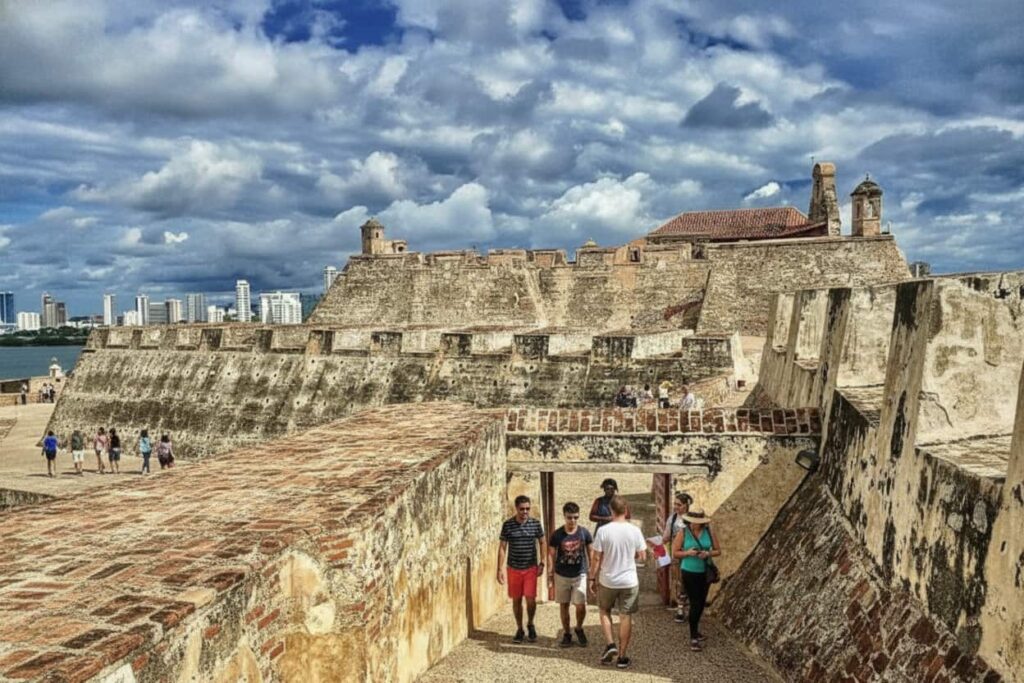
Walk through Castillo San Felipe de Barajas — the largest Spanish fortress ever built in the Americas — and descend into its tunnel network with a guide who knows the real military engineering story behind each passageway.
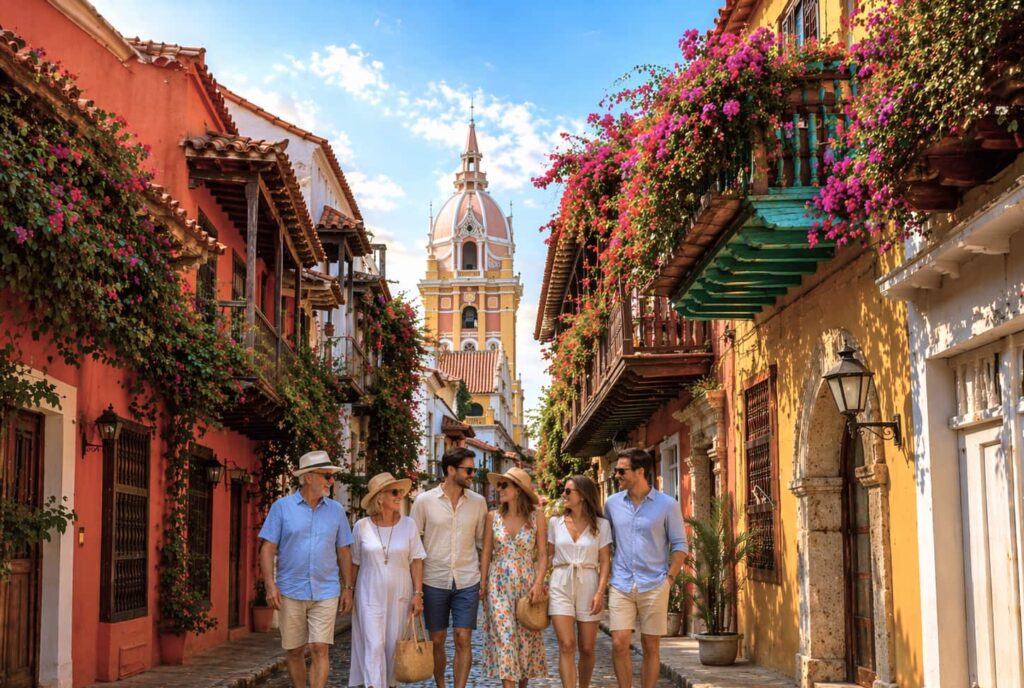
Stroll the Walled City's cobblestone streets past Santo Domingo Square, the Cathedral of Santa Catalina de Alejandría, and colonial balconies draped in bougainvillea, with your guide connecting each stop to Cartagena's path to independence.
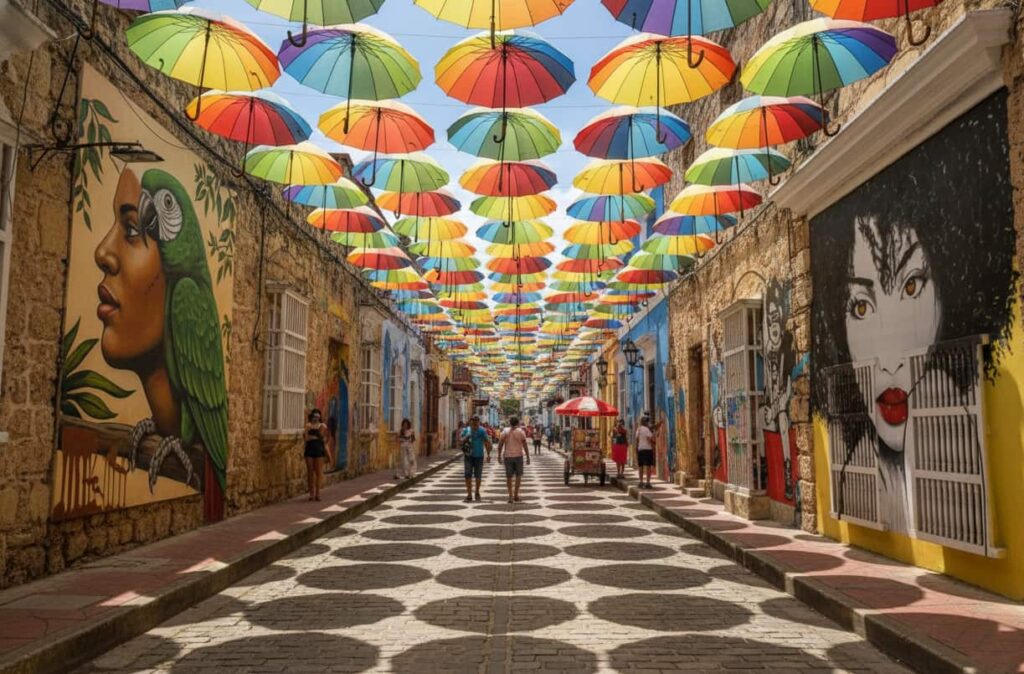
Enter Getsemaní — the neighborhood that supplied the foot soldiers of Colombian independence and now leads the country in street art — and hear its story of resilience told through its murals and its people.
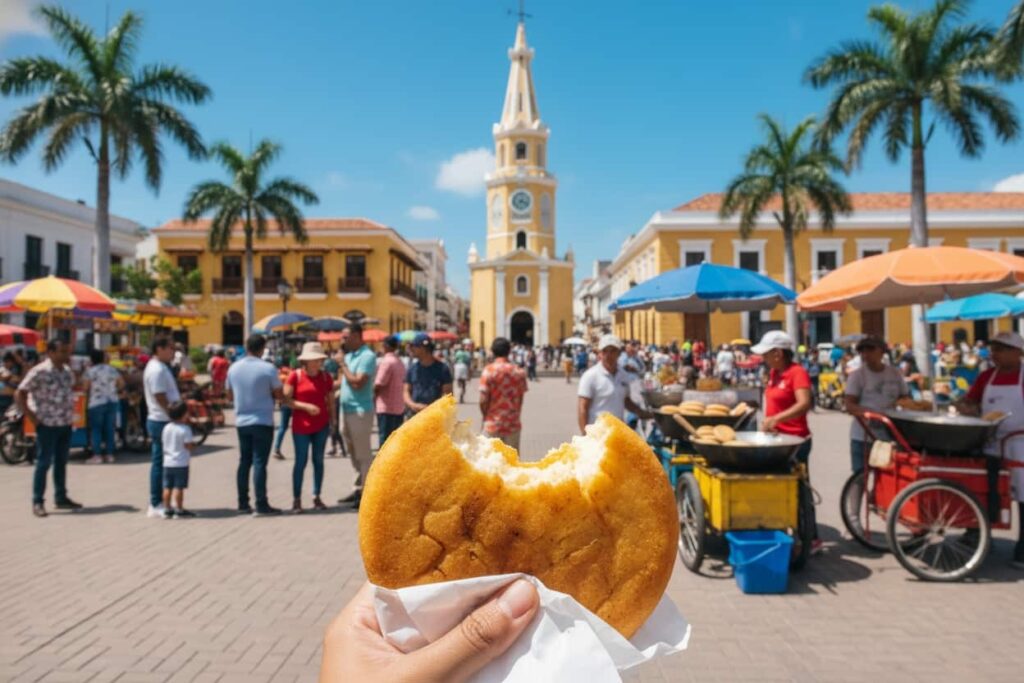
Taste Cartagena before you leave: a warm arepa de huevo and fresh coconut water, the two foods most closely associated with the city's Caribbean identity.
Ascend to the Convent of La Popa at 150 meters above sea level — Cartagena's highest point — for a 360-degree view over the Walled City, the bay, and the Caribbean islands beyond (included with the La Popa tour option).
What's Included
Private certified bilingual guide (English/Spanish) for the full tour.
Private transportation throughout.
Entrance ticket to Castillo San Felipe de Barajas.
Entrance ticket to Convent of La Popa (if La Popa tour option selected at booking).
Traditional snack — arepa de huevo and coconut water.
What's Excluded
Lunch.
Gratuities (optional).
Personal expenses and extra attractions not listed.
Know before you book
Your guide picks you up from your hotel or Airbnb — be at the main entrance or lobby 15 minutes before your tour start time. Pickup zones include Centro Histórico, Getsemaní, Bocagrande, Castillogrande, and Laguito.
Cartagena is hot and humid year-round, with temperatures typically between 28–34°C. Light, breathable clothing is essential. Bring sunglasses, a hat, and sunscreen — several stops involve time in direct sun.
The walking sections — especially in the Walled City and Getsemaní — cover cobblestone streets. Comfortable flat-soled shoes are strongly recommended. This tour is not wheelchair or stroller accessible.
The La Popa stop is only included if you select the La Popa tour option at booking. The standard tour is 5.5 hours without La Popa; the full tour with La Popa is approximately 6.5 hours. Item 5: The Cartagena Gold Museum is closed on Mondays — if your tour falls on a Monday, your guide will suggest an equivalent alternative.
Bring cash for any additional purchases, personal snacks, or souvenirs in the Walled City markets. The included snack (arepa de huevo and coconut water) is provided — lunch is not.
More Info
Cancellation Window
12 hours before starting date
Difficulty
Easy
Cancellation policy
Free cancellation up to 12 hours before departure. Cancellations made within 12 hours of the tour start time are non-refundable.
Guest Reviews
Why Book With Cielo
1,200 five-star reviews from real travelers — read them before you book.
Best Price Guarantee — find this tour cheaper elsewhere and we'll match it.
Every tour is private — your guide and vehicle are yours alone, not shared with strangers on a bus schedule.
You are booking directly with a Colombian-owned company
Our guides are English-speaking Colombian locals — people who know Cartagena's history personally, not contractors reading from a laminated card.
Other Info
A Private Cartagena City Tour: The Fortified City, the Independence Neighborhood, and the View That Makes It All Make Sense
Cartagena is dense with history, but most tours move too fast through it, treating San Felipe as a photo stop and the Walled City as a backdrop. This private tour is built differently: smaller, slower, and guided by someone who knows the difference between the story visitors expect and the one that actually happened. The result is a day that moves through four centuries of Caribbean history — military engineering, colonial commerce, political revolution, and the present-day tensions of a city being reshaped by its own reputation — at a pace that lets each layer register before the next one arrives.
Cartagena was founded in 1533 by Pedro de Heredia on the site of a Calamari indigenous settlement. Within decades it became the most important port in the Spanish empire’s Caribbean network — the gateway through which gold and silver looted from the interior of South America passed on its way to Spain. That wealth made it a permanent target. Francis Drake sacked it in 1586. Blas de Lezo repelled a massive British assault in 1741. Pirates, privateers, and rival empires circled it for two centuries. The result was one of the most heavily fortified cities in the Western Hemisphere — and those fortifications are still standing.
Castillo San Felipe de Barajas: The Fortress That Held
Castillo San Felipe de Barajas took over a century to reach its final form. Construction began in 1536 on the hill of San Lázaro — chosen because it overlooked the most vulnerable approach to the city — and the fortress was expanded repeatedly through the 17th and 18th centuries as military technology evolved. By the time the Spanish finished, it was the largest and most sophisticated fortification they had ever built in the Americas. The sheer scale of the project — a century of construction, continuously revised as the science of siege warfare changed — tells you something about how seriously the Spanish took the threat of losing this city.
The tunnel system inside the hill is one of the engineering feats that visitors remember most, and it comes with a persistent myth worth correcting. Most visitors arrive having heard that the tunnels connected the fort to the Walled City for emergency evacuation. The reality is more interesting: the tunnels were designed as acoustic chambers — soldiers listening at tunnel ends could hear footsteps on the ground above — and as explosive charges, packed with gunpowder to detonate under advancing infantry and collapse the ground beneath them. Your guide walks you through both the myth and the engineering, and the distinction between the two says something important about how colonial history gets simplified in the retelling.
The same process of simplification and correction runs through the rest of the day. The Walled City’s story is more complicated than its UNESCO designation suggests. Getsemaní’s independence role is almost never told correctly. La Popa’s position on Cartagena’s highest hill is the vantage point from which those complications finally make geographic sense. San Felipe is where the day establishes its approach: what the guide covers here is not just military history but a way of reading a place honestly.
The Walled City: 208 Years of Stone and Commerce
The walls that ring Cartagena’s historic center were built over 208 years, finally completed in 1796. They stretch eleven kilometers, reach up to twelve meters in height, and include a system of bastions, half-moons, and artillery positions that made direct assault effectively impossible. The UNESCO World Heritage designation, awarded in 1984, recognized both the military architecture and the colonial urban fabric inside — the two things that make Cartagena worth visiting and the two things that most group tours treat as separate rather than inseparable.
Walking the Walled City’s interior reveals what that fabric looks like at street level: narrow lanes that funnel ocean breezes between tall buildings, interior garden patios behind heavy wooden doors, colonial churches whose construction began before the United States existed, and plazas where the city’s political life has played out for four centuries. Santo Domingo Square — with Botero’s reclining nude on the cobblestones, the oldest church in Cartagena, and the best people-watching in the city — is a concentrated version of everything the Walled City does well. Your guide uses the square as a pause point: a place to absorb what you’ve seen in the fortress before moving into the part of the city whose story the walls were built to protect.
The Walled City’s relationship with the neighborhood immediately outside its gates is one of the most important things to understand before you cross into Getsemaní. The walls were not just military infrastructure. They were a social boundary — separating the Spanish elite and their criollo successors from the working-class population of African descent and mixed heritage that lived, worked, and eventually made history on the other side. That boundary is what your guide addresses as you move from one to the other.
Getsemaní: The Neighborhood That Actually Forced Independence
The story most guides skip — or tell too quickly — is Getsemaní’s role in Colombian independence. On November 10, 1811, it was not the wealthy criollos inside the Walled City who forced the break from Spain. It was the working-class residents of Getsemaní, outside the walls, who gathered in the streets that night and pressured the governing council to sign the declaration. The date is still celebrated as Cartagena’s independence day, and Getsemaní still identifies itself as the neighborhood that did it first.
The parallel with Bogotá’s independence narrative is worth noting. At Plaza de Bolívar — the centerpiece of the Private Bogotá City Tour — the independence story is told through the buildings of the Colombian state and the figures who negotiated the republic. In Getsemaní, the independence story is told through the neighborhood itself: not a plaza surrounded by government buildings but a community of ordinary people who decided that the moment had arrived.
Today the neighborhood’s walls carry that history in paint. The murals here are among the most politically engaged street art in Colombia — direct, detailed, and often showing the tension between the community’s past and its present reality, as rising property values driven by tourism push out the residents whose families have been here for generations. Your guide reads those murals with you, connecting the 1811 story to the 2024 one in a way that makes both more legible. Travelers who want to go deeper into the relationship between street art and political history in a Colombian city will find the Bogotá Graffiti Tour a natural companion — the same genre of politically engaged mural work, a different city, a different set of arguments.
La Popa: The View That Makes the City Legible
The Convent of Nuestra Señora de la Candelaria was founded in 1607 by Augustinian friars on the city’s highest hill, 150 meters above sea level. Spanish sailors navigating into Cartagena Bay used it as a landmark — the convent’s silhouette against the sky told them exactly where the entrance to the harbor lay. The navigational logic is still visible from the hilltop today: the bay’s entrance is directly below, the Walled City sits on its promontory to the south, and the relationship between the port, the fortifications, and the open Caribbean becomes obvious in a way that no amount of street-level walking quite achieves.
From the hilltop, the geography of the city becomes legible in a way it isn’t from street level: the Walled City as an island of stone, Bocagrande’s modern towers on the peninsula to the south, the bay opening to the Caribbean, and the green shapes of the Rosario Islands on the horizon. Those islands — the Corales del Rosario National Natural Park — are the destination of the Rosario Islands Private Day Trip from Cartagena, a half-day on the Caribbean that pairs naturally with this city tour as a second day on the coast.
La Popa is the right place to end a day in Cartagena. Everything you’ve walked through — the fortress, the walls, the independence neighborhood, the murals — makes more sense when you can see it from above. The city’s geography explains its history, and the history explains everything you’ve been looking at all day. Your guide uses the hilltop as a closing frame: a final synthesis of what the day has covered, delivered from the place that has the best view of all of it.
Continue Exploring Colombia’s Caribbean Coast
Cartagena is the natural gateway to the rest of Colombia’s Caribbean coast, and the city tour pairs well with several experiences that extend the journey in different directions. The El Totumo Mud Volcano Tour takes you an hour north along the coast to a warm mineral mud crater and an afternoon on a stretch of Caribbean beach that most visitors to the city never reach — a completely different register from the colonial fortifications, and the right complement to a day of urban history. For travelers heading further up the coast, Santa Marta and the Sierra Nevada de Santa Marta offer the natural counterpart to Cartagena’s military and colonial story: the Lost City Trek reaches a pre-Columbian site that predates Machu Picchu, four days on foot through the jungle, in a mountain range that rises from the same Caribbean coast you are looking at from La Popa.
Ready to move through Cartagena the right way? Book the private city tour above and your guide will handle everything from hotel pickup to the final drop-off — all you have to do is show up and walk.
Planning more time in Cartagena? Browse our Cartagena tours and experiences.
Before you go: our Cartagena guides
Written by the team that runs this tour.
FAQs
The standard 5.5-hour tour covers San Felipe Fortress, the Walled City, and Getsemaní with the arepa de huevo snack stop. The 6.5-hour option adds the ascent to the Convent of La Popa — Cartagena's highest point — with panoramic views over the bay and Caribbean coast. The La Popa entrance ticket is included when you select this option at booking. If it's your first time in Cartagena, the full 6.5-hour version is worth it.
Yes — contact us directly when booking to confirm your terminal and arrival time. We'll coordinate pickup and build the tour around your port schedule to make sure you're back before your ship departs.
The tunnels are real and you walk through them. They weren't escape routes — that's a popular myth. They were engineered as acoustic listening passages (to detect troop movement above ground) and explosive chambers designed to be detonated under advancing infantry. Your guide explains the actual military logic, which is considerably more interesting than the pirate story. The upper ramparts give you one of the best views in Cartagena.
The tour involves moderate walking — mostly flat cobblestone streets in the Walled City and Getsemaní, with some inclines at San Felipe Fortress and at La Popa (if selected). The pace is relaxed with regular stops. It's suitable for most fitness levels. Not wheelchair or stroller accessible due to cobblestones and fortress steps.
Getsemaní is the neighborhood outside the Walled City where Cartagena's working class, freed enslaved people, and artisans lived during the colonial era. On the night of November 10, 1811, it was Getsemaní's residents who gathered in the streets and forced the declaration of independence from Spain — not the wealthy merchants inside the walls. Today the neighborhood is known for its political street murals and its ongoing tension between community identity and rapid gentrification from tourism. Your guide walks you through both the history and the present.
Yes — the arepa de huevo and coconut water stop is included in both the 5.5-hour and the 6.5-hour La Popa option.
Related Tours

Perfect Day in Bogotá: Private Tour of Must-See Highlights
Bogota
Private, Shared
A private Bogotá City Tour gives you something most travelers to Colombia never quite manage: the actual city, not just…
$$$
7 hours

Cali City Tour: the Salsa Capital’s Secret Corners
Cali
Private, Shared
A Private Cali City Tour: Monument, River, Rhythm, and the Neighborhood That Stays Itself Cali is Colombia’s third-largest urban center,…
$$$
4 - 5 hours


Bogotá Layover Tour: From the Airport to Monserrate & Old Town
Bogota
Private
Bogotá Layover Tour: From El Dorado Airport Into the Historic Center and Back El Dorado International Airport sits at the…
$$$
5 hours