
September 12, 2026
Where you sleep in Bogotá decides more of your trip than it does in most cities, because the part of the capital a visitor uses is not a center with suburbs around it but a strip nine kilometers long running north along the mountains, and the difference between the two ends of it is forty minutes of traffic every morning and every evening. We are based in Bogotá and run nineteen tours in and around it, more than in any other city in Colombia, and we collect guests from hotels on every block of that strip, so this is the guide we give our own travelers before they book: the neighborhoods one by one with what is wrong with each of them, what a bed at 2,640 meters does to your first night, how to check that the place you are booking is legal, and what we would actually book for you depending on who you are.
The short version
Chapinero for a first trip, the Zona T and Parque de la 93 if you want the nights or you are here for work, Usaquén if you have done the center before or you are traveling with children, La Candelaria only if you accept the condition that comes with it, and Salitre only for a dawn flight or a conference at Corferias. Book the north and every museum morning starts with a drive; book the center and the nights need a car. Whatever you pick, ask for a room away from the avenue, expect the first night at altitude to be a bad one, and check the property’s Registro Nacional de Turismo number before you pay, which takes about thirty seconds and almost nobody does.
The strip, and why it decides everything
Bogotá is a city of 7,412,566 people by the 2018 census’s adjusted count, a Distrito Capital of twenty localidades that runs south to north along the eastern hills. The part of it a visitor uses is a strip along those hills from about Calle 11 to about Calle 118. La Candelaria, the colonial center, sits at the bottom around Calle 11. The Centro Internacional and La Macarena follow around Calle 26 to 30. Chapinero and its restaurant district, the Zona G, are around Calle 70. The Zona T, Zona Rosa, Parque de la 93 and Chicó run from Calle 82 to Calle 94. Usaquén is the top, at Calle 118. El Dorado airport is twelve kilometers due west of the center along Calle 26, off the strip entirely.
The grid makes this readable once you know the rule. Calles run east to west and their numbers rise as you go north; carreras run north to south and their numbers rise as you go west, away from the mountains. An address like Calle 82 # 12-15 is therefore a precise instruction, and a hotel that gives you its calle number has told you where on the strip it sits. Anything in the eighties and above is the north. Anything below the thirties is the center.
Every decision below is a trade between those two ends, and the currency is the car. There is no version of this city where you are close to both the Gold Museum and the Zona T.
Chapinero, the Zona G and Quinta Camacho
This is our default for a first trip, and it is the middle of the strip on purpose: a short ride from the historic center in the morning and a short ride from the nightlife at night, without being an hour from either. The Zona G, around Calle 69 and Carrera 5, is the city’s serious restaurant district. Quinta Camacho, just west of it, is a neighborhood of 1940s brick houses turned into small hotels, cafés and bars, and it is the most pleasant place to walk in Bogotá after dark that is not a mall. Chapinero Alto climbs the hill behind them, quieter and steeper, with views and a taxi ride to anything.
Chapinero is also the center of the city’s LGBTQ life and the most open neighborhood in Colombia for it; our list of twelve LGBTQ-friendly hotels in Bogotá starts there. The TransMilenio spine runs down Avenida Caracas on its western edge, which is useful and is also the part of the neighborhood we would not walk late.
What is wrong with it: it is a working district as well as a nightlife one, so the blocks change character fast, and the stretch between Carrera 13 and Avenida Caracas is not the stretch the hotel photographs show. Ask which side of Carrera 11 you are on.
The Zona T, Zona Rosa, Parque de la 93 and Chicó
From Calle 82 to Calle 94, between roughly Carrera 11 and Carrera 15, is where the business hotels, the embassies, the brunch places and the bars are. It is flat, it is walkable between all of them, and it is the safest-feeling part of the city to be out in at night, which is why it is the default for anyone here on business and the right answer if the nights are the point of the trip. Parque de la 93 is the calmer end, a real park with restaurants around it; the Zona T is the loud end.
What is wrong with it: it is the most expensive part of Bogotá and the least Colombian-feeling, it is forty minutes from La Candelaria in the evening rush, and on a Thursday, Friday or Saturday night the noise is real. Ask for a room on an inside face.
What those nights actually look like, what time they end by decree, and how you get back to whichever of these neighborhoods you chose, is in our Bogotá nightlife guide.
Usaquén
Usaquén was a colonial village the city grew around and still reads like one: a stone church on a plaza, a Sunday flea market around it, brunch, and a village scale that suits families and anyone who has already done the center. Our list of eight family-friendly hotels in Bogotá leans this way for a reason.
What is wrong with it: distance. Usaquén is the far end of the strip. The drive down to La Candelaria in the evening rush is a long one, every museum day starts with it, and a taxi back at midnight from the Zona T is a real fare rather than a short hop.
La Candelaria, and the condition
La Candelaria is the romantic choice and the one we recommend with a condition attached. Sleeping in a colonial house two blocks from the Plaza de Bolívar means the cable car up Monserrate, the Gold Museum, the Botero Museum and the graffiti are a walk from your door, and it means the mornings are yours: the neighborhood belongs to the people who live and study in it until the first tour groups arrive. Our La Candelaria guide is the full version of what is there.
The condition is the night. After dark, keep to the lit, busy streets between the plaza and the Chorro de Quevedo, take a car rather than walking anywhere south of Calle 7 or up toward the hills, and be awake around the Avenida Jiménez TransMilenio station on the neighborhood’s northern edge, which is on the police’s own list of the stations with the most reported theft. This is not a reason to avoid the neighborhood. It is a reason to book a hotel with a door you are happy to arrive at in a taxi at eleven at night.
What is wrong with it: it empties. Restaurants that are busy at one in the afternoon are closed at nine in the evening, and the choice after dark is a short list.
The Centro Internacional and La Macarena
Just north of the center, around Calle 26 to 30, the Centro Internacional is offices and the Museo Nacional, and La Macarena on the hillside above it is small restaurants and galleries on steep streets. It is a genuine middle option: closer to the museums than Chapinero and less empty at night than La Candelaria, with the same rule about taking a car home rather than walking.
Teusaquillo, the west, and where not to book by accident
Teusaquillo, west of Chapinero, is residential, green and full of 1930s and 1940s houses, and it is good value if you do not mind being off the hill side of the strip. Beyond it the city stops being the visitor’s Bogotá, and this is where booking sites catch people out: a map pin that looks central can be in a locality most travelers will not want to be walking around in at night, and the price will be the reason it looked attractive. The Instituto Distrital de Turismo’s own 2024 study found that short-term tourist rentals in Bogotá grew by more than 100 percent between 2016 and 2021 in Suba, Teusaquillo and Engativá — three localities that are not the strip. Check the calle and carrera numbers against the section above before you book a bargain.
Salitre and the airport
Salitre, out toward El Dorado along Calle 26, is the choice for a conference at Corferias or a flight that leaves before seven, and for nothing else. It is not a neighborhood you would spend an evening in. If the only problem is a dawn flight, the honest answer is usually to stay on the strip and leave earlier; the way in and out, with the current prices, is in our El Dorado airport guide.
With us
Wherever you end up sleeping, our Perfect Day in Bogotá is the seven-hour private version of the city with a guide, hotel to hotel, and it is designed to solve exactly the problem this page is about: it collects you wherever on the strip you are and hands the traffic to a driver. If you are staying in the center, the three-hour graffiti walk through La Candelaria is the best three hours you can spend within walking distance of your door, and the La Candelaria food tour fixes the neighborhood’s one real weakness, which is knowing where to eat in it.
What a bed at 2,640 meters does to your first night
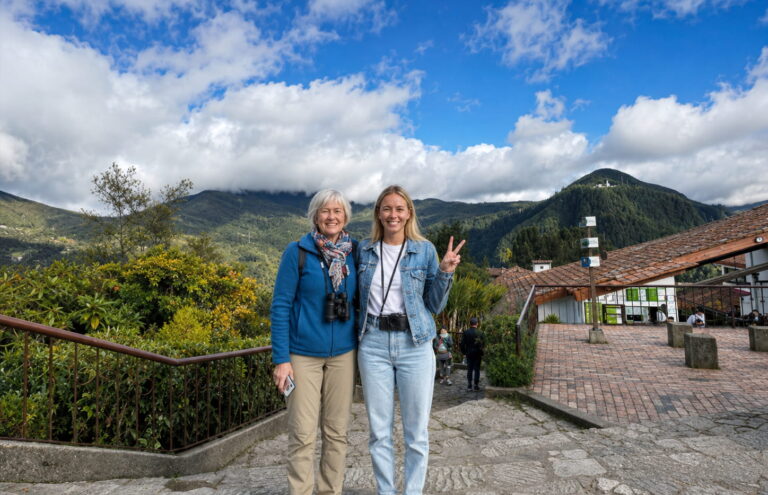
Bogotá sits on a plateau at about 2,640 meters, and the Alcaldía’s own figure for the city is 2,600. The number that matters for a hotel booking is not the daytime altitude but the sleeping altitude, because that is where altitude is felt. The CDC’s 2026 Yellow Book puts the threshold for altitude illness at a sleeping altitude of 2,450 meters and describes travelers arriving below 2,750 meters as a low-risk group on day one; symptoms, when they come, start two to twelve hours after arrival and resolve in twelve to forty-eight. Bogotá’s Secretaría de Salud says to give yourself one to two days to adapt, to rest on arrival, to drink water, to skip excess alcohol and tobacco, to use sunscreen daily and to sleep six to eight hours.
In practice this means one thing for your booking: do not schedule anything demanding for the morning after a night flight, and do not treat the first evening’s wine as a normal evening’s wine. It also means the altitude is the same in every neighborhood on this page — the strip varies by a few tens of meters, not by anything you would feel. Anyone selling you a lower-altitude neighborhood in Bogotá is selling you something that does not exist. The full version is in our Bogotá altitude guide.
The weather is the other thing a hotel cannot change. El Dorado’s IDEAM normals for 1991 to 2020 give 877.3 millimeters of rain over 119.9 days a year, a mean of 13.9 degrees, highs between 18.5 and 20.2 and lows between 6.4 and 9.6. Bogotá is not cold, but it is never warm, and heating is not standard. Ask whether the room has any.
Getting around from wherever you sleep
The strip is served by TransMilenio on Avenida Caracas and the Séptima corridor, by app cars, and by taxis. Which of those we would put you in, and when, is the subject of its own guide: getting around Bogotá. Two scheduling notes that change which neighborhood suits you.
On Sundays and holidays from seven in the morning to two in the afternoon, the city closes 141.46 kilometers of its main streets to cars for the Ciclovía, which the IDRD says more than 1.5 million people use in a week. It runs along the Séptima and Carrera 15 through most of the strip. That is a wonderful thing to wake up next to and a nuisance if you have a Sunday morning car to catch.
The museums set the other rhythm. The Gold Museum opens Tuesday to Saturday from 9 to 7 and Sundays and holidays from 10 to 5, closed Mondays, with foreign visitors paying 21,000 pesos and Sundays free. The Botero Museum is free every day it opens, Monday and Wednesday to Saturday from 9 to 7 and Sundays and holidays from 10 to 5, closed Tuesdays. Both are in La Candelaria, and both are an argument for at least one night near the center or one arranged day.
The legal check almost nobody does
Any property in Colombia that rents to tourists must hold a Registro Nacional de Turismo. It is not optional: registration is required by Ley 300 de 1996 as modified by Ley 1558 de 2012, Ley 2068 de 2020 requires it before any tourist service is provided, and Decreto 1836 de 2021 lists tourist dwellings and other lodging in category one of the providers who must register. The penalty for trading without one is closure of the establishment by the mayor, plus sanctions from the Superintendencia de Industria y Comercio. The IDT adds that the registration has to be renewed in the first three months of every year.
You can check a number yourself, free and without an account, at rnt.confecamaras.co, where the establishment lookup takes an RNT number, a NIT or the establishment’s name. Do it before you pay. Bogotá is still at the proposal stage on regulating short-term rentals — the IDT published its recommendations in April 2024 and they are recommendations, not rules — so the registry is the check that exists today, and a listing that cannot produce a number is a reason to book somewhere else.
What we would book, by who you are
First trip to Colombia, three or four nights, wants to see the city: Chapinero, around the Zona G or Quinta Camacho. Here for work or for the nights: the Zona T or Parque de la 93. Traveling with children, or a second visit: Usaquén. Here for the museums and the colonial city and willing to take cars at night: La Candelaria, with a hotel on a busy, lit street. Conference at Corferias or a flight before seven: Salitre, one night only. A week or more, working remotely: Chapinero Alto or Quinta Camacho, where the cafés are and the streets are quiet.
The one arrangement we would argue against is the split stay for a short trip. Two nights in the center and two in the north sounds like the best of both and in practice costs you a morning to the move. Pick the middle and take the cars.
Questions travelers ask
What is the best neighborhood to stay in Bogotá?
Chapinero for a first trip: it is the middle of the strip, so the historic center and the nightlife are both a short ride rather than one of them being an hour away. The Zona T and Parque de la 93 if you are here for work or for the nights, Usaquén if you want quiet or are traveling with children.
Is it safe to stay in La Candelaria?
By day it is the best-located neighborhood in the city. The condition is the night: stay on the lit, busy streets between the Plaza de Bolívar and the Chorro de Quevedo, take a car rather than walking south of Calle 7 or toward the hills, and be alert around the Avenida Jiménez TransMilenio station. The city’s own figures are in our is Bogotá safe guide.
How far is the airport from where I will be staying?
El Dorado is twelve kilometers due west of the historic center along Calle 26 and further from the north of the strip. Times depend entirely on the hour, which is the whole subject of our airport guide.
Will the altitude affect my first night?
Probably, a little. At about 2,640 meters Bogotá is above the CDC’s 2,450-meter threshold for altitude illness but in its low-risk band for day one. Expect a broken night and alcohol that hits harder than usual, give yourself one to two days, and do not book a demanding morning after a night flight.
Do Bogotá hotels have heating?
Often not, and it is rarely mentioned in a listing. With lows between 6.4 and 9.6 degrees by the IDEAM normals, it is worth asking before you book rather than after you arrive.
Is an apartment rental legal in Bogotá?
It is legal if it holds a Registro Nacional de Turismo, which the law requires of anyone renting to tourists. You can check the number free at rnt.confecamaras.co. Bogotá has not yet passed its own short-term rental rules — the IDT’s April 2024 document is a set of proposals — so the national registry is the check that exists.
Should I split my stay between two neighborhoods?
Not on a trip of three or four nights. The move costs you most of a morning and the city is not big enough to repay it. Stay in the middle of the strip and let a car do the distance.
Plan it with us
We collect guests from hotels the length of this strip every week and we will tell you honestly whether the one you are looking at is where you want to be. Send us the dates and what you want out of the city, or message us on WhatsApp, and we will build the days around wherever you sleep. The rest of the capital, from the calendar to the day trips, is in our Bogotá city guide, and every guide we have written is on the Colombia travel guides page.

Sources
DANE’s 2018 census, adjusted, for the population; bogota.gov.co for the twenty localidades and Catastro Distrital for the address system; IDRD for the Ciclovía’s 141.46 kilometers and its hours; banrepcultural.org for the Gold Museum’s and Botero Museum’s 2026 hours, prices and closed days; IDEAM’s 1991–2020 normals for the El Dorado station, published on datos.gov.co, for the rain and temperature; the CDC’s 2026 Yellow Book and Bogotá’s Secretaría de Salud for the altitude advice; Ley 300 de 1996, Ley 1558 de 2012, Ley 2068 de 2020 and Decreto 1836 de 2021 for the Registro Nacional de Turismo, with the public lookup at rnt.confecamaras.co checked by hand; the Instituto Distrital de Turismo for the renewal window and for its April 2024 document on regulating tourist housing, including the growth figures for Suba, Teusaquillo and Engativá. All read on 12 September 2026.