September 12, 2026
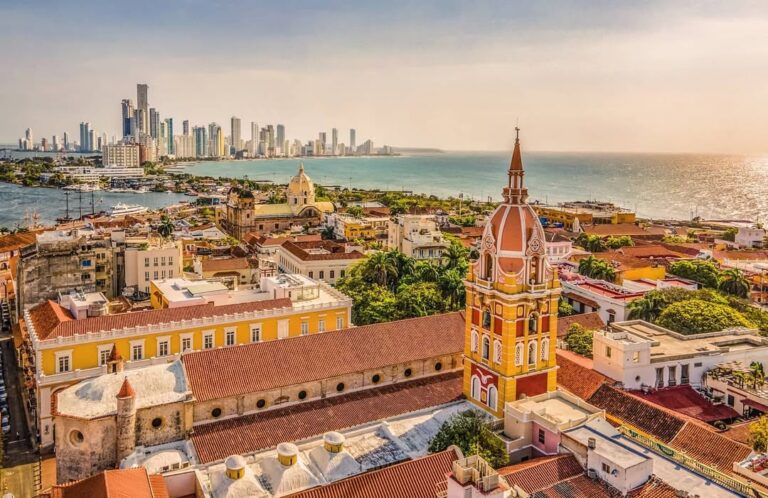
Bocagrande is the other Cartagena: a peninsula of apartment towers and hotels that runs about three kilometers into the Caribbean south of the walled city, with a beach on the open sea on one side, the bay on the other and the strip people call the city’s Miami in between, 2.2 kilometers from the clock tower. It is where many of the big hotels are, where families with children usually sleep, where our tours pick up guests every week, and where the guides written from a distance go wrong most often, because the beach they describe was rebuilt in 2025 and 2026 and the bay side they describe is being dug up until 2027. This is the page we give our own travelers who book a tower with a sea view: what the peninsula is and how it got its name, what the beach is actually like after the coastal works, Castillogrande and El Laguito at the tip, the works you will see on the bay side, the fixed fares to get here, safety by the city’s own record, and whether to sleep here or inside the walls.
The short version
Bocagrande is a beach-and-pool neighborhood ten minutes by taxi from the colonial center, not a colonial neighborhood with a beach. The sand is grey-brown, the water is warm and the vendors are constant, and the main strip is about thirty meters wider than it was before the coastal protection works that delivered the new Playa 3 in August 2025 and Playa 2 on September 6, 2026. Castillogrande, on the bay side, is calmer in the water and quieter at night, and the one of the three barrios we would choose; El Laguito is the towers at the tip. The airport fare is fixed at 34,400 pesos, the walk to the clock tower is fifteen minutes from the start of the peninsula, and every tour we run picks up at the hotels here as standard. Stay here for a pool, a beach in front of the hotel and a modern room; stay inside the walls or in Getsemaní if the city is the point. And if you came for a real beach, the one you picture is an hour away on Barú or in the Rosario Islands, and Bocagrande is where the boat picks you up.
What Bocagrande is, and how it got its name
South of the walled city, across the inner harbor, a low sandy peninsula runs out to sea for about three kilometers and holds three barrios: Bocagrande, the first you reach, with the main beach along its seaward side and the Avenida San Martín running through it; Castillogrande, on the bay side toward the tip, residential and quieter; and El Laguito, the cluster of towers around a small lagoon at the very end. The Navy’s base sits at the neck of the peninsula, where the road to the walled city begins, and the Club Naval marks the tip of Castillogrande; between them, along the bay, runs the two-kilometer promenade that the district is rebuilding as part of the works described below. By the coordinates, the first towers are 2.2 kilometers from the Puerta del Reloj, Castillogrande 3.2 and El Laguito 3.3.
The name is older than every tower. Bocagrande, the big mouth, was the wide entrance to the Bay of Cartagena between this spit of land and the island of Tierra Bomba, the way ships came in until 1640, when some Portuguese vessels ran aground on a sandbank at the entrance and the bank grew into an isthmus that joined the island to the peninsula. Two Spanish engineers, Ignacio Sala in 1750 and Lorenzo Solís in 1754, tried and failed to close the gap for good; Antonio de Arévalo began on November 11, 1771, and by 1778 had finished an underwater barrier of three rows of large baskets forming a bed of sand with stone laid on top, which stopped ships passing. It is still there under the water off the peninsula, still holding, and it has kept the bay’s main entrance closed since the end of the eighteenth century. The towers came in the twentieth; the name stayed.
The beach in 2026
Be honest with yourself about what it is. Bocagrande’s beach is grey-brown sand with warm water and a lot of vendors, an urban beach in front of a row of towers, fine for a late-afternoon swim from your hotel and a beer in a plastic chair, not the day you flew here for. On windy days the sea is rough on the seaward side; respect the flags and the lifeguards’ whistle, and from December to March, when the trade winds blow, expect surf. What has changed is the width. The Proyecto de Protección Costera, a program of the national disaster agency, the UNGRD, and the district worth 245,443 million pesos with the UNGRD paying 62 percent by the figures given at the latest delivery, has been rebuilding the strip sector by sector with breakwaters, beach fill and new drains: the new Playa 3, 200 meters of beach thirty meters wider than before, was delivered in the last week of August 2025 with the phase at 92.3 percent; the works moved to the 400 meters of Playa 1 from September 1, 2025, behind a temporary closure; in January 2026 the district’s risk office told the press that no sector opens until its drains work and the maritime authority certifies it safe; and on September 6, 2026, the UNGRD delivered Playa 2, 360 meters long and more than 50 meters wide, about 30 meters more than before, which leaves Playas 2, 3, 4 and 5 finished and the first phase at 93 percent, by the press reports of the delivery. So the beach you get in late 2026 is wider than any photo older than a year shows, and until the last sector is signed off there may still be a fenced stretch somewhere along the seafront.
The sea had its own say this year. On February 1, 2026, a cold front pushed waves of more than four meters against the city, heights the district says had not been recorded in Cartagena since 1989; Marbella and El Cabrero, north of the walls, lost much of a beach that had reached 30 meters wide, and in Castillogrande more than a kilometer of beaches saw damage to the coastal defenses, the walkways and the sand. The district’s answer is a second program, Defensa Costera 2050, 6.2 kilometers of structural protection split between the Avenida Santander below the walls, El Cabrero and Marbella, and 1.2 kilometers of Castillogrande, where ten new breakwaters are going in; two were complete by the district’s notice of March 17, 2026, and by July the press reported all ten in place. The practical reading for a traveler is simple: the seaward beach of Bocagrande is the one that has been rebuilt, the bay-side beach of Castillogrande is the one being protected, and in a windy week the flags matter more than either.
Two rules that are not about the sea. In October 2025 the Tribunal Administrativo de Bolívar gave the district sixty days to mark swimming zones separate from boat traffic at eight beaches, Bocagrande among them, after a swimmer was killed by a propeller at Cholón in June 2024; swim inside the marked zone where there is one and never toward the launches. And the vendor rule from every beach in this city: say no once, clearly, agree the price of a chair, a tent, a massage or a plate before you accept it, pay only for what you ordered, and keep the district’s Titán Chat WhatsApp line, +57 304 251 1127, open 24 hours and in several languages, for a bill that is wrong while you are still at the table. Every beach the city has, from this one to the Blue Flag at La Boquilla and the islands, is compared in our Cartagena beaches guide.
Castillogrande and El Laguito
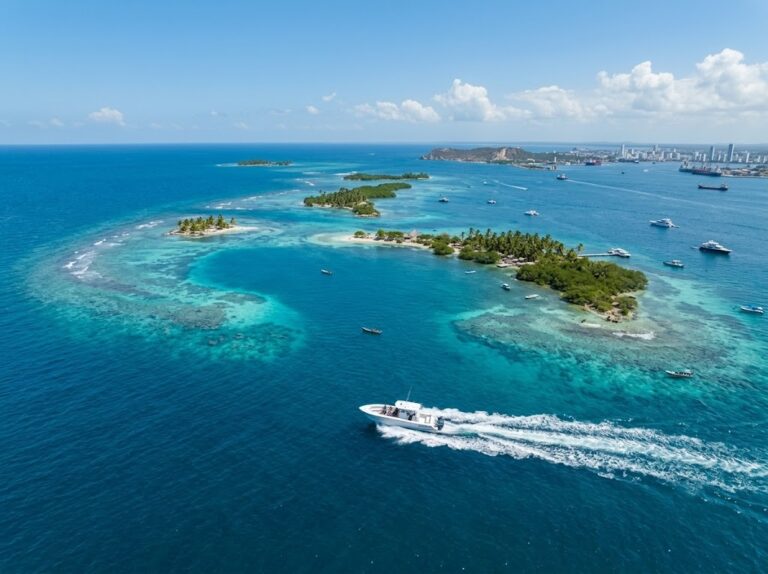
Castillogrande is the peninsula’s quiet side: a residential barrio of towers along the bay, with the calmest water of the three because the bay takes the edge off the sea, a walk along the water at dusk and almost nothing to do after dark, which is the point. It is where we would sleep on this peninsula, for the calm and for the difference in noise, at the cost of a slightly longer taxi; it is also the front the cold front hit hardest and where the ten new breakwaters of Defensa Costera 2050 are going in, so expect machinery on the shore in 2026. The Club Naval marks its tip. El Laguito, at the very end of Bocagrande, is a knot of high towers around a small lagoon with a beach on its outer side, a short walk from the main strip, quieter than the strip and further from everything else. From either, the launches to Tierra Bomba, the island across the mouth of the bay, take ten to twenty minutes, to the beach clubs of Punta Arena that face the city: better water than Bocagrande’s, the same sand, fine for a half day.
The works you will see on the bay side until 2027
Bocagrande floods when it rains hard; the district calls it one of the barrio’s historic problems, and October, the wettest month, is when the low streets show it. The fix is a single 168,000-million-peso project the district calls the “4 en 1”: new storm drains with large-capacity pipes and storm tanks, raising the road where it can be raised; the rebuilding of the Avenida Chile, the bay-side avenue, from the Portomarine building to the Club Naval at the tip of Castillogrande; new coastal protection along the whole bay shore between the two barrios; and the renewal of the two-kilometer promenade, parks and squares along it. The contract was awarded in February 2026 with a start announced for February 27; the traffic plan and the preliminary works went in from March 17, the pipes started going into the ground on April 18, and the contract allows up to four months of design and twenty of construction, so the mayor’s estimate is delivery in 2027. What that means for you is a closed block of the Carrera 3 between the Calle 10 and the Carrera 2 by the Portomarine building, a reversed Calle 10, a one-way Avenida Chile between the Calle 9 and the Calle 10, a contraflow at the neck of the peninsula by the Navy base, machinery on the bay side and detours that change as the front moves. The beach and the seaward side are not the site; a room with a sea view is a room away from it. If you are choosing a hotel on the bay side in 2026 or the first half of 2027, ask what the works are doing that month before you book.
Staying in Bocagrande
Stay here if the point of the trip is a pool, a beach in front of the hotel and a modern room with a balcony over the water; families with children usually do, and so does anyone who finds the colonial center hot and close at night, which it is. The big hotels and the apartment towers are here, the beach is across the road, and the walled city is a fixed-fare taxi away for every dinner, which is the real cost of Bocagrande and the reason the walls or Getsemaní win for anyone whose trip is the colonial city. We do not sell rooms and name no hotels, so the choice between towers is yours; the one rule we insist on is the law’s: under article 3 of Ley 2068 de 2020 every hotel and every tourist apartment must be in the Registro Nacional de Turismo before it takes a guest, and you can look a name up on the registry’s site before you pay. The neighborhood-by-neighborhood comparison, with the distances, the taxi zones and the three-day and seven-day answers, is in our guide to where to stay in Cartagena.
What to do from Bocagrande, in the order the heat dictates
The peninsula itself gives you the beach, the seafront walk and the bay at sunset; everything else is ten minutes away, and the order is the order of the heat. Do the walled city and the Castillo de San Felipe in the morning with a private guide who picks you up at your hotel here, the way our city tour does before the heat, and be back at the pool by early afternoon when the streets are at their hottest; take the sunset boat from the Muelle de los Pegasos, the colonial skyline on one side of the bay and your own tower on the other; give one full day to the water, the private boat to the Rosario Islands or, with children, the day at Playa Tranquila on Barú, both with pickup at the hotels here; and keep Getsemaní for an evening, going back by taxi rather than on foot along the causeway after dark. What each of those is, hour by hour and with the 2026 prices, is in our guide to things to do in Cartagena.
Eating and the nights
Bocagrande eats and drinks along its avenues and the seafront, and it has its own bars, but its nights are quieter than Getsemaní’s and end earlier, which is either the reason to stay here or the reason not to. We keep no restaurant list on this page because prices and owners change faster than we can verify them; the rules do not. Agree the price before you sit on the beach, read the menu before you order on the avenue, watch your drink poured, and after midnight take a licensed or app taxi back rather than walking the causeway from the center. If you want the evening to be about the food, the walled city is ten minutes away and our food tour through it is the fastest way to learn what to order for the rest of the week.
Getting to Bocagrande, and getting around
From the airport, Rafael Núñez in Crespo on the northern seafront, the fare from the official taxi stands is fixed by zone under the district’s 2026 decree, Decreto 0051 de 2026, and Bocagrande, Castillogrande and El Laguito are the far end of the tariff at 34,400 pesos, plus 1,100 at night from 7 p.m. to 5 a.m.; the airport’s own line is fifteen minutes to the peninsula, and the evening rush, cruise days and December add ten to twenty. A private transfer with the driver waiting inside the terminal with your name, the flight tracked and the price fixed in dollars starts at 49 US dollars with Safe Transfers by Cielo.Travel, which is how we bring our own guests in. From the clock tower, the start of the peninsula is 2.2 kilometers, a fifteen-minute walk past the Navy base, and the tip at El Laguito 3.3; a taxi is five to ten minutes, with the fare agreed before you get in because meters are not used here, or a ride app. Inside the peninsula everything is on foot, and every tour we run picks up at the hotels in Bocagrande, Castillogrande and El Laguito as standard. The full airport picture, zone by zone, is in our airport guide, and the heat, the rain and the wind month by month, from the IDEAM’s numbers, are in our Cartagena weather guide.
Is Bocagrande safe?
Yes, by day and by evening, with the rules of every Colombian city. The peninsula is residential, busy on the seafront, quiet at night and policed, and what reaches visitors here is the bill, the vendor and the occasional confidence trick rather than violence: in May 2026 the police’s anti-kidnapping unit, the Gaula, arrested two men in Bocagrande who had watched tourists on the beach for hours, posed as members of an armed group to demand 750 dollars from a couple, followed them and came back the next day for a million pesos, and were caught as the money changed hands. The lesson is what to do with strangers who know your hotel: nothing, and tell reception. Wear no gold on the beach, keep the phone in your pocket, watch the flags on windy days, swim inside the marked zone, and after midnight take a car back from the center rather than walking. The city’s numbers, neighborhood by neighborhood, are in our guide to whether Cartagena is safe.
Bocagrande or the walled city, honestly
The walled city if the point of the trip is the colonial city and you accept the heat, the noise and the prices; Getsemaní if you want the walls at five minutes and the nights on your doorstep for less; Bocagrande or Castillogrande if the point is a pool and the beach and you accept a taxi to the center for every dinner. A family with a week does well here with the center as two mornings and the islands as a day; a couple with three nights and the city as the reason does better inside the walls. What you should not expect from Bocagrande is a Caribbean beach of the postcard kind: the water people picture when they book the flight is at Playa Blanca, Playa Tranquila and the Rosario Islands, an hour away by boat or by road, and the peninsula’s real gift is that the boats and the cars leave from your hotel door. Our guides to the walled city and to Getsemaní say what each of those is like to live in for three days, and the city as a whole, from what it is to how many days it needs, is in our Cartagena travel guide.
Questions travelers ask
What is Bocagrande in Cartagena?
The peninsula of apartment towers, hotels and beach that runs about three kilometers into the Caribbean south of the walled city, 2.2 kilometers from the clock tower, in three barrios: Bocagrande on the seaward side, Castillogrande on the bay side and El Laguito at the tip. The name is older than the towers: it was the bay’s wide entrance, closed by an underwater barrier finished in 1778.
Is Bocagrande beach worth it?
For a swim from your hotel and a late afternoon in a plastic chair, yes; as the beach day of your trip, no. The sand is grey-brown, the water warm and the vendors constant, and the strip is about thirty meters wider after the coastal works delivered Playa 3 in August 2025 and Playa 2 in September 2026. The beach you came for is on Barú or in the Rosario Islands, an hour away.
Can you swim at Bocagrande?
Yes. Respect the flags and the lifeguards, expect surf from December to March when the trade winds blow, and swim inside the zone marked for swimmers, which the Tribunal Administrativo de Bolívar ordered the district to separate from boat traffic in October 2025. Castillogrande, on the bay side, is calmer.
How far is Bocagrande from the walled city?
About 2.2 kilometers from the Puerta del Reloj to the start of the peninsula and 3.3 to El Laguito at the tip, by the coordinates: a fifteen-minute walk to the first towers, five to ten minutes by taxi with the fare agreed first, and 34,400 pesos from the airport under the 2026 tariff.
Is Bocagrande safe at night?
Yes, with the rules: it is residential, quiet and policed, and the risk is the bill, not violence. Take a licensed or app taxi back from the walled city or Getsemaní after dark rather than walking, keep the phone in your pocket and the gold in the safe, and treat anyone who approaches knowing your hotel as a reason to tell reception.
Is it better to stay in Bocagrande or the walled city?
The walled city if the colonial city is the point and you accept the heat, the noise and the prices; Bocagrande or Castillogrande if a pool and a beach in front of the hotel are the point and you accept a taxi to the center for every dinner. Families with children usually choose the peninsula; couples with three nights usually choose the walls.
What are the works in Bocagrande?
Two programs at once. On the seaward beach, the coastal protection project of the UNGRD and the district, which has rebuilt the strip sector by sector and delivered Playa 2 on September 6, 2026, with the first phase at 93 percent; on the bay side, the district’s 168,000-million-peso “4 en 1”, new drains against the floods, the rebuilding of the Avenida Chile, coastal protection along the bay and a new promenade, with works from 2026, delivery estimated for 2027 and street closures around the Portomarine building meanwhile.
How do I get from Cartagena airport to Bocagrande?
From the official taxi stands at the airport the fare is fixed at 34,400 pesos to Bocagrande, Castillogrande and El Laguito under Decreto 0051 de 2026, plus 1,100 at night from 7 p.m. to 5 a.m., for a ride the airport puts at fifteen minutes; a private transfer with the driver waiting inside the terminal starts at 49 US dollars with Safe Transfers by Cielo.Travel.
Plan it with us
Every tour we run in Cartagena picks up at the hotels in Bocagrande, Castillogrande and El Laguito as standard: the private morning through the walls and the Castillo before the heat, the food tour, the sunset boat, the private boat to the Rosario Islands and the day at Playa Tranquila that we recommend to families, all run by the people who wrote this page, and the transfer from Rafael Núñez to your door is operated by Safe Transfers by Cielo.Travel. Write to us on WhatsApp with your dates and your hotel, or start with our Cartagena tours and the rest of our Colombia guides.
Sources
The facts on this page were checked on September 12, 2026 against the following sources: Fortificaciones Cartagena de Indias, the Escuela Taller’s site, for the underwater barrier and the name; the Alcaldía de Cartagena’s notices of August 26, 2025 on the delivery of Playa 3 and the start of Playa 1, January 8, 2026 on Playa 2, February 21, 2026, March 18, 2026 and April 19, 2026 on the “4 en 1” project, its cost, its calendar and its traffic plan, March 18, 2026 on the Castillogrande breakwaters of Defensa Costera 2050, and March 26, 2026 on the cold front of February 1; El Universal of September 6, 2026 for the delivery of Playa 2, El Tiempo of January 8, 2026 for the risk office’s conditions and El Universal of July 21, 2026 for the Castillogrande breakwaters (press, non-authoritative); Ley 2068 de 2020, article 3, on the Senate’s site, and the Registro Nacional de Turismo for the registration rule; and our own Cartagena guides to the beaches, safety, the airport, where to stay and the weather, each sourced in place, for the Tribunal’s October 2025 ruling, the Gaula case, Titán Chat, the 2026 taxi tariff and the IDEAM’s normals. Distances are calculated from coordinates; the tour prices were read on the tour pages today.