September 11, 2026
Santa Marta is the oldest surviving Spanish city in Colombia, founded on 29 July 1525, and the base for the best stretch of the Caribbean coast: Tayrona National Park less than an hour east, Minca in the Sierra Nevada foothills less than an hour up, Taganga’s fishing bay fifteen minutes north, the Lost City four days on foot into the mountains, and Palomino further along the same road. The city itself is a working port of about half a million people with a small historic center, a bay that faces the sunset and, behind it, the highest coastal mountain range in the world. Most people give it a night on the way to the park and leave feeling they missed something. This guide is how we plan it for our own travelers: what the city is, what is worth your time in the old center, how the beaches sort out, how Tayrona, Minca, the Lost City and Palomino fit, the airport, whether it is safe, the weather, where to stay and how to build three or four days that work.
The short version
Give Santa Marta three days: one for the old city and the Quinta de San Pedro Alejandrino, where Bolívar died in 1830; one for Tayrona and the hike to Cabo San Juan; one for Minca in the hills or a private boat to the beaches you cannot drive to. Sleep in the historic center for the restaurants and the walkable blocks, in Rodadero for the beach and the hotels, or up the coast near the park gates if Tayrona is the point of the trip. The airport is 16.5 kilometers south of the center, with Avianca and Copa at the counters and a private transfer from 49 US dollars. The park closes three times a year, in February, June and from October 19 to November 2 in 2026, and the Lost City is closed from October 1 to 31, 2026 by ICANH’s calendar, so check both calendars before you fix dates. The city’s homicide count fell in 2025 but the rate is still among the higher ones in the country, which changes how you move at night, not whether you come. It is hot all year, dry from December to April, wettest in September and October. Our private days from Santa Marta start at 81 US dollars per person for two travelers.
What Santa Marta is
Rodrigo de Bastidas reached this coast in 1502 and came back to found the city on 29 July 1525, which makes it, by the district’s own account, the first city founded in South America and, thirteen years older than Bogotá, the oldest surviving one in Colombia. The colonial fabric is thinner than Cartagena’s for a reason the city’s own history gives: the pirates arrived in 1543 and Santa Marta was burned more than twenty times before 1692, so what stands today is later than the founding, with the Cathedral and the three-hundred-year-old Casa de la Aduana as the anchors. Bolívar came here in December 1830, spent the first days of the month in the city and died at the Quinta de San Pedro Alejandrino, the estate outside town, on 17 December; his body was waked from that night until the 20th, when he was buried in the Cathedral. The 2018 census counted 479,853 people in the district, which runs across 2,393 square kilometers from the beach to the 5,775-meter summits of the Sierra Nevada, the mountain the city describes as the highest in the world at sea level. It is a port city first and tourism runs on top of that, which is why Santa Marta feels like a Colombian city with visitors in it rather than a resort, and why the Fiestas del Mar in late July, around the city’s anniversary and running since 1959, are a local party first. In 2025 the city turned five hundred.
The old city: a morning that is enough
The historic center is a few blocks between the bay and the market, and it walks in a morning. Start on the Parque de Bolívar, where the Casa de la Aduana, three hundred years old, a national monument since 1979 and the building where Bolívar was a guest and where his funeral was held, now houses the Museo del Oro Tairona: 565 objects, 471 of them pre-Hispanic and 207 of those goldwork, in four rooms that run from the Tayrona societies through the people of the Magdalena to the house’s own history. It is free, needs no reservation, and opens Tuesday to Saturday from 9 to 5 and Sunday from 10 to 3, closed Mondays, by the Banco de la República’s own listing. Two blocks away the Cathedral holds the tomb of Bastidas and was Bolívar’s first resting place in 1830, before Venezuela reclaimed him. The Parque de los Novios is the square that comes alive at night, ringed with restaurants, and the Malecón along the bay is where the city watches the sun go down behind the headland. Our three-hour private walk covers the museum, the square, the Cathedral and the streets between them with a guide who knows the sequence, from 84 US dollars per person, and our four-hour food tour does the same blocks through the public market, at least five tastings from the vendors samarios use, from 81.
The Quinta de San Pedro Alejandrino
The old hacienda on the edge of the city where Bolívar died on 17 December 1830 is the one visit that justifies leaving the center. The grounds hold the house, the Altar de la Patria, the botanical garden and the Museo Bolivariano de Arte Contemporáneo, founded on 24 July 1986; one ticket covers all of it. The foundation that runs it publishes its 2026 prices: 30,000 pesos for a foreign visitor from age 13, 24,000 for Colombians, 22,000 for children from 6 to 12 and for Colombian seniors over 65, 28,000 for foreign seniors, free under 6. The ticket office opens from 9 to 4:30 in low season and from 8:30 to 5 in high season, the grounds close half an hour later, it shortens to 1:30 on December 24 and 31 and closes on January 1, and the young volunteer guides work for tips. Our five-hour private city tour combines it with the old center, entrance and pickup included, from 102 US dollars per person; it is the day we would give a first visit.

The beaches: Rodadero, Taganga, Bahía Concha and the bays by boat
Santa Marta’s own bay is a port, not a beach, so the swimming is elsewhere and each option is a different kind of day. Rodadero, south of the center on the way to the airport, is the beach the tourism portal calls the most popular on the Colombian Caribbean, with the hotel towers, the promenade, the water sports and the crowds that go with it; from its pier the boats run out to Playa Blanca, the cove around the headland. Taganga, fifteen minutes north, is a fishing village in a bay ringed by mountains, the town where people learn to dive at the certified schools and where the sunset over the water is the evening plan; its boats also go into the park. Bahía Concha, fifteen minutes from the city by road, is the first bay of Tayrona National Park, with its own year-round ticket, 43,500 pesos for a foreign visitor in 2026, and since the March 2026 reopening order the road beyond the gate is for pedestrians and light electric moto-cars only. Beyond it, through the Palangana gate, are Neguanje and Playa Cristal. And there is the sea route: our private boat day from Santa Marta goes to Santo Cristo, Inca Inca and Playa Blanca, three beaches reached only by water, eight hours with a private boat and guide from 445 US dollars per person, with the caveat that the sea can cancel it on the morning and the refund is full when it does.
Tayrona, in one paragraph
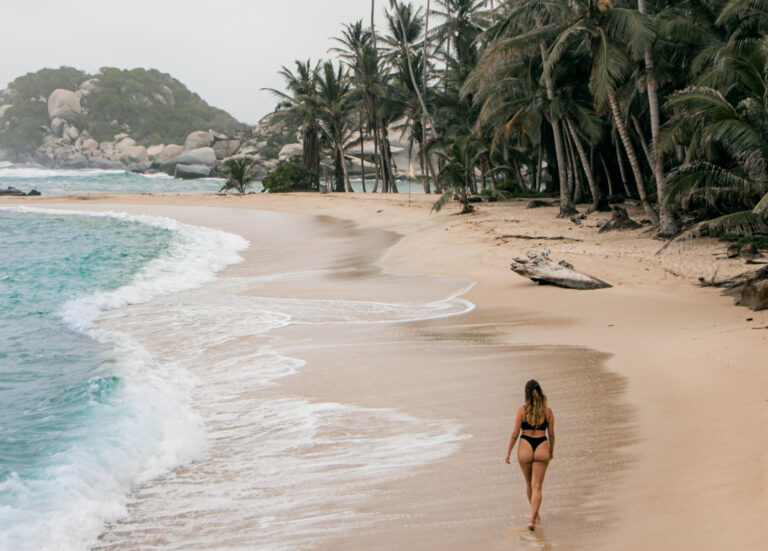
The park is the reason most people come. Go in at El Zaino, 32 kilometers and about 45 minutes east, and walk through the forest to Arrecifes, La Piscina and Cabo San Juan, about four hours of hiking across the day with the swims where the park allows them, which is not at Arrecifes. Tickets are sold only at the gate on the day, 81,000 pesos in low season and 96,500 in high season for a foreign visitor in 2026, plus compulsory insurance and an induction talk, and the park closes for the Respira Tayrona rests from February 1 to 15, June 1 to 15 and October 19 to November 2, and closed outside that calendar twice in 2026. The gates, the hours, the fees, the closures, the hike and where to sleep inside are all in our Tayrona guide; our Tayrona day, private from your hotel or shared from Rodadero, is from 139 US dollars with the entrance and the insurance handled.
Minca and the Sierra Nevada
Minca is the day for the heat: less than an hour up from the city into the foothills, Hacienda La Victoria, one of the country’s oldest coffee farms, the cold pools of Pozos Azules and the Marinka waterfalls, eight hours with a private guide from 172 US dollars per person, lunch on your own in the village. It is also as far into the Sierra Nevada as a visitor goes. The national park behind it covers about 573,000 hectares, from the beach to the perpetual snow, and Parques Nacionales lists it without ecotourism: no tourist activity is allowed in the high Sierra, the lakes, the páramos or the snow peaks, about 96 percent of the park overlaps three indigenous reserves and the whole massif sits inside the Línea Negra, the protection line of the four peoples under a 2018 decree. What you can reach is the foothill belt, and it is worth reaching for one number: 22 bird species that exist nowhere else on earth, close to a fifth of Colombia’s endemic birds, on a mountain whose foothills you can drive into. Birders come for that alone. If you go up without us, the shared jeeps and vans to Minca leave from the public market building in the center, not from a terminal; the city counted 500 tourists a day taking them in high season back in 2018, and the road is at its worst in the hours after rain, which on this coast means the afternoon. The village, the waterfalls, the farm, the birds and the road are in our Minca guide.
The Lost City
Ciudad Perdida, Teyuna to the four peoples who manage access to it, is the Tayrona city of stone terraces in the Sierra that the outside world did not know existed until 1972; the archaeological park has been run by the national anthropology institute, ICANH, since 1976, opens from 7 in the morning to 3 in the afternoon, and can only be reached on foot, four days there and back through the jungle with a guide. Two things to know before you book. The trek is real walking in heat and mud, and it is the best thing in the region for anyone who can do it. And the park closes for a stretch every year by ICANH resolution, for about two weeks each September up to 2024 and, by the institute’s published calendar for the second half of 2026, from October 1 to 31 this year, so no trek can reach the site in October 2026; during a closure only the indigenous authorities, ICANH staff, park officials and the security forces may enter and no operator can negotiate around it. Our four-day trek, with the entrance, the guide and nine meals, is from 710 US dollars per person, and the itinerary is on the Lost City trek page. The four days in detail, the weather by month, the vaccine and the October closure are in our Lost City trek guide.
Palomino and the road east
Past the park gates the Troncal del Caribe continues east to Palomino, the river-mouth village on the La Guajira side of the departmental line, in our drivers’ experience an hour and a half to two hours from Santa Marta depending on the road. It is the day of the river: our shared tubing day floats the Palomino River from the forest to the sea from 90 US dollars, and the horseback ride along the beach at sunrise or sunset is from 120, both with pickup by motorbike from Palomino because the starting points are not reachable by car. One thing about that road: at the Mendihuaca river, east of the park, traffic crosses a military bridge 64 meters long and 4.2 meters wide that the national roads institute installed in March 2026 after the old bridge collapsed and describes as a transitional solution, so the last stretch can back up. Palomino is not the Guajira desert; Cabo de la Vela and Punta Gallinas are hours further on, and a different trip. The beach, the river, the tubing and the bridge are in our Palomino guide. The desert itself, Cabo de la Vela, Punta Gallinas and the rancherías, is in our La Guajira guide.
The city you pass halfway along that road is worth a stop of its own, and the riverfront, the food and the safety numbers are in our Barranquilla guide.
The airport, and getting here from Cartagena
Simón Bolívar International Airport, SMR, sits at kilometer 12 of the Santa Marta to Ciénaga road, 16.5 kilometers from the center by the airport’s own figure, which puts it on the far side of Rodadero and Pozos Colorados from the historic center and on the opposite side of the city from Tayrona; it operates from 6 in the morning to midnight, and Avianca and Copa Airlines are the carriers with counters on its ground floor, so you fly in from Bogotá or Medellín, or from Panama on Copa. A private transfer from the airport with our sister company Safe Transfers is from 49 US dollars, and an hourly driver, useful for the Quinta or a Taganga evening, from 40 with a three-hour minimum, both booked on the Santa Marta page of Safe Transfers. By road, Barranquilla is 93 kilometers away by the district’s figure, and Cartagena about 230 kilometers and four to five hours by the figures the press and the toll directories publish, since no authority publishes a door-to-door time; it is the leg most of our two-week trips make by private car after Cartagena, and between Barranquilla and Ciénaga the road crosses the Isla de Salamanca park, 56,200 hectares of mangrove declared the same day as Tayrona, which the parks authority calls an international airport for migratory birds and where its one instruction to drivers is to slow down. The terminal, the taxi desk with the district’s fares, the apps and the drive to the park are in our Santa Marta airport guide.
Book the drive to Santa Marta
Simón Bolívar into town, Cartagena along the coast, or straight past the city to Tayrona and Palomino without stopping. If you are going east, the airport run and the first day’s drive are the same drive.
Road detail on Safe Transfers: Cartagena to Santa Marta and the airport transfer.
Is Santa Marta safe?
Safer than the numbers suggest for a visitor. By the figures of the national forensic institute reported in the regional press, Santa Marta recorded 182 homicides in 2025, a rate of 31.3 per 100,000, down from 208 in 2024 and still the ninth-highest rate among the country's 23 main capitals. The figure is the city's, not the visitor's: what a visitor meets is theft in the crowded blocks and on the beach, unlicensed taxis, and the road at night. The rules are the ones we use everywhere in Colombia: a car you booked, not one you flagged, the phone in your pocket in the center and on the Rodadero promenade, nothing valuable on the sand, the historic center on foot by day and by car after dinner, and Taganga by car, not on foot, after dark. The park, Minca, the boats and the Lost City are as safe as anywhere in the country, with one caveat that is about the calendar, not crime: Tayrona's gates closed twice in 2026 for reasons on the roads around it, so we check the day before every departure. The city's figures for 2025 and 2026, the sea rules and the neighborhoods, one by one, are in our guide to whether Santa Marta is safe.
Weather and when to go
The airport's long-term averages from the national meteorological institute make Santa Marta one of the driest places on the Colombian coast, about 560 millimeters of rain a year: January to April almost dry, with rain on fewer than two days a month, then a wet season from May to November that peaks in September and October, when the city averages 99 and 127 millimeters and about nine rainy days each. The temperature does not move, a monthly mean of 27 to 29 degrees, afternoons of 32 to 34, nights of 23 to 26, humidity between 70 and 79 percent; the city's own description gives a range of 23 to 32 degrees. The hills are wetter and cooler, which is why you go up to Minca. Plan around three calendars, not the weather: the park's high-season fees and crowds from December 1 to January 31, June 1 to July 31, Holy Week and the long weekends; the park's three closures; and the Lost City's annual closure, October in 2026. February to April, after the February closure, is dry, cheaper and quieter, and it is the window we pick; late July has the Fiestas del Mar, the city's biggest week. For the whole country month by month, read our guide to the best time to visit Colombia.
Where to stay
Four choices, and they are different trips. The historic center is the one we suggest for a first visit: boutique hotels in old houses, the restaurants of the Parque de los Novios on foot, the market and the museum a few blocks away, and the Malecón for the sunset; the trade-off is that the sea in front of it is a port. Rodadero, south of the center, is the beach hotel zone, with the towers on the sand, the promenade and the boats to Playa Blanca, and a longer ride to the park; Bello Horizonte and Pozos Colorados, further south toward the airport, are the resort strip, quiet and closest to arrivals. Taganga, fifteen minutes north, is the fishing village with hostels, dive schools and the best sunset, better for a night than a base. And for anyone whose trip is the park, the lodges along the Troncal near the Tayrona gates put you minutes from El Zaino for the early start, and Minca's small hotels put you in the cool with the birds. Whichever you choose, book the night before Tayrona somewhere you can leave before seven.
A plan that works
Day one, arrive, and give the afternoon to the old city: the Gold Museum, the Cathedral, the Parque de los Novios for dinner and the Malecón at sunset, on foot from a hotel in the center. Day two, Tayrona early, in at El Zaino and out before the gate closes, tired and salty. Day three, the Quinta in the morning with the city tour, then Rodadero or Taganga for the afternoon, or swap the whole day for Minca and the waterfalls. A fourth day is the private boat to the three beaches, or Palomino and the river. If you have the legs and the days, the Lost City is four days added to the front or the back, not squeezed into the middle. Two nights is the minimum that makes the flights worth it; three is the trip; a week is the coast done properly with Cartagena in front of it, which is how our Colombia itinerary builds the last three days.
What it costs, and what is included
Our days from Santa Marta are private unless we say otherwise, with hotel pickup, an English-speaking guide, the vehicle, the entrances named and all-risk insurance, priced per person for two travelers with discounts for larger groups: the food tour from 81 US dollars, the old-city walk from 84, the city tour with the Quinta from 102, Tayrona from 139 with the park entrance, Minca from 172 with the farm entrance, the private boat to three beaches from 445, the Lost City trek from 710 with the entrance and nine meals; the Palomino tubing and horseback days are shared, from 90 and 120. On your own, the Gold Museum is free, the Quinta is 30,000 pesos for a foreign adult in 2026, Bahía Concha 43,500 and the main park 81,000 to 96,500 plus insurance. A private airport transfer is from 49 US dollars.
What we do differently
We plan Santa Marta from the calendars outward: the park's closures, the Lost City's annual closure, the gate hours and the sea, and then the days fall into place around them instead of against them. One guide who knows the old city's sequence, not a loop of the same three squares; the Quinta with its entrance bought; the Tayrona day that leaves early enough to walk in, swim and walk out; the boat that is cancelled and refunded when the sea says so rather than sent out anyway; and a driver who knows which road is open that morning, from the airport to the last stretch past the park. Every day is a vehicle, a guide and your group, and the evenings are yours in the Parque de los Novios.
Questions travelers ask
Is Santa Marta worth visiting?
Yes, as the base for Tayrona, Minca, the Lost City and the boats, and for one morning in the old city and the Quinta. As a beach city on its own it is not the reason to come; the coves reached from it are.
Is Santa Marta safe for tourists?
With ordinary city rules, yes. The homicide rate is among the higher ones in the country, and it is a city figure; the risks to visitors are theft, unlicensed taxis and the road at night. Book your cars, keep the phone away in the center and on the beach, and take a car after dark.
How many days do you need in Santa Marta?
Three: the old city and the Quinta, Tayrona, and Minca or the boat. Add a fourth for Palomino, and four more for the Lost City trek if you have the legs.
Santa Marta or Cartagena?
Both, in that order from Cartagena, as our two-week itinerary does. Cartagena is the walled city and the islands; Santa Marta is the park, the mountains and the trek. If you can only take one and you want colonial streets, take Cartagena; if you want the jungle beach at Cabo San Juan, take Santa Marta. Cartagena's side is in our Cartagena guide.
How far is the airport from Santa Marta?
16.5 kilometers south of the center by the airport's own figure, past Rodadero, at kilometer 12 of the Ciénaga road; it opens from 6 a.m. to midnight. A private transfer is from 49 US dollars.
What is the weather like in Santa Marta?
Hot all year, 27 to 29 degrees on average with afternoons above 32, almost dry from December to April and wettest in September and October. The hills above the city are cooler and wetter.
Can you visit Tayrona from Santa Marta in a day?
Yes, and most people do: the El Zaino gate is 32 kilometers and about 45 minutes away, and the hike to Cabo San Juan and back fits in a ten-hour day with an early start. Check the park's closure dates first; they are in our Tayrona guide.
Plan it with us
Every day we run in Santa Marta is guided, with the entrances, the insurance and the pickup handled and the calendars checked before you leave the hotel. Write to us on WhatsApp with your dates, or start with our Santa Marta tours page. For an evening in the old city, our Santa Marta food tour covers the Caribbean market and the street food.