September 9, 2026
Where you sleep in Medellín decides more of your trip than in most cities, because the valley is long, the hills are steep and the neighborhoods have personalities that do not overlap. First visit, nightlife, walking distance to restaurants: El Poblado. A flatter, more local city you can walk end to end: Laureles. Quiet nights, families, a town square with buñuelos: Envigado or Sabaneta. Downtown for the day, not for the night. We run tours here every day and pick guests up in all of these places, so this is the comparison we give people who ask us where to stay, with the trade-offs included.
The city itself, the valley, the metro and the calendar, is in our Medellín city guide.
The short version
Stay in El Poblado if it is your first time, you want to walk to dinner and you do not mind hills and a lively scene; choose Provenza, Manila or Astorga over the streets right on Parque Lleras. Stay in Laureles if you want a neighborhood that locals live in, flat streets, cafés on every corner and the bars of La 70 a short walk away. Stay in Envigado or Sabaneta if you travel with children, want quiet nights or plan to be out on day trips most days. Skip downtown as a base, however cheap the room looks, and skip anything that is not on the metro or a short car ride from it. All of these are safe for the rules in our guide to whether Medellín is safe, which are the same rules everywhere.
How the city is laid out
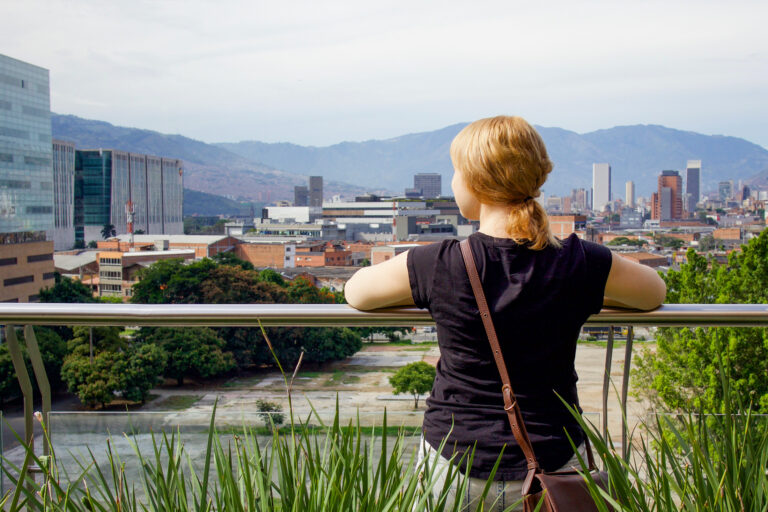
Medellín fills a narrow valley running north to south, with the Medellín River and the metro’s Line A down the middle. Downtown sits in the center of the valley, El Poblado climbs the eastern slopes south of it, Laureles spreads flat across the western side, and Envigado, Itagüí and Sabaneta are separate municipalities that continue the city to the south without any visible border. The metro is the spine: Poblado and Aguacatala stations for El Poblado, Estadio and Floresta on Line B for Laureles, Ayurá and Envigado for Envigado, and Sabaneta for Sabaneta. Anything within a ten-minute walk of one of those stations is well placed. Two airports serve the city: José María Córdova, the international one, is over the mountains to the east, 35 to 60 minutes from the city depending on traffic and route, and Olaya Herrera, for regional flights, sits inside the city in Guayabal, south of Laureles and next to Belén.
El Poblado
El Poblado is where most visitors stay, and for good reasons: the largest concentration of hotels, restaurants and cafés in the city, the two metro stations, the malls, and a feeling of safety by day and evening that comes from crowds, cameras and police. It is also hilly, which surprises people; a hotel “ten minutes from Lleras” can be ten minutes uphill. Inside it, the sectors matter. Provenza is the restaurant-and-café strip, walkable and busy until late; Manila is quieter, low-rise and residential, a few blocks from everything; Astorga sits between the two. Parque Lleras itself is the nightlife square, loud until the small hours, and it is where the city’s problems with drink-spiking and the sex trade concentrate: in April 2024 the mayor’s office drew a polygon around Parque Lleras, Provenza, Parque El Poblado and the La Presidenta linear park, banned the offer and demand of sex work inside it for six months and piloted a 1 a.m. closing time for bars. The measure tells you what the square was turning into and why we send guests two or three streets away from it. Best for a first visit, for nightlife within walking distance, and for anyone who wants to walk to dinner rather than order a car.
Laureles and Estadio
Laureles is the flat, green, curving neighborhood on the west side of the river, laid out in 1943 by the painter and architect Pedro Nel Gómez on the garden-city idea, not the Spanish grid, which is why the streets bend and you get lost pleasantly. Time Out named it the coolest neighborhood in the world in October 2023, and the effect has been more cafés, more visitors and higher rents, not a change of character: it is still a place where people live, walk their dogs and eat breakfast at the bakery. The bars and restaurants of La 70 (Carrera 70) run along its western edge toward the Atanasio Girardot stadium, and the Estadio and Floresta metro stations are a few stops from downtown. Stay here if you want to walk everywhere on flat ground, if you prefer neighbors to tourists, or if you have been to Medellín before. Two caveats: the airport ride is a little longer than from El Poblado, and Olaya Herrera, the regional airport, is close enough to hear by day.
Envigado
Envigado is its own municipality, a few minutes south of El Poblado by metro from the Ayurá and Envigado stations, and it feels like the town it still is: a central park with the church, streets of family houses, a restaurant row known as the Calle de la Buena Mesa, and Casa Museo Otraparte, the house of the philosopher Fernando González, now a museum with a garden café. It is calm at night and popular with families and with visitors who plan to spend their days on tours and want to come back to quiet. The trade-off is fewer hotels and a car or metro ride to the El Poblado scene, which is what some guests want.
Sabaneta
Farther south, Sabaneta is the smallest municipality in Colombia, fifteen square kilometers around a park where the whole town seems to eat buñuelos on Sunday. It has its own metro station near the end of Line A, apartment buildings that rent well by the week, and a pace that has nothing to do with Parque Lleras. Stay here for long stays, for families, or if a friend or relative lives nearby; it is a real place, not a visitor district, and that is both its charm and its limit.
Which of these neighborhoods is the right one to go out in, rather than to sleep in, is a different question, and we answer it in our Medellín nightlife guide, along with the drink-spiking risk the United States Embassy has been warning about since 2023.
Downtown, Belén, Ciudad del Río, and where we would not stay
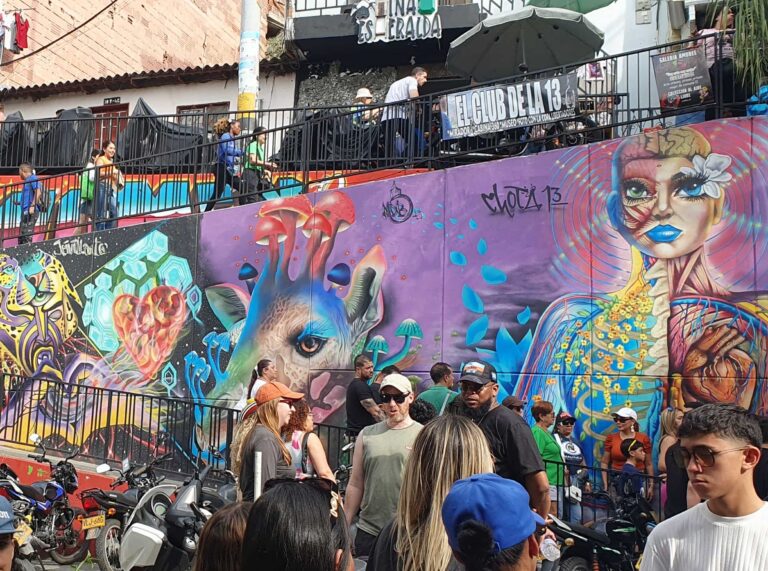
Downtown, La Candelaria, has the cheapest rooms in the city and the best daytime square kilometer in it: Plaza Botero, the Museo de Antioquia, the churches and the markets. It empties and darkens after office hours, and we do not recommend sleeping there; visit it in the morning, ideally with our shared walking tour, which leaves daily at 10 a.m., and go back to your neighborhood before dark. Belén, west of the river below Laureles, is a large residential district with almost no tourist infrastructure. Ciudad del Río, between downtown and El Poblado on the river, is the newer quarter around the Museo de Arte Moderno and the Mercado del Río food hall, with apartment towers and a station, Industriales, close by; it works for a design-minded stay if you are happy to take a car to dinner. Comuna 13 is a place to visit with a guide, not a place to stay, and the hillside neighborhoods that the Metrocable lines fly over are not on any visitor’s list for accommodation.
Hotel or apartment
Both work, with two things to know. Short-term rentals in Colombia must be registered in the National Tourism Registry, the RNT, and the number must appear on the listing; the city announced controls on unregistered rentals in Laureles, El Poblado and La Candelaria in March 2026, and residential buildings can prohibit tourist rentals outright when their rules say so or when seventy percent of owners vote for it. Ask for the RNT number before you book and prefer buildings that plainly allow rentals, because the alternative is a doorman who was not told you were coming. The second thing favors hotels: foreign visitors who enter as tourists are exempt from the 19 percent IVA on hotel stays under the tax code, for hotels registered in the RNT. Have your passport and proof of your tourist entry at check-in, the stamp or your migration record if you came in through the Biomig gates, and if a quote includes IVA, ask why.
Getting from the airport to each neighborhood
From José María Córdova, every neighborhood on this page is a single car ride: 35 to 60 minutes to El Poblado by the tunnel or the Las Palmas road, a little longer to Laureles and Belén on the far side of the river, and about the same to Envigado and Sabaneta by the Las Palmas road. Our Medellín airport guide has the flat taxi fares, the bus and the reasons ride apps do not work at the doors. Our transfers are operated by Safe Transfers by Cielo.Travel, our transfer company, with a host inside arrivals, a fixed price to any address on this list and your flight tracked, which matters most when you land at night and your building has a doorman to talk to.
Book the drive from the airport
El Poblado, Laureles, Envigado or the center — the drive down from Rionegro is the same length whichever neighborhood you chose, and it is the part of the arrival worth arranging first.
Every route out of the valley is on Medellín transfers; the airport detail is on Safe Transfers.
Noise, hills, rain, altitude and addresses
El Poblado's noise is real near Lleras and on Provenza on weekend nights; two streets away it is quiet, and a room facing the back of the building is worth asking for anywhere in the city. El Poblado's hills matter for anyone with a stroller, a bad knee or a heavy suitcase; Laureles, Envigado and Sabaneta are flat. Rain comes in the afternoon most of the year, which is why we start tours early and why a neighborhood with cafés to duck into is more useful than one with views; our weather guide has the month-by-month numbers. The altitude, about 1,500 meters, keeps the city between roughly 16 and 26 degrees all year, so no hotel needs heating and only the ones in the sun need air conditioning. And addresses: a Colombian address is a street, a cross street and a distance from the corner, which drivers read easily, but send the hotel name as well.
What we do
Every private tour we run in Medellín, from the city tour to Guatapé and Comuna 13, picks you up at your hotel or apartment in any of the neighborhoods on this page and brings you back, with a guide who lives here from start to finish. If you are deciding between two neighborhoods and want a local's opinion on a specific hotel or block, write to us; it costs nothing and we answer the same day.
Questions travelers ask
Is El Poblado or Laureles better for tourists?
El Poblado for a first visit, nightlife and the most hotels within walking distance of restaurants; Laureles for flat streets, a neighborhood locals live in and a calmer version of the city. Both are safe with the usual rules, both are on the metro, and both are a short car ride from each other.
Is it safe to stay in downtown Medellín?
We do not recommend it. Downtown is excellent by day and empty after dark, and a hotel there means walking back through it at night. Stay in El Poblado, Laureles or Envigado and visit downtown in the morning.
Which neighborhood is best for families?
Laureles for a walkable base with parks and flat streets, Envigado or Sabaneta for quiet nights and a town feel, and Manila in El Poblado if you want to be close to the restaurants without the noise of Lleras.
Where should I stay in Medellín for nightlife?
El Poblado, on or near Provenza and Parque Lleras, with the drink and dating-app rules on our safety page taken seriously; La 70 in Laureles is the local, lower-key alternative.
How far is El Poblado from the airport?
Thirty-five to sixty minutes by car from José María Córdova depending on traffic and whether you take the tunnel or Las Palmas; the flat taxi fare and the transfer options are in our airport guide.
Do I need a car in Medellín?
No. The metro, ride apps by day and night, and pre-booked cars for the airport cover everything, and our tours include pickup. Parking is scarce and the hills are steep; nobody we know rents a car here.
Plan it with us
Tell us your dates and the kind of trip, and we will tell you which neighborhood and which block; write to us on WhatsApp. Then start planning the days with our guide to things to do in Medellín and our Medellín tours page.