
+ 1,200 verified five-star reviews for Cielo.Travel on Google and TripAdvisor.
Duration
Tour Type
Pricing
Languages
Overview
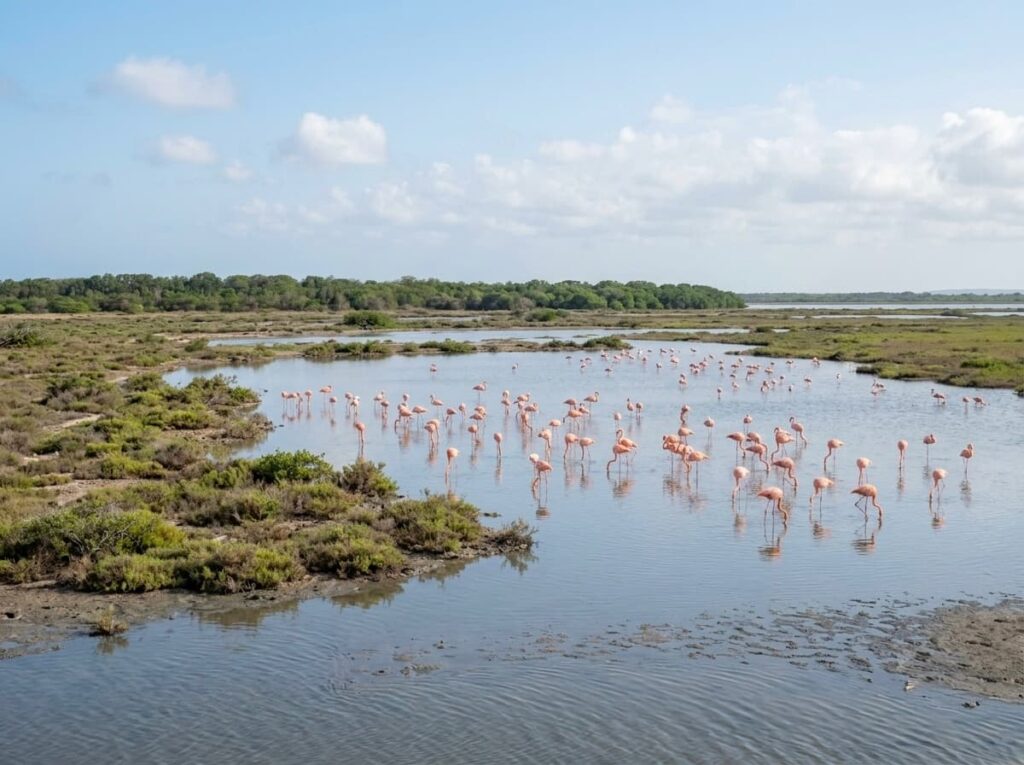
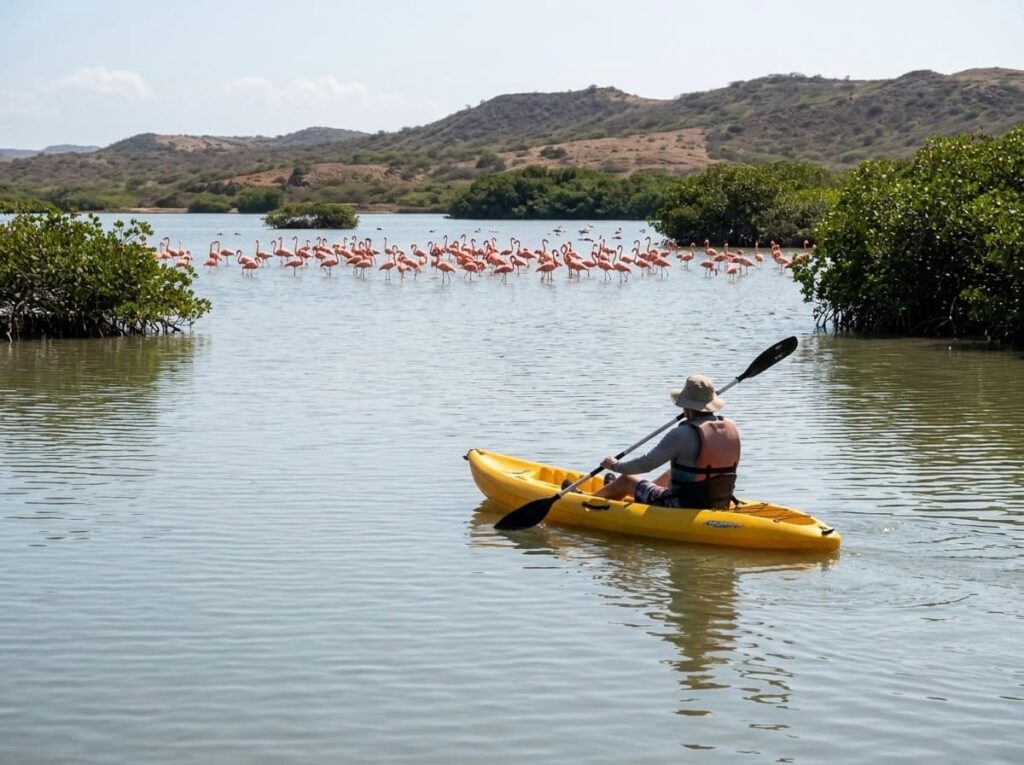
The Sanctuary of Flamingos at Playa de Camarones is a salty coastal lagoon 15 minutes from Riohacha where Caribbean flamingos come to feed on brine shrimp — the crustacean responsible for their color. Flamingos are not born pink; they become pink through what they eat, and the Artemia Salina of this lagoon is why the colony returns here year after year. Understanding that before you get on the water changes how you watch them: the curved neck, the sweeping bill, the synchronized feeding movements of the group are not abstract behaviors but the visible expression of a specific ecological relationship between this bird and this place. The half-day kayak circuit covers the lagoon’s four main swamps at the pace and proximity that a kayak allows — quiet enough not to scatter the birds, low enough to observe them at water level — while your guide identifies the wider birdlife that the open, shallow environment makes unusually visible: herons, cormorants, pelicans, kingfishers, and plovers working different zones of the same lagoon system.
The circuit takes two and a half hours, followed by lunch at Playa de Camarones — a small Wayuu fishing village whose relationship with the lagoon is practical and long-standing, and whose food reflects it: Caribbean seafood and fish prepared in the coastal tradition, not on a tourist menu. The total tour runs six hours including the drives from and back to Riohacha. Bring a light jacket for the wind on the water, sunscreen, a hat, and sunglasses — the lagoon is open and flat with no shade, and the light off the water is intense. The tour runs as a shared experience; contact us before booking if you prefer a private departure.
Itinerary
Highlights
Reach the Sanctuary of Flamingos at Playa de Camarones — a beach 15 minutes from Riohacha where Caribbean flamingos come to feed on brine shrimp (Artemia Salina), the crustacean that gives them their characteristic pink color.
Kayak around the salty lagoon and watch the flamingos at close range as they feed — your guide explains the ecological importance of the sanctuary to the local community and to Colombia's Caribbean wildlife.
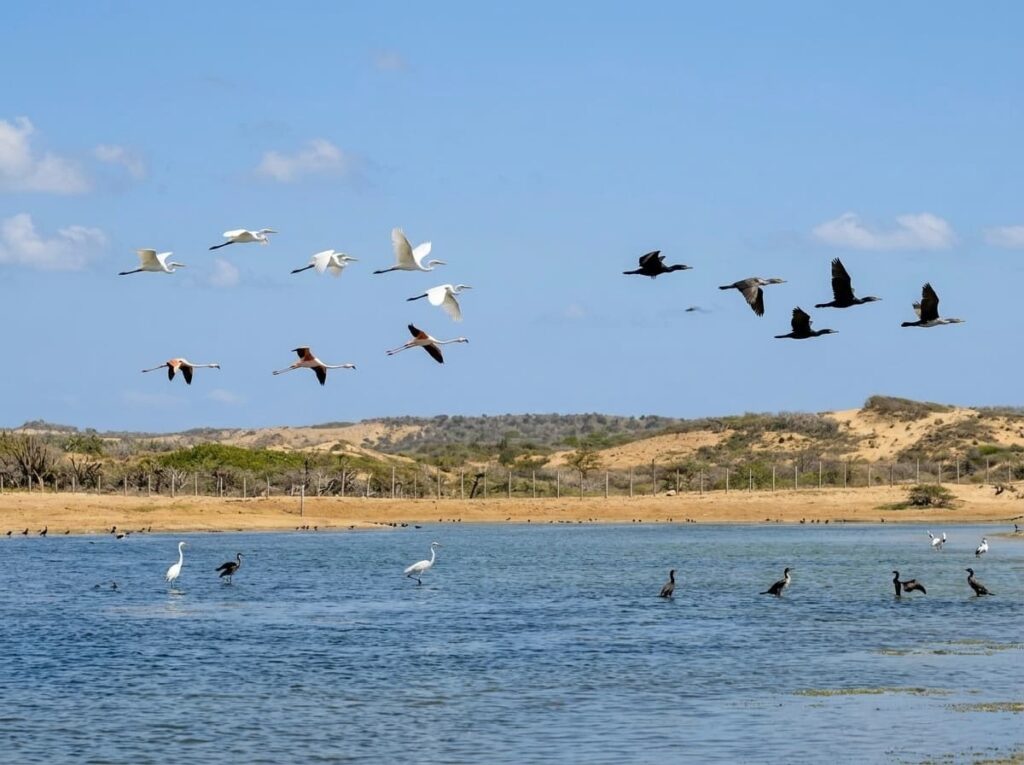
Observe the full diversity of the sanctuary's four main swamps: hummingbirds, seagulls, white herons, cormorants, plovers, kingfishers, needle ducks, shovelers, and pelicans share the lagoon with the Caribbean flamingo.
Experience an authentic natural encounter in a place still largely off the standard tourist circuit — the Sanctuary of Flamingos is one of the few places in Colombia where you can see these birds in their natural feeding habitat.
What's Included
Guide (shared tour — local guides may have limited English in this rural region).
Hotel pickup and drop-off.
Entry to the Sanctuary of Flamingos.
Boat transportation on the lagoon.
All-risk insurance.
What's Excluded
Breakfast and lunch (lunch available for purchase at Playa de Camarones).
Extra purchases.
Know before you book
This tour does not offer vegan options for the lunch stop at Playa de Camarones. The traditional food available there is based on local Caribbean seafood and meat dishes. If you have dietary restrictions beyond this, bring your own food.
This tour operates in a rural region of La Guajira. Local guides are knowledgeable and experienced, but may not be completely bilingual in English. The core experience — kayaking the lagoon and seeing the flamingos — does not require extensive verbal commentary to be worthwhile.
The flamingos come to the lagoon to feed on brine shrimp and can be seen throughout the year, though numbers vary by season. Your guide will know the current conditions on the day.
The climate at Playa de Camarones is dry and windy year-round with temperatures ranging from around 4°C (39°F) in winter to 25°C (77°F) in summer. Bring a light jacket for the water, sunscreen, and a hat.
This is a shared tour. You will be with other travelers in the group. If you prefer a private experience, contact us before booking and we can advise on private availability.
More Info
Cancellation Window
12 hours before starting date
Difficulty
Easy
Cancellation policy
Free cancellation up to 12 hours before departure. Cancellations made within 12 hours of the tour start time are non-refundable.
Guest Reviews
Why Book With Cielo
1,200 five-star reviews from real travelers — read them before you book.
Best Price Guarantee — find this tour cheaper elsewhere and we'll match it.
Private transportation door-to-door — no shared shuttles, no waiting around for strangers.
Booking directly with us means your money stays with a Colombian-owned company, not a platform commission.
Our team coordinates everything — pickup timing, pilot briefing, and return logistics — so you focus only on the flight.
Other Info
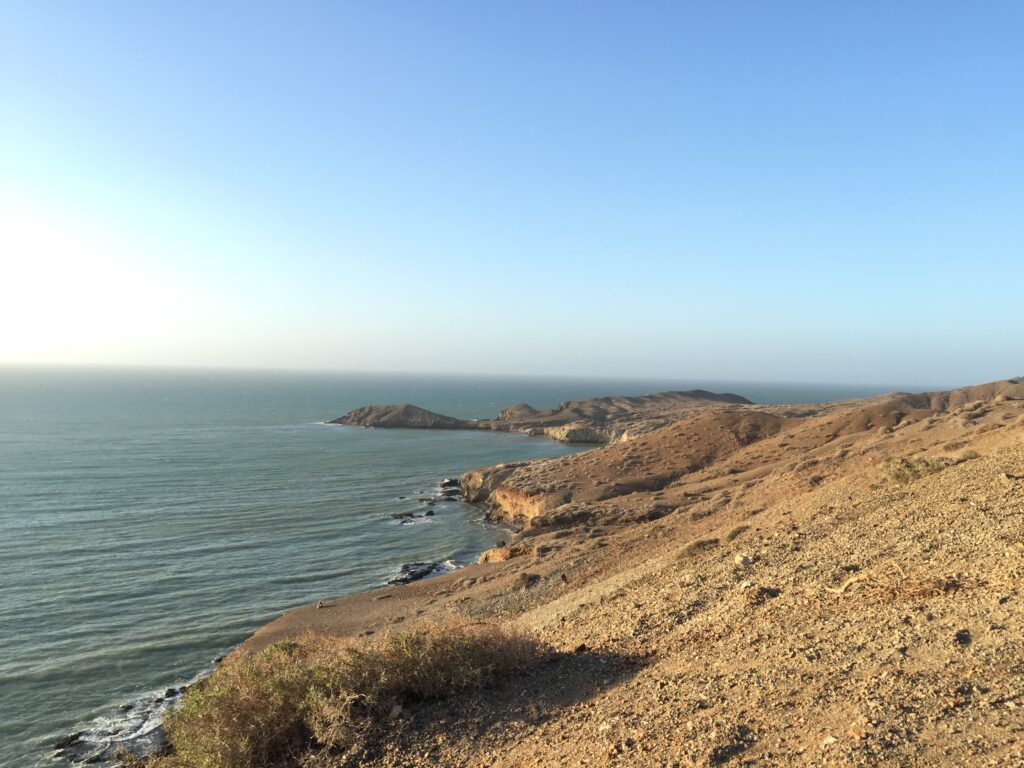
The flamingo Sanctuary Tour in La Guajira takes you to one of the least-visited and most visually striking wildlife destinations on Colombia’s Caribbean coast. Most travelers who come to La Guajira focus on the desert landscape of the peninsula — the red dunes, the indigenous Wayuu communities, the remote beaches at Cabo de la Vela and Punta Gallinas. The Sanctuary of Flamingos at Playa de Camarones is different: a salty coastal lagoon 15 minutes from Riohacha where Caribbean flamingos come to feed, and where a half-day kayak circuit puts you close enough to watch them do it. It is a quieter, more intimate experience than the desert tour, and it reveals a side of La Guajira that the peninsula’s dramatic landscape tends to overshadow.
Why the Flamingos Come Here: The Science Behind the Color
The flamingos come to Playa de Camarones for a specific reason, and understanding that reason changes how you watch them. The lagoon is home to Artemia Salina — brine shrimp, a small pink crustacean that is one of the Caribbean flamingo’s primary food sources and, incidentally, the compound responsible for the birds’ color. Flamingos are not born pink. They become pink through what they eat — the carotenoid pigments in the brine shrimp accumulate in the birds’ feathers and skin over time, and the intensity of the color reflects the richness of their diet. A flamingo feeding in this lagoon is not just a beautiful bird doing a photogenic thing. It is an animal engaged in the specific behavior that makes it look the way it does, in the specific place that provides what it needs to do that.
Your guide explains this on arrival, and the explanation transforms the observation. The curved neck, the downward-facing bill sweeping through the shallow water, the particular posture of a feeding flamingo — these are not abstract behaviors. They are the visible expression of a relationship between this bird and this lagoon that has been going on for as long as the lagoon has existed. The brine shrimp are here because the salinity of the water is right. The flamingos are here because the brine shrimp are here. The lagoon is here because the geography of the La Guajira coast creates the conditions for a salty, shallow, protected body of water at exactly this point on the Caribbean shore. The ecology is a chain, and watching the flamingos is watching one link of it.
The Kayak Circuit: Four Swamps, Multiple Species, One Lagoon System
The kayak circuit covers the lagoon’s four main swamps in a route that your guide navigates while maintaining the respectful distances from wildlife that the sanctuary’s management protocols require. The circuit takes approximately two and a half hours, and the pace is unhurried — this is not a race across the water but a slow movement through a shallow, open ecosystem that reveals more the more patiently you look at it.
The Flamingos: Pink Against the Lagoon
The Caribbean flamingo — Phoenicopterus ruber — is the largest of the six flamingo species and the only one native to the Americas. It is also one of the most visually dramatic: a bird that stands over a meter tall, with plumage that ranges from pale pink in younger individuals to deep coral in fully mature adults that have been feeding in productive lagoons for years. At Camarones, the colony that returns to feed includes individuals across that color spectrum, and watching them in a group — the synchronized feeding movements, the occasional display behavior, the way the entire colony shifts when something disturbs them — is one of the more striking wildlife encounters available on the Caribbean coast.
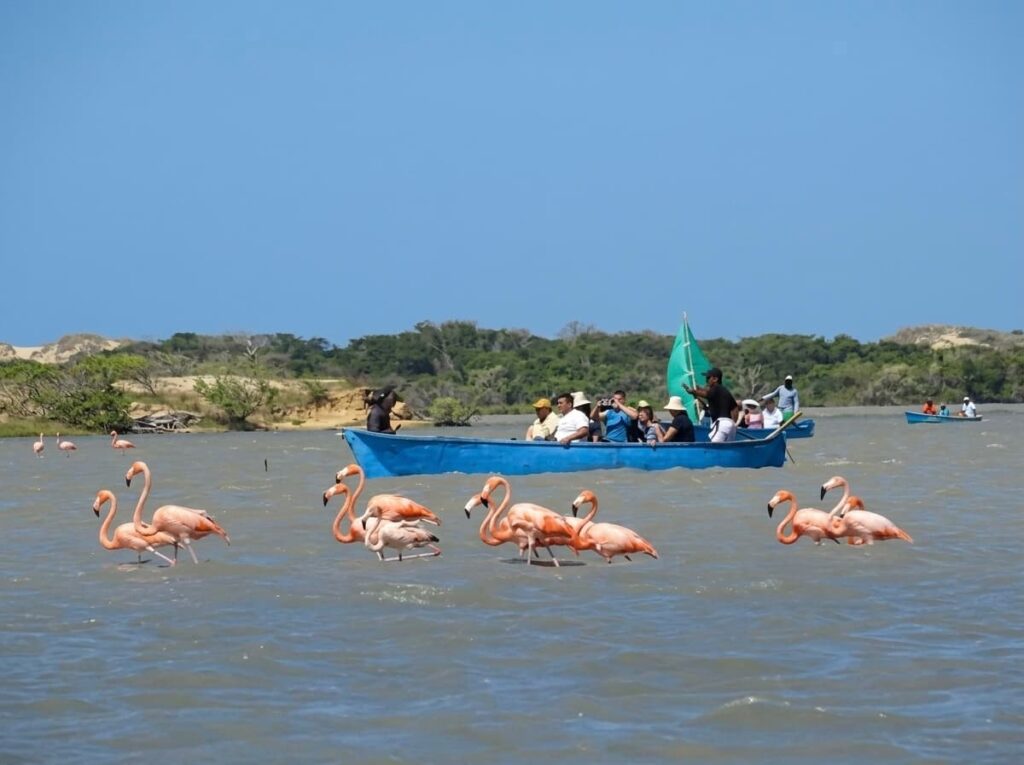
The kayak is the right vessel for this observation. A motorboat would scatter the birds and produce noise that makes the experience less about the flamingos and more about the boat. A kayak is quiet enough that you can approach to viewing distance without disrupting the feeding behavior, and low enough to the water that you are at the birds’ level rather than looking down at them. The distance your guide maintains is not just protocol — it is the distance at which the flamingos continue feeding rather than taking flight, which is the observation worth having.
Beyond the Flamingos: The Lagoon’s Full Birdlife
The sanctuary hosts a much wider range of birds than most visitors expect, and the open, shallow environment of the lagoon makes them more visible than they would be in a denser or deeper habitat. White herons stand in the shallows with the stillness of objects rather than animals, waiting for the fish movement that triggers the strike. Cormorants dry their wings on the exposed mudflats between dives. Pelicans cross the lagoon in formation at low altitude, their wingspans improbable against the flat water. Kingfishers work the lagoon edges. Needle ducks, shovelers, and plovers occupy the margins where the water shallows to centimeters and the mudflat begins.
Your guide identifies species as you move through the circuit, providing the behavioral and ecological context that makes each identification more than a name — why this bird is in this zone of the lagoon, what it is doing, how its behavior relates to the birds around it. For travelers with a specific interest in birding, the Camarones lagoon is a genuinely productive site. For those encountering these species for the first time, the guide’s explanations provide the framework that makes the encounter coherent rather than overwhelming.
Playa de Camarones: The Village Behind the Lagoon
Playa de Camarones itself is a small fishing village on the Caribbean coast, and after the lagoon circuit there is time to eat a traditional lunch at one of the local restaurants before the return to Riohacha. The food is local in the most direct sense — Caribbean seafood and fish prepared in the Wayuu tradition, using ingredients from the same coastal ecosystem you have just spent two and a half hours paddling through. The dishes are not on a standard tourist menu because the village is not on a standard tourist circuit. This is a community whose relationship with the lagoon and its resources is practical and long-standing — the same water that feeds the flamingos feeds the village — and eating there is a direct extension of the ecological and cultural logic of the day.
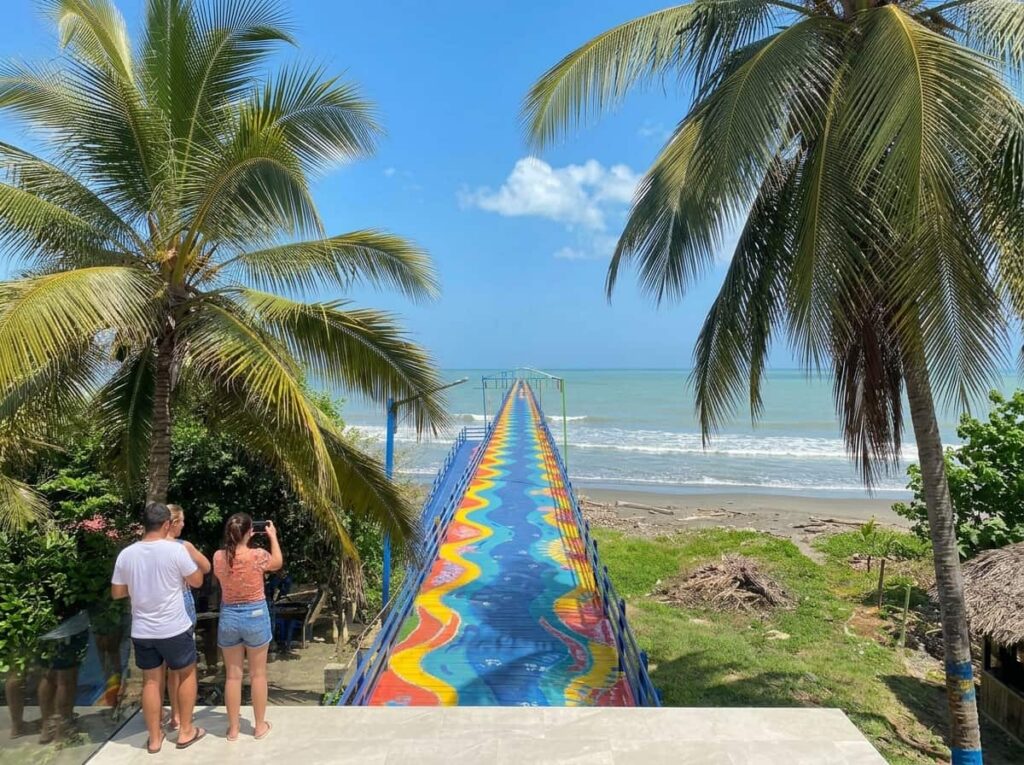
The beach at Camarones is quiet and working rather than developed and resort-facing. Fishing boats are pulled up on the sand. The buildings along the shore are the functional structures of a small coastal settlement rather than the designed facades of a tourism infrastructure. The wind off the Caribbean is constant here, and the light on the water in the early afternoon has the particular quality of a coast that faces almost directly north into open sea. There is time after lunch to walk the beach or sit in the shade before the return drive, and most guests use it without being prompted — the village has a quality of unhurried ordinary life that is itself worth spending time in.
The Wayuu Context: Understanding La Guajira’s Human Geography
La Guajira is one of the most culturally distinct regions in Colombia, shaped by the Wayuu people — the largest indigenous group in the country, with a population of several hundred thousand distributed across the Colombian and Venezuelan sides of the peninsula. The Wayuu have maintained their language, their social structure, their material traditions, and their relationship with the land and sea of La Guajira across five centuries of colonial and post-colonial history with a degree of cultural continuity that is unusual anywhere in South America.
The Camarones lagoon sits within the Wayuu’s traditional territory, and the community that manages the sanctuary and operates the tourism there is Wayuu. The local guides who lead the kayak circuit have grown up in this environment and have a relationship with the lagoon that is both practical and cultural — it is not only a wildlife sanctuary to them but a resource, a landmark, and a part of the landscape they were raised in. That knowledge is part of what you access on the tour, and your guide’s explanation of the flamingos and the lagoon ecosystem draws on it.
Practical Notes: Climate, Equipment, and Logistics
The climate at Playa de Camarones is dry and windy year-round, with temperatures that can range considerably depending on the season and the time of day. A light jacket is useful on the water, where the Caribbean wind comes off the lagoon without obstruction and the evaporative cooling of paddling can make the temperature feel lower than the thermometer suggests. Sunscreen and a hat are essential — the lagoon is open and flat, with no shade, and the combination of direct sun and reflected light off the water is intense. Bring sunglasses and a water bottle.
The tour runs six hours in total, with the pickup and return drives taking approximately 30 minutes each way. The kayak section covers two and a half hours on the lagoon, and the lunch and beach time fills another two and a half hours. The tour is offered as a shared experience, which means you will be with other travelers on the lagoon circuit. If you prefer a private experience, contact us before booking to arrange a private departure. Local guides at this destination are knowledgeable and experienced, but may not be fully bilingual in English — the kayak experience itself communicates what matters, and your guide’s expertise is most fully expressed in the observation and explanation of what you are seeing rather than in formal narration.
Continue Exploring La Guajira
For travelers spending more time in La Guajira Desert Punta Gallinas 3 Days Tour goes deeper into the peninsula, reaching the northernmost point of South America at Punta Gallinas and the red dunes of the Wayuu desert. The two experiences — the lagoon and the desert — together give you the full range of what this remote region offers: the coastal ecosystem and the arid interior, the flamingo sanctuary and the Wayuu communities of the deep peninsula, the Caribbean shore and the dunes that meet it at the continent’s edge.
Ready to see the flamingos? Book the Sanctuary of Flamingos day tour above and your guide will handle the pickup, the lagoon circuit, and the return to Riohacha — all you need is a jacket, sunscreen, and an interest in what lives at the edge of the Caribbean.
Planning more time in La Guajira? Browse our La Guajira tours and experiences.
Before you go: our Colombia guides
Written by the team that runs this tour.
FAQs
You can see flamingos in Colombia at Playa de Camarones — a beach located 15 minutes from Riohacha in the La Guajira department. The flamingos come here specifically because the salty lagoon is home to Artemia Salina, a brine shrimp that is one of their main food sources and the crustacean responsible for their characteristic pink color.
The sanctuary's four main swamps are home to a wide variety of bird species: hummingbirds, seagulls, white herons, cormorants, plovers, kingfishers, needle ducks, shovelers, pelicans, and the Caribbean flamingo. You'll see them while kayaking around the lagoon. After the kayak circuit, you can enjoy a traditional lunch (not included) at the beach.
Playa de Camarones is dry, windy, and partly cloudy year-round. Summers are comfortable and mild; winters are colder and windier. Temperatures range from around 4°C (39°F) to 25°C (77°F). Bring a light jacket for the water sections, sunscreen, and a hat.
This is a shared tour — you will be with other travelers in the group. If you prefer a private experience, contact us before booking and we can advise on private availability and pricing.
Breakfast and lunch are not included in the tour price. After the lagoon kayak, there is time to enjoy a typical traditional lunch at Playa de Camarones at your own cost. Note that the local food at this destination is based on Caribbean seafood and meat — vegan options are not available.
Related Tours
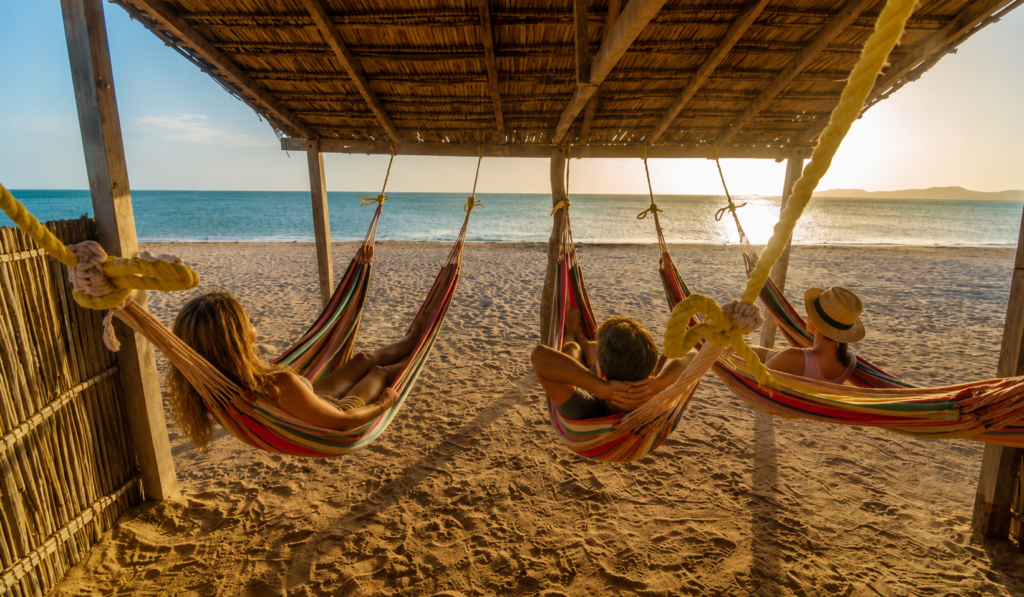

La Guajira Desert & Punta Gallinas 3-Day Tour
La Guajira
Multi-Day, Private
A 3 day tour in La Guajira takes you to one of the most remote and least-visited corners of Colombia…
$$$
3 Days

Cartagena Sunset Private Boat Tour: Caribbean Bay Cruise at Golden Hour
Cartagena
Private
Cartagena Sunset Private Boat Tour: The Walled City From the Water at the Hour It Was Built to Be Seen…
$$$
3 hours

Rosario Islands Tour: Private Boat Day Trip from Cartagena
Cartagena
Private
Rosario Islands Private Boat Tour from Cartagena: Coral Reefs, White Sand, and a Full Day on the Caribbean Your Rosario…
$$$
8 hours