
September 8, 2026
Guatapé is the day trip everyone in Medellín takes, and most people do it badly: they arrive at the rock at noon with the tour buses, climb in the heat, and spend two hours of the afternoon in traffic on the way back. We run this day as a private tour all year, so this is the version we would do ourselves: what the place is, what it costs in 2026, how to get there by bus, car or with us, and the order that turns it into a good day instead of a long one.
The short version
Guatapé is three things, not one: a granite monolith you climb, a reservoir you cross by boat, and a small town whose houses are painted with folk-art panels. It sits 81 kilometers east of Medellín, about an hour and fifty minutes by road when the traffic behaves, at 1,925 meters above sea level. The rock costs 35,000 pesos to climb and takes fifteen to thirty minutes up its 740 steps. The bus from Terminal del Norte costs 24,000 pesos each way. Leave Medellín by seven, climb before ten, eat trout by the water, take the boat after lunch and you are back in the city by early evening. That is the whole plan; the rest of this guide is the detail that makes it work.
What Guatapé is
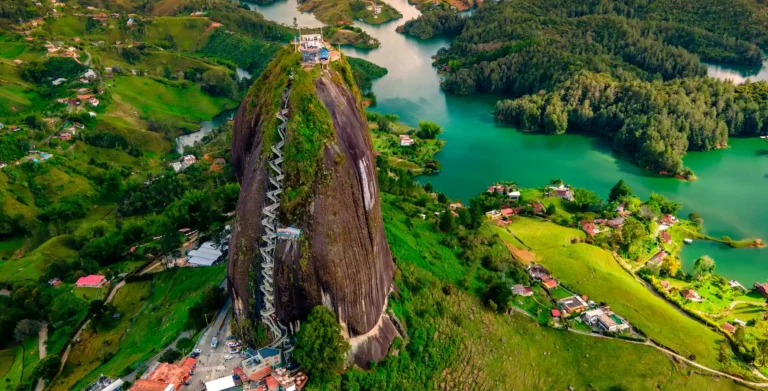
The names confuse first-time visitors, so start there. The rock is called La Piedra del Peñol by some and El Peñón de Guatapé by others, because it stands on the line between two municipalities that have argued about it for decades. Years ago residents of Guatapé began painting the town’s name on its face; El Peñol objected, the work stopped, and the half-finished letters, a G and the first stroke of a U, are still there today. Locals call them “the GI”. Both towns are real places: El Peñol is the newer town on the road in, rebuilt after the original was flooded, and Guatapé is the colorful one on the water where you spend the afternoon.
The water is not a lake. It is the Peñol-Guatapé reservoir, built by Medellín’s public utility EPM in the 1970s to generate electricity, and it drowned the original town of El Peñol to do it. A cross rises from the water where the old church stood, and the boats go out to it. The green peninsulas you see from the top of the rock are the ridges of the flooded valley.
The rock: 740 steps, 35,000 pesos, and when to climb
La Piedra is a single block of granodiorite from the Antioquia batholith, roughly 220 meters tall and about 70 million years old. Nobody climbed it until July 16, 1954, when three men from Guatapé, Luis Villegas, Ramón Díaz and Pedro Nel Ramírez, went up the one crack in its face with wooden boards wedged into the rock. The staircase built into that crack is what you climb today: 740 steps by the operator’s count, 702 by the tourism bureau’s, with handrails the whole way and landings where you can stop. Fit adults do it in fifteen minutes; most people take twenty-five with photos, and a child of eight can do it with breaks. At the top there is a viewing tower, drinks, fruit and bathrooms, and a view of the reservoir that is close to 360 degrees.
The ticket is 35,000 pesos per person for everyone, a single price set on January 1, 2026 by the private company that runs the site. Their own website still shows the 2023 price, so do not be surprised by the difference at the gate, and expect it to move again. The site opens at eight in the morning and closes late afternoon; hours have shifted more than once, so treat four o’clock as the last sensible time to start the climb. Parking at the base is paid by the hour. Bring cash: cards are not the norm on this road.
The single most important decision of the day is when you climb. Before ten the stairs are shaded, the air is cool, and on a good morning you watch the last mist lift off the water from the top. From eleven onward the tour buses from Medellín arrive together, the staircase becomes a queue, and the sun is on the rock. Everything else in this guide is arranged around getting you up those stairs early.
The town: zócalos, the Calle del Recuerdo and the malecón
Guatapé’s houses are covered in zócalos, raised panels of painted cement that run along the lower third of every facade. They began in the early twentieth century as a practical way to protect walls from damp; the paintings came later, and now every house tells you something about the family inside: fishing boats, coffee harvests, farm animals, the family’s trade. The densest concentration is on the small square of the zócalos on Carrera 29, and the Calle del Recuerdo nearby recreates the streets of the old, drowned El Peñol using panels that residents salvaged from the houses before the water came.
The town is small. An hour on foot covers the plaza, the church, the zócalo streets and the 900-meter malecón along the water, and that hour is better with someone who can read the panels for you. Lunch is trout, the dish of the reservoir, fried, grilled or in garlic sauce, and the restaurants along the water are where to eat it. If you want something sweet afterwards, the town has learned to make cinnamon rolls and pastries for the Medellín crowd, which is not a complaint.
The reservoir: the boat and the drowned town
Boats leave from the malecón and the standard trip is about an hour: out past the islands and the lakeside houses to the cross that marks the old El Peñol, with the rock in view from the water the whole way. Shared boats with a guide were advertised at 60,000 pesos per person in 2026; private boats for up to six people run from about 280,000 pesos an hour. Prices vary by boat and by how busy the day is, so agree the fare before you step on board. People skip the boat when they are short of time, and regret it: the reservoir is what makes the top of the rock worth climbing, and you understand it better from the water.
Getting there from Medellín
By bus. Sotrasanvicente runs the route from Terminal del Norte, ticket window 14, with 31 departures a day between six in the morning and half past seven at night, 24,000 pesos each way. The ride is about two hours. Most drivers will drop you at the turnoff for the rock if you ask for La Piedra; from the road it is a short, steep walk or a moto-taxi to the ticket office. Climb, then take a moto-taxi or the next bus the few minutes on to Guatapé town. The last bus back leaves Guatapé at half past seven, but the afternoon buses fill on weekends, so buy your return ticket when you arrive rather than at five o’clock.
By car. Take the Medellín-Bogotá highway and turn off at Marinilla for El Peñol and Guatapé: one toll, about an hour and fifty minutes without traffic. The Túnel de Oriente is the faster way out of the city but adds a second toll. The return on a Sunday evening is where the drive becomes three hours; leave Guatapé by four if you are driving yourself.
With us. Our Guatapé day is ten hours door to door from your Medellín hotel. The private version is the day described in this guide: a bilingual guide who explains the valley and the flood on the drive out, the climb timed for the morning, Guatapé’s streets with someone who reads the zócalos, lunch by the water, the boat to the cross, and the drive back while you sleep. The shared version keeps it simple: pickup, transport and the rock ticket. Either way you never look at a bus timetable.
Getting here is the other half of the day, and on this one the hour you leave decides everything. Medellín transfers has this route and every other road out of the valley on one page, with the booking widget on it — including the run straight here from the airport, which is worth doing if you are staying lakeside.
Book the drive to Guatapé
Leaving early is the whole difference on this one. A private car goes when you want rather than when the bus fills, and it can run straight from the airport if you are staying lakeside.
Road detail on Safe Transfers: Medellín to Guatapé and the airport run.
The day, in order
Leave Medellín between seven and half past. Be at the base of the rock by nine, climb, and be back down by ten with the crowd just arriving behind you. Drive or ride the few minutes into Guatapé and walk the zócalo streets while the light is still soft. Lunch at half past twelve, trout by the water. Boat at two, an hour on the reservoir. Coffee and something sweet at three, and on the road by four, which puts you in your hotel between six and seven with the whole thing done in daylight.
If you only have half a day, do the rock and the town and skip the boat, and go on a weekday. If you have a night to spare, stay in Guatapé, watch the tour buses leave at five, and have the town to yourself until the next wave arrives at eleven the following morning.
What the day costs
Doing it yourself by bus: 48,000 pesos in bus fares, 35,000 for the rock, 60,000 for a shared boat with a guide, plus lunch and the moto-taxis, so about 150,000 pesos before you eat. Add the two hours each way on a bus and the queue on the stairs if you arrive with everyone else. A private tour costs more and buys back the timing, the guide and the transport; whether that is worth it depends on how many of you there are and how much your day in Colombia is worth to you. For a couple or a family it usually is; for a solo traveler on a long trip the bus is a perfectly good day.
When to go
Guatapé is worth it in any month. The region has two wetter stretches, roughly April to May and October to November, and afternoon showers are common the rest of the year too, which is one more reason to climb in the morning. Weekends bring Medellín to Guatapé, and Colombia's long weekends, many public holidays are moved to a Monday, bring the whole department. A Tuesday to Thursday morning is the calmest version of the place; a Saturday at noon is the version people complain about online.
Six mistakes we see every week
Arriving at the rock at noon. Assuming the rock is in Guatapé town when it is a few minutes' drive before it. Underestimating 740 steps at 1,925 meters after a night out in El Poblado. Skipping the boat to save an hour. Arriving without cash. And leaving Guatapé at five on a Sunday with everyone else, which turns an hour and fifty minutes into three hours.
The other two days out of Medellín have their own guides: our Jardín guide and our Santa Fe de Antioquia guide.
Questions travelers ask
How many steps does the rock have?
740 by the operator's count, 702 by the Medellín tourism bureau's. Either way, plan on fifteen to thirty minutes up with handrails and landings, and about half that down.
How much does it cost to climb La Piedra del Peñol in 2026?
35,000 Colombian pesos per person, one price for everyone, since January 1, 2026. Parking is extra and paid by the hour.
Can I do Guatapé in half a day from Medellín?
Only just. Two hours out, the climb, an hour in town and two hours back is six hours without the boat. It works as a long morning if you leave at seven; it does not work as an afternoon.
Is the bus or a tour better?
The bus is cheap and easy to find and gives you a full day for under 150,000 pesos. A tour gives you the timing, a guide who explains what you are looking at, and a car back to your hotel door. Groups and families tend to prefer the tour; solo travelers with time tend to take the bus.
Is it Guatapé or El Peñol?
Both. The rock stands on the boundary and each town claims it. The rock is closer to El Peñol; the town you will photograph is Guatapé.
Is Guatapé worth it?
Yes, if you climb early. The view from the top is one of the best in Colombia and the town is one of the prettiest. Done at midday on a Saturday, it is a queue with a view.
Plan it with us
Our Guatapé day runs from Medellín year-round, private or shared, in English or Spanish, with hotel pickup. Write to us on WhatsApp with your dates, or see everything we run in the city on our Medellín tours page.
Spending more days in the city? Our guide to things to do in Medellín puts Comuna 13, the Metrocable, downtown and the day trips in the order that works.