
September 8, 2026
Medellín is the city travelers arrive in with the longest list and leave having done the same four things as everyone else, usually in the wrong order and at the wrong hour. We run twelve tours here, from Comuna 13 to Guatapé, which means we spend most of the week watching what works. This is that list: what is worth your time in 2026, what it costs at the gate, when to go, and the handful of famous things you can skip without regret.
What the city is, how the valley shapes it and how many days to give it are in our Medellín city guide.
The short version
With one day, do Comuna 13 in the morning, downtown and the Museo de Antioquia after lunch, and the sunset from Pueblito Paisa. With two, add the Metrocable to Parque Arví and an evening in Laureles. With three, spend one of them in Guatapé. Beyond three: Jardín or Santa Fe de Antioquia, a paragliding flight over the valley, a match at the Atanasio Girardot, the flower farms of Santa Elena. The city sits at 1,479 meters with an average of 24 degrees all year, so everything on this list works in any month. It is the hour, not the season, that makes or breaks each one.
Comuna 13: the escalators, the murals and the right hour
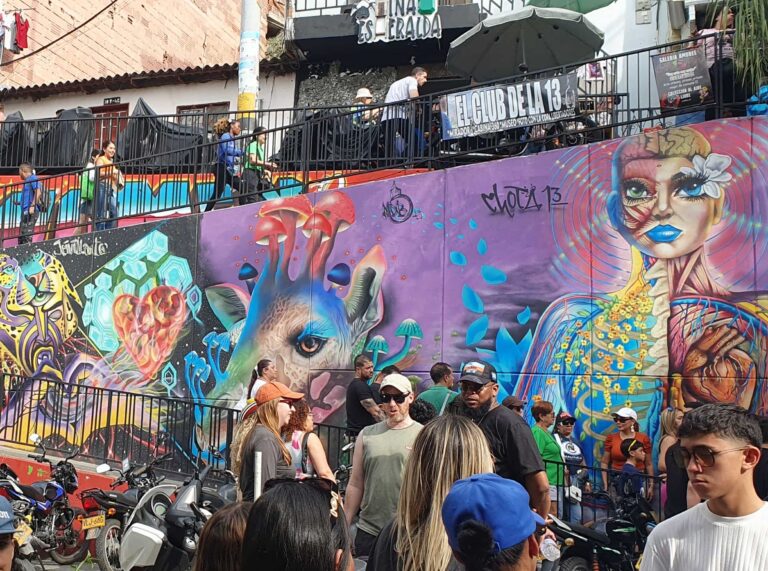
The most visited place in the city is a hillside neighborhood that, twenty years ago, nobody visited at all. Comuna 13 had the worst of Medellín’s violence, and its transformation is the story every guide tells you while standing next to a mural of it. The physical center of the visit is a set of outdoor escalators: 384 meters in six sections, opened in December 2011 to replace a climb the city compared to 28 floors of stairs. Around them, the walls of Las Independencias are painted, repainted and painted again by artists who grew up on those streets, and the graffiti tour that walks you through them is the best two hours you can spend in Medellín.
Three things decide whether it is a good visit. Go in the morning on a weekday: almost two million people came through in 2024, more than ten thousand a day, and by early afternoon on a Saturday the walkway is a slow queue with reggaeton. Go with someone from there: the murals are a language, and without a translator you are photographing wallpaper. And spend money on the way up and down, on the mango popsicles, the coffee and the prints, because that economy is the point of the whole exercise. The metro gets you there on Line B to San Javier, and from the station the Metrocable line J climbs over the comuna if you want the view before the walk. Our private Comuna 13 graffiti tour is five hours with hotel pickup, a guide who lives in the district and no group to keep up with.
We wrote a full guide to visiting Comuna 13: the history behind the murals, the escalators, the metro route and the hour that makes the visit.
Ride the Metrocable, and keep going to Arví
Medellín’s cable cars are public transport, not a ride, and that is exactly why you should take them. Line K, from Acevedo up to Santo Domingo, opened on August 7, 2004 as the first aerial cable in the world to run as urban mass transit, and it changed how the city thought about its hillsides. One metro fare covers the trip: in 2026 a ride costs 4,400 pesos with the bearer card sold at any station, or 3,820 with a personalized Cívica card, and the change from train to cable is free. Ride it late in the morning, stand on the uphill side of the cabin, and watch the city drop away beneath you.
At Santo Domingo you can change to line L, the tourist cable that crosses the ridge to Parque Arví: 1,761 hectares of forest between 2,400 and 2,600 meters, with trails, a campesino market and air several degrees cooler than the valley. Line L is priced separately, about 26,700 pesos each way for foreign visitors in 2026 and 11,900 for Colombians with a Cívica card, and it runs Wednesday to Monday from nine to six, opening at half past eight on Sundays. It stops on Tuesdays for maintenance, the same day the park closes, so check the day before you go. Entry to the park is free, and the park’s own guided walks leave every half hour from ten, listed at 30,000 pesos for foreign visitors. Bring a jacket. If you would rather have the forest explained than found, our Arví Park tour does the cable, the trails and the streams in six hours, private or shared.
Downtown: Plaza Botero, the Museo de Antioquia and the streets around them
El Centro is loud, crowded and the most interesting square kilometer in the city, and it is the part of Medellín most visitors see through a car window. Do not. Start at Plaza Botero, where the 23 bronze sculptures Fernando Botero gave his hometown in 2002 stand in the open for anyone to touch, in front of the black and white Palacio de la Cultura. Behind them is the Museo de Antioquia, founded in 1881 and the second museum ever opened in Colombia, with the largest collection of Botero’s work anywhere and rooms of Débora Arango and Pedro Nel Gómez that are, for many people, the surprise of the visit. In 2026 admission is 46,000 pesos for foreign visitors and 18,000 for Colombians; it is open until half past five Monday to Saturday and until half past four on Sundays.
From the plaza, walk the pedestrian stretch of Carabobo, look up at the old railway station and the Parque de las Luces, and eat something from a cart. Then leave before dark: downtown is a daytime place, which is not a warning so much as a description of when it is good. If you want the streets with context, our downtown walking tour leaves every day at ten with a bilingual guide, and the private city tour puts San Antonio Park, Plaza Botero, the Palacio and Comuna 13 into one day with a car and a guide.
Casa de la Memoria: the museum that explains the rest
Every other stop on this list makes more sense after this one. The Museo Casa de la Memoria, in the Parque Bicentenario just east of downtown, was built by the city to hold the memory of the armed conflict and of Medellín’s own worst decades, told by the people who lived through them rather than the ones who caused them. It is free, open Tuesday to Friday from nine to six and weekends and holidays from ten to four, and most of it is in Spanish, with enough images and audio that the language matters less than you would expect. Give it ninety minutes, ideally before Comuna 13 rather than after. Our historical tour pairs it with the Placita de Flórez market and the old center in four hours.
The Escobar question
You will be offered a Pablo Escobar tour within an hour of arriving, and you should know what you are buying. The city would prefer you did not, and the people who lost family to those years have every right to that preference. The demand exists anyway, and the worst version, the one with the souvenir T-shirts and a relative charging admission to a house, is the one to avoid. If you go, go with a guide who grew up here, who takes you to the prison he built for himself, the rooftop where it ended, the cemetery and the neighborhood he paid for, and lets the gratitude and the grief stand next to each other without telling you which one to feel. That is how our five-hour version is run, and we would rather you did it that way, after Casa de la Memoria, than not at all.
A half day in the north: the Botanical Garden, Explora and the Planetarium
The Jardín Botánico Joaquín Antonio Uribe is the calmest place inside the city and its best free afternoon. Entry costs nothing; it opens Tuesday to Friday from half past nine to four and weekends and holidays from nine to four, and it closes on Mondays unless the Monday is a holiday. The Orquideorama, a wooden honeycomb canopy over the orchid collection, is the photograph everyone takes; nobody expects the iguanas in the trees. Parque Explora, across the street, is the science museum and aquarium, worth a rainy afternoon or any afternoon with children: foreign visitors pay 67,950 pesos in 2026, the planetarium next door is 46,400, and Explora closes on Mondays. Universidad station on Line A leaves you at the gate of all three, and our Botanical Garden and Arví tour joins the garden to the cable in a single day.
Pueblito Paisa: go for the view
On top of Cerro Nutibara, 80 meters above the city, there is a replica of a traditional Antioquian village built in 1978, with a plaza, a church and a row of souvenir shops. The village is fine. The view is the reason to go: the whole Aburrá valley in one look, the towers of El Poblado to the south, the northern hillsides with the cable lines drawn across them. It is free, open every day from half past five in the morning to ten at night, and the ten minutes before sunset are the ten minutes to be there. Take a taxi up; the walk is pleasant in daylight and unnecessary at dusk.
El Poblado, Provenza and Laureles: where to sleep and where to eat
El Poblado is where most first-time visitors stay, and around Provenza it has a density of good restaurants, cocktail bars and specialty coffee that few neighborhoods in Colombia can match. It is also, around Parque Lleras after ten at night, the loudest and most transactional corner of the city, and families and light sleepers should pick their street with that in mind. Laureles, across the river, is flatter, greener and more local: the bars of La 70, the bakeries around the Segundo Parque, and a grid you can walk. Envigado, south of El Poblado, is a separate municipality that feels like a small town with a metro station. Eat a bandeja paisa once, for the record; then eat what the city cooks now, which is better.
Things to do that are not on the postcard
Fly. The ridge at San Félix, above Bello, is one of the most reliable paragliding sites in the country, and a tandem flight puts the entire valley under your feet in a single morning. Our paragliding morning includes private transport, equipment and insurance.
Throw. Tejo is Colombia’s national game: a metal puck, a clay target and small packets of gunpowder that go off when you hit them, played with beer in hand. Our tejo evening reserves a court and explains the rules before the first explosion.
Shout. Atlético Nacional and Independiente Medellín share the Atanasio Girardot stadium, and a home match is the fastest way to understand the city. Buy tickets through the club, sit with the neutral crowd, and go with someone who knows which gate is yours.
Ride. The tram of Ayacucho, line T-A, runs east from San Antonio through neighborhoods no tour visits, and two more cables, H and M, climb from it. A metro card and an hour cover the lot.
The Feria de las Flores and the silleteros of Santa Elena
For ten days around the turn of July and August the city stops for the Feria de las Flores. The 2026 edition, the sixty-ninth, ran from July 31 to August 9 and closed, as it always does, with the Desfile de Silleteros: flower growers from Santa Elena, the corregimiento in the hills above the city, walking the streets with wooden frames of flowers on their backs, a tradition older than the fair itself. If you are coming in August, book your hotel months ahead and plan the trip around the parade day. The rest of the year, the silletero farms of Santa Elena receive visitors, and the drive up is the same road that leads to Arví.
Day trips: Guatapé, Jardín and Santa Fe de Antioquia
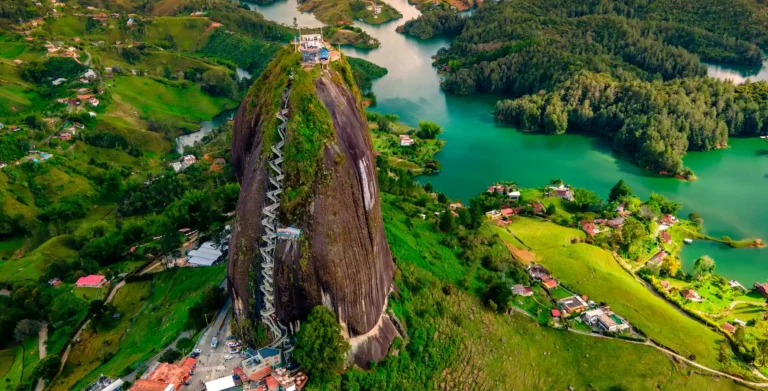
Guatapé. The rock, the reservoir and the painted town, 81 kilometers east: the best day trip in Antioquia, and most people do it badly. We wrote a separate guide to doing it right: 740 steps, a 35,000-peso ticket, and a climb that has to happen before ten. Our Guatapé day is ten hours door to door, private or shared.
Jardín. 130 kilometers southwest and about three hours on the road, one of Colombia’s eighteen official heritage towns: a coffee town with a plaza that fills with families at dusk, farms you can walk through, and a drive that is part of the appeal. Our Jardín day trip runs eight hours, private, with a coffee farm built in, and our Jardín guide has the road, the basilica after the earthquake, the birds and the risk.
Santa Fe de Antioquia. 56 kilometers west and a little over an hour away, at 27 degrees: the colonial capital of the province before Medellín existed, with cobbled streets, churches a hundred to three hundred years old, and the Puente de Occidente, built between 1888 and 1895 and a national monument since 1978. Our heritage day tour covers the town, the bridge and the museum in eight hours.
The old capital itself, the heat, the toll and the bridge you now cross on foot are in our Santa Fe de Antioquia guide.
When to come, and what the weather does
Medellín’s temperature stays between 16 and 26 degrees all year; what changes between months is rain. The driest stretch runs from mid-December to the beginning of March, April to May and September to November are the wetter periods, and in every month the morning is the reliable half of the day, which is why every plan in this guide starts early. The international airport, José María Córdova, is in Rionegro on the plateau east of the city, 45 minutes to an hour from El Poblado through the Túnel de Oriente; the small Olaya Herrera airport inside the city handles regional flights. If your trip continues to Bogotá, Cartagena or the coffee region, our Colombia itinerary guide covers the order that works.
Landing at José María Córdova? Our Medellín airport guide covers the taxi, the bus and the transfer down, with 2026 prices.
For the month-by-month numbers and the two dry seasons, read our Medellín weather guide.
Safety in one paragraph
Medellín is a big city with a short list of rules. Keep your phone in your pocket downtown and on the metro. Do not walk alone late at night in El Centro or around Parque Lleras. At night, use a ride app or a driver you know, not a taxi flagged on the street. Do not accept drinks from strangers; the drink-spiking scams around the nightlife areas are real, and they are the risk that reaches visitors. And learn the phrase locals use, no dar papaya, which means do not make yourself the easy target. That is the whole list, and it is shorter than the one for most large cities.
The long version, with the 2026 numbers, the neighborhoods and what happens to visitors, is in our guide to whether Medellín is safe.
Choosing a base? Our guide to where to stay in Medellín compares El Poblado, Laureles, Envigado and Sabaneta for noise, hills, metro access and the airport ride.
Five things you can skip
Comuna 13 on a Saturday afternoon. Any Escobar tour with a gift shop. Parque Lleras after midnight, unless that is specifically what you came for. Arví on a Tuesday, when the cable and the park are closed. And the rock at Guatapé at noon.
Questions travelers ask
How many days do I need in Medellín?
Three in the city and one in Guatapé is the plan that leaves nobody disappointed. Two days cover Comuna 13, downtown, the Metrocable and one good night out; five let you add Jardín or Santa Fe de Antioquia and a lazy day in Laureles.
Is Medellín safe for tourists?
Yes, with the rules above. The neighborhoods visitors use, El Poblado, Laureles and Envigado, are calm by day and busy by night, and the places on this list are visited by thousands of people every day. The risks that reach tourists are theft of phones and drink-spiking around the nightlife, both of which are avoidable.
What is the best month to visit Medellín?
Mid-December to early March for the driest weather, August for the Feria de las Flores, and any month for the temperature, which barely moves. Book earlier for the fair and for the December holidays.
How much does the metro cost in 2026?
4,400 pesos per trip with the bearer card sold at the stations, or 3,820 with a personalized Cívica card. The Arví cable, line L, is charged separately at about 26,700 pesos each way for foreign visitors.
Is Comuna 13 safe to visit?
Yes, by day and with the crowds. Go in the morning, go with a local guide, keep your phone in hand only when you are using it, and leave when the walkway starts to fill.
Can I see Guatapé in one day from Medellín?
Yes, and it is the day trip to choose if you only take one. Leave by seven, climb the rock before ten, and read our Guatapé guide for the order of the rest.
Plan it with us
We operate twelve tours in and around Medellín, private or shared, in English or Spanish, with hotel pickup. Write to us on WhatsApp with your dates, or see everything we run in the city on our Medellín tours page.