September 9, 2026
Bogotá is a long city on a high plain, and the way to get around it depends on which of its ten kilometers you are crossing and at what hour. The visitor’s city runs north from La Candelaria, the colonial center, through the Centro Internacional and Chapinero to the Zona T, Parque de la 93 and Usaquén, along a handful of avenues that everyone uses at the same time twice a day. There is a bus rapid transit system with stations in the middle of those avenues, a metered yellow taxi you should never hail on the street, four ride apps in a legal gray zone, a bike network longer than most cities’ and a Sunday morning when the main roads close to cars, a metro that will not open until 2028, and the option we use most: a driver who knows the city. Here is each one as it works in 2026, with the fares, the card you need, the hours, and our rule for when to take which.
The short version
By day, walk inside a neighborhood and take a car between neighborhoods. TransMilenio is fast, 3,550 pesos, and worth riding once with a Tullave card and no phone in your hand. Never hail a taxi on the street; order it through an app or your hotel, or use Uber, DiDi, Cabify or inDrive, which work in Bogotá and pick up wherever the app says. After dark, a car door to door, whatever the distance. On Sundays and holidays the ciclovía closes 141 kilometers of streets to cars from 7 am to 2 pm and the city turns into a bike ride. For a day with several stops, a day trip, or an evening out, a driver by the hour costs from 40 US dollars with Safe Transfers by Cielo.Travel, our transfer company, and every tour we run includes the car.
Reading the city first
Bogotá’s addresses are a grid, and once you can read one you can find anything. Calles run east to west and their numbers grow as you go north; carreras run north to south and their numbers grow as you go west, away from the mountains, which are always east. An address like Calle 72 # 10-34 means a door on Calle 72, thirty-four meters from Carrera 10; Carrera 7 # 72-41 means a door on Carrera 7 near Calle 72. A “Sur” after the number puts the street south of Calle 1, in the half of the city visitors rarely see. The two numbers of an address tell you the distance between any two places: La Candelaria sits around Calle 11, the Zona T around Calle 82, Usaquén around Calle 118. That ten-kilometer line is the axis of everything below. What each neighborhood on it is for, and where to sleep, is in our Bogotá guide.
The clock matters as much as the map. The rush runs from about six to nine in the morning and five to eight in the evening, rain turns a twenty-minute ride into an hour, and the altitude, about 2,640 meters, makes the first day’s walk shorter than you planned. Plan the far-apart things for the middle of the day and the close-together things for the evening. The rain’s hours and months are in our Bogotá weather guide.
TransMilenio and the SITP: the buses, the card, the rules
TransMilenio is Bogotá’s bus rapid transit system: long red buses in their own lanes down the middle of the main avenues, boarding at enclosed stations with turnstiles, plus green feeder buses that reach the neighborhoods from the portals at the ends of the lines, blue SITP buses on ordinary streets, and TransMiCable, a cable car in Ciudad Bolívar in the south. The 2026 fare is 3,550 pesos on all of them, all day, including Sundays and holidays. You pay with a Tullave card: the basic anonymous card costs 8,000 pesos at any station and can be loaded with as many trips as you like, but a lost card’s balance is gone and it gives no free transfers; the personalized Tullave Plus, also 8,000, is the one with the 125-minute window for free transfers between a trunk bus and a zonal or feeder bus, and it is issued at personalization points, not at every station. A pilot that began at Portal Norte in December 2024 lets you tap a Visa or Mastercard, or a phone wallet, at that portal and, since January 2026, at Estación El Tiempo, at the full fare and without transfers; everywhere else the card is the way in. The trunk lines run from about 4 am to 11 pm on weekdays, from 5 am on Saturdays and from 5 am to 10 pm on Sundays and holidays, according to the schedule TransMilenio published in early 2025; the TransMiApp has the current hours by route.
The corridors that matter to a visitor are three. The Avenida Caracas and Autopista Norte trunk runs the length of the city north from Avenida Jiménez at the edge of La Candelaria through Calle 45, Calle 72 and Calle 100 to Portal Norte, which is the spine of Chapinero and the north. The Calle 26 line runs west from the university district at the edge of the center past Museo Nacional to the airport, where the K86 dual bus stops at Door 2 of Terminal 1. And the Carrera Séptima, the street everyone walks, has no trunk line; the dual buses and the blue SITP buses run along it in traffic.
The rule for riding it is the one from our guide to whether Bogotá is safe: phone away, bag in front, no luggage, and extra attention at Avenida Jiménez, Calle 100, Portal Norte and Calle 45, which led the stations for theft in 2025 with 3,600 cases across the system, almost double the year before, by the security secretariat’s own figures. The buses are full at rush hour to a degree that surprises people from cities with metros. Ride it in daylight, between the rush hours, for a trip along one corridor, and take a car when the trip needs a transfer at night.
Taxis: metered, regulated, and never hailed on the street
Bogotá’s yellow taxis run on a meter, and the city sets the tariff by decree each February. For 2026, under Decreto 042 de 2026, the meter starts at 4,500 pesos, adds 159 pesos per 100 meters, has a minimum fare of 8,000, and adds 3,800 at night and on Sundays and holidays, 1,400 for a door-to-door call and 8,000 for a trip from the airport; taxis certified under the city’s “excelencia operacional” scheme run a slightly higher tariff, 4,800 to start and 172 per 100 meters. On the decree’s arithmetic a ride from La Candelaria to the Zona T starts around 16,000 pesos before time in traffic; the fare is not the problem with Bogotá’s taxis.
The problem is the street. The “paseo millonario,” a taxi hailed on the street in which accomplices board and the passenger is drugged or driven from cash machine to cash machine, is the reason for our rule about not taking street taxis in Bogotá, and the authorities’ own alert in February 2026 named the Zona T, Modelia and Galerías as the places it starts. A taxi ordered through an app, with the plate on the screen and the trip shared with someone, is a different vehicle in every way that matters: the decree even sets a separate tariff for taxis hired through a platform, 4,600 pesos to start and 1,625 per kilometer. Your hotel can call one; the airport has an authorized lane between Doors 8 and 10 of Terminal 1. Those three, and nothing from the curb.
The apps: Uber, DiDi, Cabify, inDrive
All four operate in Bogotá, pick up everywhere including the airport, show the price before you confirm, and rise with demand in the rain and the evening rush. They also sit in a legal gray zone: the platforms are not licensed as public transport in Colombia, a government bill filed in January 2026 to fine drivers and users was withdrawn a few weeks later for redrafting, and at the time of writing the apps work as they did, with drivers who sometimes ask you to sit in front and avoid the taxi lanes. Our rule is short: match the plate before you get in, share the trip, keep the phone in your pocket while you wait, and treat the app as the way to move between neighborhoods, not as a reason to stand on a dark corner with a screen lit. On a first night, when the flight and the altitude have done their work, a pre-booked transfer, with a host waiting inside the terminal, is simpler than any app; the options are in our El Dorado airport guide.
Walking: where it is the best way, and where it is not
Inside a neighborhood, walking is the best thing about Bogotá. La Candelaria by day is a walk from Chorro de Quevedo to Plaza de Bolívar and the museums; Chapinero’s Zona G and the streets up toward the hills are a walk; the Zona T to Parque de la 93 is a flat stroll along Carrera 11 and Carrera 15; Usaquén’s old center is a village on foot. Between neighborhoods, the distances are longer than the map suggests and the avenues are not built for pedestrians, so the walk from the center to Chapinero is a project, not a stroll. Three practical things: the altitude shortens your first day’s range, the afternoon rain in the wet months arrives fast, and after dark the rule is a car door to door, whatever the distance. The colonial center on foot, museum by museum, is in our La Candelaria guide.
Bikes: 661 kilometers of lanes and a Sunday when the city belongs to them
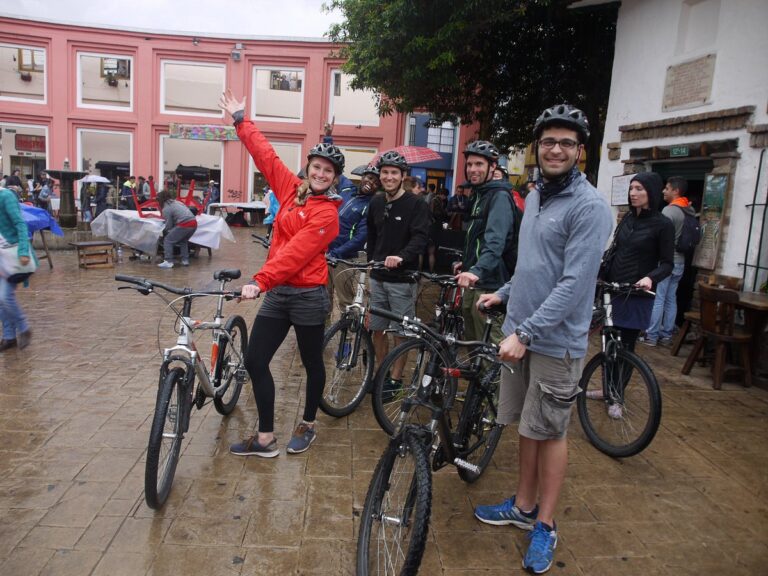
Bogotá has 661 kilometers of bike lanes by the city’s infrastructure institute’s count in February 2025, more than most capitals, and on Sundays and holidays the ciclovía closes a circuit of 141 kilometers of main streets to cars from 7 am to 2 pm, including the Carrera Séptima through the center and the north. It is the best single morning in the city and the safest place to ride, because the streets are full of families. On weekdays the lanes exist but the traffic beside them is real, and a first-time visitor should ride with someone who knows which lanes connect. Our private bike tour does exactly that in four hours, from the founding plazas of La Candelaria to the tree-lined Park Way in Teusaquillo, at your pace, with the bikes and the route handled.
The metro that is not open yet
Bogotá is building its first metro line, and it is not an option on this trip. Line 1 is an elevated line of 23.9 kilometers and 16 stations from Bosa in the south to Calle 72 at Avenida Caracas, in Chapinero; the city reported the works at 80.37 percent complete on June 30, 2026, with test running planned from September 2027 and commercial service in March 2028. Until then, the viaduct is the construction you will see along Avenida Caracas, and the buses above are the system.
When a driver is the right answer
Four situations, in our experience, are worth a driver by the hour rather than a chain of app rides: a day with several stops across the city, an evening out with a group, a day trip to Zipaquirá, Guatavita or Villa de Leyva, and any trip with someone who does not want to manage apps at 2,600 meters. Our transfers and drivers are operated by Safe Transfers by Cielo.Travel, our transfer company: a trained, vetted local driver and an insured SUV or sedan from 40 US dollars an hour, booked for two, four or eight hours, with support from the Bogotá operations team; most drivers speak Spanish, and a bilingual virtual concierge can be added. Book it at Safe Transfers, private hourly chauffeur in Bogotá. Every tour we run, from our private Perfect Day in Bogotá to the day trips, already includes the vehicle and the pickup, which is why our guests rarely need any of the options above until the evening.
Book a driver, by the hour or point to point
Everything above is how Bogotá moves. This is the version where you do not have to think about it: one car, one driver, a price agreed before you get in, and no meter.
For the roads that leave the city altogether, see Bogotá transfers.
Leaving Bogotá
El Dorado is inside the city, about twelve kilometers west of the center along Calle 26, and the ride there is in our airport guide. Intercity buses leave from the Terminal de Transporte in Salitre and its northern and southern satellites, which is fine for Villa de Leyva or the coffee towns with time to spare; the flights to Medellín, Cartagena and the rest are short and cheap enough that most of our guests fly; and for the road with a driver, Safe Transfers runs city-to-city transfers and day trips from Bogotá. Whatever the mode, leave the hotel earlier than the map says: the road to the airport and the road out of the city share the rush. The colonial town three hours north, and how to see it in one day or two, is in our Villa de Leyva guide.
What we do differently
We do not run the buses or the apps; we run the alternative. Our tours in Bogotá pick you up at the hotel with a guide who lives here and a car between stops, and our transfers and drivers, by Safe Transfers by Cielo.Travel, put a vetted driver at the terminal or at your door. The point is the same as the point of this page: nobody in our care is negotiating at a curb or reading a station map at ten at night.
Questions travelers ask
Is there Uber in Bogotá?
Yes. Uber, DiDi, Cabify and inDrive all work in Bogotá and at the airport, in a legal gray zone the government tried and failed to close in early 2026. Match the plate, share the trip, and expect the driver to ask you to sit in front.
How much is a taxi in Bogotá in 2026?
The meter starts at 4,500 pesos and adds 159 per 100 meters, with a minimum of 8,000, plus 3,800 at night and on Sundays and holidays and 8,000 from the airport, under Decreto 042 de 2026. Order it through an app or your hotel; never hail one on the street.
How does TransMilenio work for a tourist?
Buy a basic Tullave card for 8,000 pesos at any station, load it, and tap in at the turnstile; each trip is 3,550 pesos. Ride it in daylight along one corridor with your phone in your pocket, and take a car for anything that needs a transfer at night.
Does Bogotá have a metro?
Not yet. The first line, elevated, from Bosa to Calle 72, was 80 percent built in June 2026 and is planned to open to passengers in March 2028. Until then TransMilenio is the mass transit.
Can I walk around Bogotá?
Inside a neighborhood by day, yes, and it is the best way to see La Candelaria, Chapinero and Usaquén. Between neighborhoods take a car, and after dark take a car door to door whatever the distance.
What is the ciclovía in Bogotá?
Every Sunday and holiday from 7 am to 2 pm the city closes a circuit of 141 kilometers of main streets to cars for bikes, runners and walkers, including the Carrera Séptima. It is the best morning in the city and the safest ride.
Should I hire a driver in Bogotá?
For a day with several stops, a day trip or an evening out with a group, yes: a vetted driver and an insured car from 40 US dollars an hour with Safe Transfers, our transfer company, for two, four or eight hours. Our tours already include the car.
Plan it with us
Every tour we run in Bogotá is private, with hotel pickup and a guide who lives here, and our transfers and drivers are operated by Safe Transfers by Cielo.Travel. Write to us on WhatsApp with your dates, or start with our Bogotá tours page.