
September 10, 2026
Salento is a small town of painted balconies at the top of the coffee region, and the Cocora Valley is the green bowl ten kilometers above it where the tallest palms in the world stand in the mist. Most people come for one photograph and leave with a day they talk about for years: the jeep up from the plaza, the walk among the wax palms, a coffee farm where the cup you drink at home was picked by hand, and an afternoon on a street where every house is a different color. We run private tours here from Armenia, Pereira, Filandia and Salento itself, so this is the guide we wish our guests had before they arrived: what the town and the valley are, the two ways to walk the valley, how the coffee farm works, how to get here from Bogotá and Medellín, what it costs, and the one rule that decides whether you see the palms or a cloud.
The short version
Fly to Armenia, or to Pereira once its airport is back to full capacity after the August 2026 earthquake, about an hour in the air from Bogotá or Medellín, and you are in Salento within an hour or so by road. Go up to the Cocora Valley early, before the cloud settles on the ridge and the afternoon rain arrives, and walk either the short loop among the palms, an hour or so, or the long loop through the cloud forest, five to six hours. Spend the afternoon at a coffee farm and on Salento’s Calle Real, and if you have a second day give it to Filandia, the quieter town twenty kilometers away with the best viewpoint in the region. Everything here runs in every month of the year; the driest weeks are in July and August and around January. Our private Cocora Valley and coffee farm day covers all of it from your hotel door, and the tour options start from 80 US dollars per person.
Salento, the town
Salento was founded in 1842, which makes it the oldest town in Quindío, and it has kept the look of that century better than any of its neighbors: two-story bahareque houses of cane, wood and earth, painted in the bright combinations the coffee region is known for, with wooden balconies over the street. The town sits about 25 kilometers north of Armenia at an average of 18 degrees Celsius, cool enough for a jacket in the evening, with a little under ten thousand people in the municipality and a good many more visitors on any holiday weekend. Everything starts at the main square, the Parque Principal, with the church of Nuestra Señora del Carmen on one side and the line of jeeps on another. The Calle Real, which is Carrera Sexta on the map, runs north from the square with the craft shops, cafés and restaurants, and ends at the foot of the Alto de la Cruz, a climb of more than two hundred steps past the stations of the cross to the viewpoint over the town, the Cocora Valley and, on a clear morning, the peaks of Los Nevados behind it. The local dishes are trout in every form, a sancocho, the bandeja paisa of the region and the cochinillo a la Cocora; the trout is farmed in the valley, which is why the restaurants at its entrance serve it.
The Cocora Valley
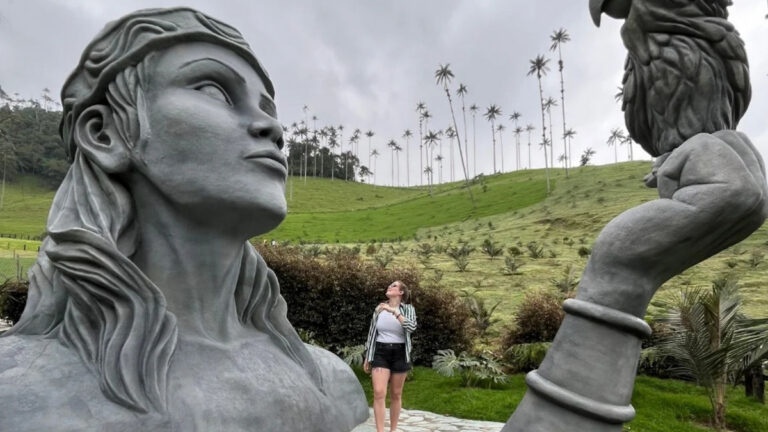
The valley is ten kilometers north of town along the Quindío river, between 1,800 and 2,400 meters, and it is the home of the Quindío wax palm, Ceroxylon quindiuense, which grows to sixty meters and has been Colombia’s national tree since Ley 61 de 1985; the same law makes cutting one a crime. The palms stand alone on open pasture, which is the strange and beautiful thing about the place: they were left when the forest around them was cleared, and they rise out of the grass like columns with the cloud moving between them. The valley sits against the Parque Nacional Natural Los Nevados, which Parques Nacionales records as declared on April 30, 1974 and covering 61,388.24 hectares, and it is habitat for the yellow-eared parrot, which nests in the palms. Above the pasture the trail climbs into cloud forest, and above that is Cerro Morrogacho, at 3,450 meters, reached only on foot.
There are two ways to walk it. The short way is the loop among the palms themselves, on the open slopes near the entrance, an hour or so at an easy pace with the best photographs of the day; this is the walk on our tours, with a guide who explains why the palms are alone and which way the cloud is going. The long way is the classic loop of five to six hours: up the valley floor along the river, across the hanging bridges, into the cloud forest to the hummingbird house at Acaime, then steeply up to the ridge and back down through the palms. It is not technical, but it is muddy in every month, it climbs a few hundred meters at altitude, and the second half is where the rain finds you if you started late. Horses can be hired at the entrance for part of it. The trails cross private land, and the farms charge small entrance fees in cash at their gates; bring pesos, real shoes, a rain layer and water, and start early. From Salento the way up is the jeep, the open-backed Willys that line the square and leave when they fill, a short ride that is part of the day; our tours skip the wait and take you up in your own vehicle.
The coffee farm
A coffee farm visit is the other half of a Salento day, and the difference between a good one and a tourist one is whether you walk the rows. On ours you see the seedbeds, pick ripe cherries from the trees, follow the beans through pulping, washing and drying, watch the roast, and finish with a tasting led by a barista who explains why the same bean tastes different at three roasts. The farms around Salento are part of the Paisaje Cultural Cafetero, the coffee landscape UNESCO inscribed in 2011 under criteria (v) and (vi): 141,120 hectares of inscribed property with a 207,000 hectare buffer zone, across Caldas, Quindío, Risaralda and Valle del Cauca. By the growers’ federation’s own count there are more than 95,000 farms on 172,000 hectares of coffee inside it. The farms here are small and steep and picked by hand through much of the year, and that is what the visit is for. For a longer version, our “farmer for a day” tour at Finca Luger spends two hours on the farm before the walking tour of Salento and a tasting with the baristas.
Filandia, the quieter town
Twenty kilometers from Salento and fourteen miles north of Armenia, Filandia is the same century of painted houses without the crowds, a town that stayed a town. Its viewpoint, the Mirador Colina Iluminada, is a wooden tower of about 27 meters built of mangrove, zapan and bamboo on a hill above the streets; on a clear day it looks over Pereira and several towns of Quindío and Valle del Cauca. Our private coffee town tour pairs Filandia and Salento in four to six hours, and our full day adds the Cocora Valley to both in six.
Getting here
First, the earthquake. The magnitude 7.4 quake of August 10, 2026 damaged 45 houses in Salento, mostly in the historic center, injured three people who were treated and released, and killed no one here; the main road stayed open, water and power were back within days, and the town hall’s message on August 24 was that commerce and tourism continue with no restrictions. The Cocora Valley, the jeeps and the trails are running. The airport that changed is Pereira’s: Matecaña was closed for sixteen days and reopened on August 26 with two of its six gates, so for the rest of 2026 fly into Armenia, whose El Edén reopened on August 11. Ask your hotel whether it is open before you book, and read what is open across the region in our Armenia guide.
The coffee region has two airports that matter for Salento: Matecaña in Pereira and El Edén in Armenia, each about an hour in the air from Bogotá or Medellín, with Armenia 25 kilometers from the town and Pereira a little further. The way most people do it is to fly in, stay two nights in Salento, Filandia or one of the farm hotels between them, and fly out to Cartagena or back to Bogotá; the road from Medellín is most of a day and beautiful, and worth it only if the drive is the point. Our tours pick up in Armenia, Pereira, Filandia and Salento, so the base is yours to choose. Inside the region, distances are short and the roads wind; the drive from Armenia or Pereira to the Cocora Valley is about two hours door to door with the stop in Salento, and from Salento itself the valley is a short jeep ride. The rest of the region, from the hot springs to Manizales and how many days it all needs, is in our Colombia coffee region guide; Pereira as a base, with the airport and the hot springs, is in our Pereira guide.
Book the drive to Salento
Most people arrive through Matecaña in Pereira and drive on, or come down by road from Medellín. Either way the last stretch is narrow and the hour you reach Cocora decides the walk.
The guided version is our Filandia, Salento and Cocora day; road detail is on Safe Transfers.
When to go
It rains in the coffee region in every month, and that is why it is green: Armenia's airport records more than 2,200 millimeters a year by IDEAM's 1991 to 2020 normals, with only July and August under 120 millimeters and April, October and November above 250. The rule is the same in every month: the valley in the morning, when the palms stand clear and the cloud is still on the peaks, and the farm and the town in the afternoon, when the rain comes. January and the July to August window are the driest, April to May and October to November the wettest, and none of it stops a tour. Holy Week, the long weekends and the second half of December fill Salento with Colombian visitors and the valley road with cars; on those dates we leave earlier. The country-wide calendar is in our guide to the best time to visit Colombia.
A day that works
This is the day we run most, and the order matters. Pickup at your hotel in Armenia, Pereira, Filandia or Salento in the morning, and the drive up to the Cocora Valley, about two hours with the views, arriving while the palms are still clear. An hour on foot among the palms with your guide. Down to a traditional coffee farm for an hour in the rows and at the drying beds, then an hour of tasting with a barista. An hour in Salento on the Calle Real and up the Alto de la Cruz, with time to yourself for lunch and the craft shops. Then the drive back, another two hours. Eight to ten hours in all, private, with the entrance to the valley, the farm visit and the walking tour included, and a private English-speaking guide from the first minute. The shorter versions are a five-to-six-hour private day with the valley and Salento only, a four-to-five-hour private coffee farm visit, a four-hour shared valley walk, and a three-hour shared walking tour of Salento that meets at the main square; the options start from 80 US dollars per person.
What it costs, and what is included
Our private Cocora Valley and coffee farm day includes the private English-speaking guide, hotel or Airbnb pickup and drop-off in Armenia, Salento, Filandia or Pereira, the entrance to the Cocora Valley, the coffee farm visit with planting, harvesting, roasting and tasting, and the walking tour of Salento with free time; prices are per person for two travelers, with discounts for larger groups, and the options start from 80 US dollars per person, with a minimum of two on the shared versions. What is not included is written on each tour page, usually lunch and personal purchases. If you are doing the valley on your own, budget for the jeep from the square, the entrance fees at the farms along the trail, which are paid in cash, and lunch at one of the trout restaurants at the entrance.
What we do differently
We start early, because the palms are the day and the cloud does not wait. Our guides work this valley all year, so they know which loop fits your group and where the trail is worst after rain. The farm we take you to is a traditional working farm, not a demonstration, and the tasting is led by a barista rather than a sales pitch. And because the vehicle is yours for the day, the order of the stops bends to the weather and to you: if the ridge is clear at eight in the morning, that is where you will be.
Questions travelers ask
How long is the Cocora Valley hike?
The short loop among the wax palms is about an hour at an easy pace. The full loop through the cloud forest to the hummingbird house at Acaime and back over the ridge takes five to six hours, with mud in every month and a few hundred meters of climbing at altitude.
Can you visit the Cocora Valley without a tour?
Yes. Take a jeep from Salento's main square, which leaves when it fills, pay the small cash entrance fees at the farms along the trail, and start early. A guide adds the explanation, the timing and the vehicle, and on a tour the farm and the town are part of the same day.
How do you get from Salento to the Cocora Valley?
The valley is ten kilometers north of town. The jeeps, the Willys, leave from the Parque Principal; our tours drive you up in your own vehicle from your hotel.
How many days do you need in Salento?
One full day covers the valley, a coffee farm and the town, which is our most popular tour. Two nights let you add Filandia, the Santa Rita waterfall or a second farm, and to see the valley on the morning after a night in town.
Is Salento worth visiting?
Yes, and the Cocora Valley is the reason. If you have ten days in Colombia, the coffee region is the stop people talk about most when they get home, and Salento is the town to base it on.
What is the wax palm?
Ceroxylon quindiuense, the Quindío wax palm, grows to sixty meters and has been Colombia's national tree since 1985, protected by law. The Cocora Valley is where the tallest stands of it are, alone on open pasture at 1,800 to 2,400 meters.
Which airport is closest to Salento?
Armenia's El Edén, 25 kilometers away, then Pereira's Matecaña a little further; both are about an hour by air from Bogotá or Medellín. Our tours pick up at hotels in both cities. After the August 2026 earthquake, Armenia is also the one to use.
Plan it with us
Every tour we run in the coffee region is private, with hotel pickup and a guide who lives here, in English or Spanish, in every month of the year. Write to us on WhatsApp with your dates and where you are staying, or start with our coffee region tours page.
