
September 11, 2026
Bogotá sits at about 2,640 meters above sea level, roughly 8,660 feet, on the highest plateau of the Colombian Andes; the city’s own pages round it to 2,600, which is the average for the plateau, and the difference does not change anything that follows. It is the first thing the altitude does to most of our guests, before the city has done anything at all: the stairs at the hotel are longer than they look, the first night’s sleep is shallow, and a glass of wine at dinner turns into a headache by morning. This is what we tell people before they land, with the numbers from the city’s health secretariat and the CDC’s travel medicine handbook rather than from a forum: how high the city and its hills really are, what the thin air does and to whom, what the first 48 hours should look like, which medicines the doctors recommend and which our guides carry, when a headache is more than a headache, and how we order the first four days so that Monserrate, Guatavita and the páramo come in the right sequence.
The road in from the airport, and what the altitude does to that first afternoon, is in our El Dorado airport guide; the order of the whole trip is in our Colombia itinerary.
The short version
Bogotá is high enough to feel and not high enough to be dangerous for a healthy traveler: the CDC’s threshold for altitude illness is a sleeping altitude of 2,450 meters, the city is just above it, and its profile falls in the handbook’s low-risk category, where the first night is spent below 2,750. About a quarter of visitors who sleep above 2,450 meters get some acute mountain sickness by the CDC’s count, which in Bogotá means a headache, poor sleep, shortness of breath on stairs, no appetite, and a hangover feeling that arrives two to twelve hours after you land and clears in one to two days if you do not climb higher. The city’s health secretariat asks for one or two days of adaptation, rest, water, no excess of alcohol or tobacco, sunscreen every day and six to eight hours of sleep; the CDC adds no alcohol and only mild exercise for the first 48 hours. Monserrate, at 3,152 meters, is for day two by cable car, not day one on foot; Guatavita, at 3,000, for day three; the páramo above 3,100 for day four. If you have heart or lung disease, sleep apnea or sickle cell trait, talk to a doctor before you fly, and if a headache comes with confusion, a cough that will not stop or breathlessness at rest, that is a clinic visit, not a nap. Monserrate itself, with the three ways up and the right morning to go, is in our Monserrate guide.
The numbers: the city, the airport, the hills and the air
The plateau the city sits on averages 2,600 meters by the Alcaldía’s own description; 2,640 is the figure in common use and the one we use across our guides; the weather station at El Dorado airport, where you land, is at 2,547. The hills that frame the city are higher: Monserrate, whose church you will see from almost everywhere, is at 3,152 meters by the operator’s figure, about 10,340 feet, which is 500 meters above the streets and the reason a cable car and a funicular exist. The day trips go up and down from there: Lake Guatavita is at about 3,000 meters and its rim trail at 3,100, the Peñas Blancas viewpoint on our Chingaza hike is at 3,100 and higher, and Villa de Leyva, three hours north, drops to 2,149, which is why a night there feels like a holiday from the altitude. In the standard atmosphere the air at 2,600 meters carries about 73 percent of the pressure it has at sea level and at Monserrate’s summit about 68 percent; the CDC gives the physiological version, that at around 3,050 meters the oxygen you breathe in is 69 percent of what it is at sea level, enough to drop a healthy person’s blood oxygen saturation to 88 to 91 percent on arrival, which is where the shorter breath on the stairs comes from.
What it feels like, and who feels it
The Secretaría Distrital de Salud’s own list, published for visitors in April 2024, runs: dizziness, headache, difficulty breathing, low blood pressure, nausea, fatigue and weakness, the symptoms of what Colombians call soroche. The CDC describes acute mountain sickness as feeling like an alcohol hangover, with headache as the cardinal symptom accompanied by loss of appetite, dizziness, fatigue, nausea or occasionally vomiting, with onset usually two to twelve hours after arrival and often during or after the first night. Sleep is the most common complaint at altitude, and above about 2,700 meters some degree of periodic breathing at night becomes nearly universal, which is why the second night is often worse than you expected and the third is fine. Who gets it is partly luck: the CDC’s figure is that about 25 percent of visitors sleeping above 2,450 meters in Colorado get some acute mountain sickness, children are as susceptible as adults, people over 50 slightly less so, and fitness does not protect you. Most of our guests feel some of it on the first day; few feel nothing.
The first 48 hours, by the city’s doctors and the CDC’s
The health secretariat’s advice is simple and we follow it in the way we schedule people: the body needs one or two days to adapt, so avoid physical effort and rest, and leave the demanding activities for the end of the trip; drink water, because dehydration raises the risk of altitude sickness; avoid excess alcohol, which dehydrates, and tobacco, which makes breathing harder; use sunscreen every day; and sleep six to eight continuous hours. The CDC’s rules for the first 48 hours are the same in stronger words: no alcohol, only mild exercise, and never go up to sleep at a higher altitude while you have symptoms, no matter how minor they seem. Acclimatization is a process of three to five days, and acute mountain sickness generally resolves within 12 to 48 hours if you do not go higher. In practice, for a guest who lands in the afternoon: the driver at the airport, the hotel, a flat walk and an early dinner, water rather than wine, and bed; the next morning the city as it is meant to be seen, from a vehicle and on flat streets, with the cable car doing the climbing.
Medicine: what the doctors recommend and what we carry
We are a tour company, not doctors, so this paragraph repeats the CDC and adds nothing. The preventive medicine for altitude is acetazolamide, the drug many travelers know as Diamox, and the CDC’s prophylactic dose is 125 milligrams every 12 hours, beginning the day before ascent and continuing for the first two days at altitude; the common side effect is tingling in the fingers and toes, carbonated drinks taste flat while you take it, and the CDC notes that cross-sensitivity with antibiotic sulfa drugs has not been reported, which is a conversation for your doctor, not for us. Ibuprofen, 600 milligrams every eight hours, also helps prevent acute mountain sickness, though not quite as well. For a headache that has already arrived, the CDC’s answer is non-opiate painkillers, ibuprofen 600 milligrams or acetaminophen 500 milligrams every eight hours, plus rest and water; a descent of 300 meters improves things quickly, which in Bogotá is the difference between Monserrate and the city, not between the city and anywhere else. Our guides carry water and painkillers, know the nearest clinic on every route, and will end a day early without argument; what they do not carry is oxygen, which the health secretariat lists as a treatment that is sometimes needed and which is a clinic’s job, not a guide’s.
When it is more than a headache
The two dangerous forms of altitude illness, fluid in the lungs and swelling of the brain, are rare at Bogotá’s height: the CDC puts high-altitude cerebral edema as rare below 4,300 meters and pulmonary edema at one in a hundred travelers or fewer even above 4,300, which is 1,100 meters higher than Monserrate. What to watch for anyway is a headache that does not respond to painkillers, confusion or clumsiness, breathlessness at rest instead of on the stairs, and a cough that will not stop; any of those on the first or second night is a reason to call us or the hotel and go to a clinic, where supplemental oxygen is, in the CDC’s words, very effective at restoring oxygenation. The people who should plan before they fly, not after they land, are the ones on the CDC’s list: coronary artery disease, any chronic lung disease, obstructive sleep apnea or sickle cell trait, even when well controlled, should be discussed with a doctor who knows altitude medicine. If that is you, tell us when you book and we build the first days lower and slower, and our páramo hike is not recommended, by its own booking terms, for travelers who are pregnant or have a heart condition.
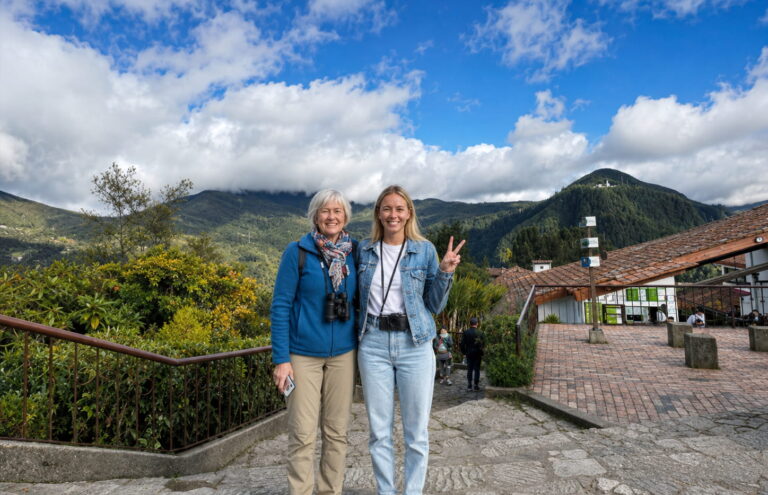
How we order the first four days
Day one is arrival: the transfer from El Dorado, the hotel, a flat walk in the neighborhood if you land early, dinner without alcohol, an early night. Day two is the city, and it is the day our Perfect Day tour was built for, because it is private, it moves by vehicle between the stops, the walking in La Candelaria is flat and slow, and the climb to Monserrate is done by cable car or funicular with the guide watching how you feel; the museums are indoors, and the coffee stop is a rest. Day three goes higher for the first time: Lake Guatavita at 3,000 meters, with a two-hour guided walk to the rim at 3,100 and a village at 2,680 for lunch, or the Salt Cathedral at Zipaquirá, an hour north on the same plateau and underground. Day four is for the people who want the mountains: the Chingaza páramo to the Peñas Blancas viewpoint above 3,100 meters, seven kilometers with 500 meters of climbing, which our tour page itself says needs at least one day of acclimatization and which we would put on the third day at the earliest and the fourth by preference. Villa de Leyva, at 2,149 meters, is the other way to spend a night: lower, warmer and drier, and a good second stop for anyone who found the first two nights hard. And if you are coming to Bogotá from Cartagena, Medellín or the coffee region, all of them lower, the first-day rules apply again, in a milder form, because Medellín at 1,479 meters is not an acclimatization for 2,640.
Monserrate, by the operator’s own numbers
The hill is open every day of the year, and the funicular and cable car run from 6:30 in the morning to 10 at night from Monday to Saturday, from 5:30 in the morning to 5 in the afternoon on Sundays and from 6:30 to 5 on holidays, with the ticket booth closing at the same hours; the operator warns that the hours can change for maintenance or equipment. The 2026 fares, in Colombian pesos, are 35,000 for the round trip and 21,000 one way from Monday to Saturday and on holidays, 21,000 for the round trip on Sundays, 29,500 for travelers over 62 on weekdays and 16,500 on Sundays, and a 96,500 fast pass on any day. The walking trail belongs to the city and is run by the IDRD: open every day from 5 in the morning to 1 in the afternoon to go up and until 4 to come down, closed on Tuesdays for maintenance, no children under a meter tall and no pets. Between August 31 and September 25 the operator is running only the cable car on weekdays, with both systems on weekends. Our advice on the altitude is the same for everyone: go up by cable car on day two, not day one; walk down only if you have slept two nights in the city and the knees agree; the summit is 500 meters above the streets and the sun there is stronger than it feels, so the sunscreen the health secretariat asks for is not optional. The basilica is open from 6 in the morning to 7 at night except Tuesdays, when it opens at noon.
The weather at 2,640 meters, by IDEAM’s numbers
Altitude sets the temperature, and Bogotá has no seasons in the sense a visitor means: the city’s own description is a homogeneous climate all year with an average of 14 degrees. The table is IDEAM’s 1991 to 2020 normal for the El Dorado airport station, at 2,547 meters, with the average daily high and low in degrees and the rain in millimeters per month; the year adds up to 877 millimeters on 120 days, with April, May, October and November the wet months and the sun strongest, at close to six hours a day, in January and February. The month-by-month table and which side of the city gets the rain are in our Bogotá weather guide.
| Month | High | Low | Rain |
|---|---|---|---|
| January | 20.1 | 6.4 | 33 |
| February | 20.2 | 7.6 | 51 |
| March | 19.8 | 8.6 | 83 |
| April | 19.5 | 9.6 | 117 |
| May | 19.4 | 9.6 | 109 |
| June | 18.9 | 9.1 | 57 |
| July | 18.5 | 8.6 | 49 |
| August | 18.8 | 8.4 | 44 |
| September | 19.2 | 7.8 | 57 |
| October | 19.4 | 8.3 | 108 |
| November | 19.4 | 8.6 | 107 |
| December | 19.8 | 7.5 | 61 |
What that means for the altitude: the air is cool enough that you will not notice how much water you are losing, and dry enough in the sunny months that you are losing a lot, so the bottle matters more here than on the coast; the sun at this height burns faster than it feels, cloudy or not; and the mornings, at seven or eight degrees, want a jacket that comes off layer by layer until noon. A light jacket, a rain layer, a hat and sunscreen are the whole packing list for the altitude, plus flat shoes for La Candelaria’s cobbles.

Children, older travelers and anyone with a condition
Children get altitude sickness as often as adults by the CDC’s account, and they are worse at saying so, so a child who is irritable, off food or sleepless on the first day in Bogotá is telling you something; our city tours are private, so a slow morning and a hotel stop cost nothing. Travelers over 50 are slightly less susceptible, not immune. Pregnancy, heart disease, chronic lung disease and sleep apnea are the reasons to see a doctor before flying, and the reasons we keep the páramo and the 3,000-meter walks off the first days for everyone and off the trip entirely for some. None of this is a reason not to come: Bogotá is a city of more than seven million people who live at this height, 7,412,566 by the 2018 census’s adjusted count, and in our experience the visitors who have a bad time are the ones who tried to do Monserrate on foot, three museums and a late night with aguardiente on the day they landed. The city itself, neighborhood by neighborhood and day by day, is in our Bogotá guide.
What we do differently, and what we cannot promise
We build the first days of every Bogotá trip around the altitude: a private driver at the airport, the city on day two with the cable car doing the climbing, the 3,000-meter days on day three and the páramo on day four, guides who carry water and painkillers and will shorten a day, and a straight answer when you ask whether you should hike. What we cannot promise is that you will feel nothing on the first night; nobody can, and the guests who read this page before they land are the ones who arrive with acetazolamide in the bag if their doctor agreed, a bottle of water in hand, and no plans for the first evening.
Questions travelers ask
How high is Bogotá in feet?
About 8,660 feet, from 2,640 meters; the city’s own average for the plateau is 2,600 meters, about 8,530 feet, and Monserrate’s summit is 3,152 meters, about 10,340 feet.
Will I get altitude sickness in Bogotá?
Probably a mild version: the CDC’s figure is that about a quarter of visitors sleeping above 2,450 meters get some acute mountain sickness, and Bogotá is just above that line. A headache, poor sleep and short breath on stairs on the first day are normal and clear in one to two days.
How long does it take to acclimatize to Bogotá?
The city’s health secretariat says one or two days; the CDC says symptoms resolve within 12 to 48 hours if you do not go higher and that the acute acclimatization takes three to five days. Plan the strenuous things for day three onward.
Can I go up Monserrate on my first day?
By cable car, if you feel fine after a night’s sleep, yes; we schedule it for day two. Walking up, 500 meters of climbing to 3,152 meters, is for day three or later, and the trail is closed on Tuesdays.
Should I take Diamox for Bogotá?
Ask your doctor. The CDC’s prophylactic dose of acetazolamide is 125 milligrams every 12 hours from the day before you arrive through the first two days, and it is reasonable for people who have suffered at altitude before; most healthy travelers manage Bogotá with rest and water.
Is Bogotá’s altitude dangerous?
Not for a healthy traveler who takes the first two days gently. The serious forms of altitude illness are rare below 4,300 meters by the CDC’s account. People with heart disease, chronic lung disease, sleep apnea or sickle cell trait should see a doctor before flying.
What should I drink and avoid on the first day?
Water, and more of it than you think, by the health secretariat’s advice; no alcohol for the first 48 hours by the CDC’s, and go easy on tobacco. Eat lightly and early.
Plan it with us
Write to us on WhatsApp with your arrival time and we will order the first days around it, or start with our Bogotá tours page.
Sources
The facts on this page were checked on September 11, 2026 against the following sources: the Alcaldía de Bogotá’s general information page and the Secretaría Distrital de Salud’s health recommendations for visitors of April 17, 2024; the CDC Yellow Book 2026 chapter on high-altitude travel and altitude illness; Cerro de Monserrate’s schedules and prices page; IDEAM’s climatological normals on datos.gov.co, El Dorado airport station; and the DANE’s 2018 census profile of Bogotá. The air pressure figures are the standard atmosphere calculated for each height. Our own programs’ inclusions and prices are those on our Perfect Day tour page and our Chingaza hike page on the same date. This page is travel advice, not medical advice; where it repeats a doctor’s recommendation, it names the source.