September 12, 2026
Getsemaní is the neighborhood on the other side of the Clock Tower, the part of old Cartagena that was outside the walls when the walls mattered and is inside the World Heritage line now: a few dozen blocks of one-story houses, painted walls, a church on a square, and the streets where a Black militia forced the city to declare independence on November 11, 1811. Today it is where the city eats, drinks and dances after dark, where most of the murals are, where the hostels and the boutique hotels share a block with families who have been there for generations, and where a visitor who reads only the Old City guides misses the half of Cartagena that is alive. We run three tours through it, our guides live in the city, and this is the neighborhood as we would explain it on the first evening: what it is and where it ends, the story its walls tell and which parts are true, the plaza and the church, the murals and the streets, the fort next door with its 2026 prices, what to eat, whether to sleep here, the rules for the night, the November fiestas that are its own, and the evening in the order we would do it.
The short version
Walk in through the Puerta del Reloj, cross the Camellón de los Mártires and you are there in five minutes; everything in the neighborhood is within ten minutes on foot, and the Castillo de San Felipe is 740 meters from the plaza. Do the murals and the fort in the morning, before ten, with a guide who can read the walls; do the plaza in the evening, from about seven, when the neighborhood comes out to sit on the church steps; eat an arepa de huevo from a cart and drink the coconut lemonade; keep the phone and the chain out of sight on the Calle de la Media Luna; and sleep here if you want the nights, in the Old City if you want the quiet. If your dates can move, the second week of November, when the city’s independence fiestas end with the Cabildo de Getsemaní, is the week this neighborhood was made for.
What Getsemaní is, and where it ends
Getsemaní began as an island. The land beyond the Bahía de las Ánimas passed after the conquest to the accountant Rodrigo Durán and then to the dean Juan Pérez de Materano, who gave it the name of the garden where Jesus prayed, and for the first century of the city it was the arrabal, the suburb outside the fortified core, joined to it by a drawbridge over the San Anastasio creek at the gate now called the Puerta del Reloj. Between 1625 and 1634 much of it was enclosed by its own walls and it became one more neighborhood of the city, by the Banco de la República’s encyclopedia, and its population was everyone the walled center did not have room for: indigenous people, free and enslaved Black residents, Portuguese and Jewish traders, Spaniards of small means, and the artisans, sailors, carters and shopkeepers of a port. UNESCO, which inscribed Cartagena’s port, fortresses and group of monuments on the World Heritage list in 1984, describes the three sectors of the historic center in one line each and calls Getsemaní “the suburban quarter once inhabited by the artisans and slaves.” That sentence is the neighborhood’s whole social history, and the reason its story is different from the one told inside the walls.
On the ground, Getsemaní is the wedge of streets between the Camellón de los Mártires and the Centro de Convenciones on the west, the lagoons on the east, and the Calle de la Media Luna running through the middle from the Camellón toward the India Catalina roundabout and the road to San Felipe. It is small: the Plaza de la Trinidad is 470 meters from the Clock Tower, 560 from the Muelle de la Bodeguita where the island boats leave, 320 from the Convention Center, 740 from the entrance to the Castillo and about 2.2 kilometers from the beach at Bocagrande, all in straight lines. The Old City is the museum; Getsemaní is the street. The houses are one and two stories, the doors open onto the sidewalk, the music comes from inside, and the walls, most of them, have been painted.
The 1811 story, and why the neighborhood tells it on its walls
Cartagena declared absolute independence from Spain on November 11, 1811, and it was Getsemaní that forced the declaration. The man the neighborhood remembers is Pedro Romero, a metalworker and, by 1808, the contractor of the navy’s arsenal, born in Cartagena in 1756 by the most recent census research or in Matanzas, Cuba, by the older account; on that day he led the armed uprising of the neighborhood’s people, the lancers of Getsemaní, most of them Black and mulato, that made the creole junta sign. The Banco de la República’s encyclopedia is the source for all of that, and it is the story a guide will tell you on the Plaza de la Trinidad, where the neighborhood gathered, and it is why the neighborhood’s independence day is the city’s and not the other way round. The price came five years later: on February 24, 1816, after the siege by Pablo Morillo, nine leaders of the independence were shot on the square in front of the Puerta del Reloj, which the city named the Paseo de los Mártires at the centenary of their deaths and which you cross every time you walk from the Old City into Getsemaní; the busts along it are theirs. The centenary of the independence itself, November 11, 1911, gave the Parque del Centenario, on the other side of the Camellón, its name.
The city celebrates all of this every November with the Fiestas de Independencia, and the 2026 program, published by the Alcaldía in February, runs from November 1 to 15: the Festival Regional de Gaitas from the 1st to the 4th, the Desfile en Traje de Baño on the 7th, the solemn session, the floral offering and the serenade on the 11th, the Gran Desfile de Independencia on the 12th, the Festival Náutico and the Bololó del Arsenal on the 13th and 14th, the Cabildo de Getsemaní on the 14th, and the coronation of the Reinado Popular on the 15th. The Cabildo is the neighborhood’s own parade, and the Arsenal is its bar street; if you want Getsemaní at its loudest and most itself, that is the week.
The Plaza de la Trinidad and the church
The plaza is the neighborhood’s living room and the reason to come at night. The church that gives it its name, the Iglesia de la Santísima Trinidad, was raised around 1600, by the Instituto Cervantes’ account of the city, after the bishop asked the king for a parish for a suburb whose people lived too far from the cathedral; a neighbor, the captain Julio Evangelista, offered to pay for it in exchange for the patronage, a royal decree of 1642 asked the governor how many people lived there and how far they were from the cathedral, and the answer got the church built, the second-oldest in Cartagena. Its final plans date from 1716 and copy the cathedral: three naves, side chapels forming a cross, wooden mudéjar ceilings, a plain two-tier portal and a heavy bell tower, and inside an altarpiece of Purgatory repainted in 1868 in which the archangel Michael stands where the Virgin usually does. By day the church is a cool room and the plaza is quiet; from about seven in the evening the square fills with neighbors on the steps, children with a ball, a dance troupe or a drummer, carts selling arepas de huevo, sausages, cold beer and coconut lemonade, and travelers from the hostels a block away, and it stays that way until the small hours on weekends. There is no ticket, no hours and no dress code; it is a public square in a neighborhood that lives outdoors, and the only rule is the one for every crowd in Cartagena, which is in the safety section below.
The streets, the murals and the Ermita de San Roque
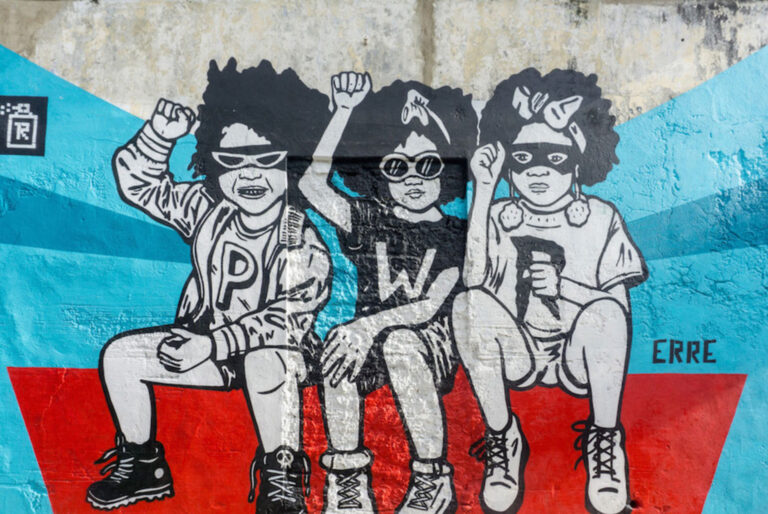
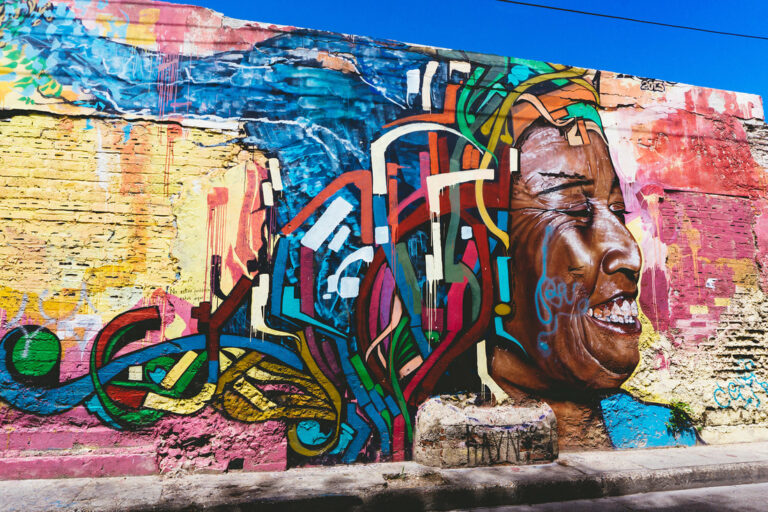
The murals are what most visitors come for, and they have a date. In December 2013 a street-art festival called Ciudad Mural, organized by the Bogotá collective Vértigo Graffiti with the city, the heritage institute and the Marca País behind it, brought more than 45 national and international artists, twenty of them from Cartagena, to paint the neighborhood’s walls with its own images, the singer Joe Arroyo, the sea turtles, the fruit trays, the boats and the gulls, as the press reported at the time; the goal, in the organizer’s words, was a route of murals for visitors and the transformation of walls that were falling down. The route grew from there, by the artists and the residents, and it is now the densest street art we know on Colombia’s Caribbean coast: the Calle de la Sierpe and the Calle San Juan behind the plaza, the Callejón Angosto, the walls along the Calle de la Media Luna and the Calle del Arsenal, and the big pieces that everyone photographs, the three women with painted faces, the smiling man with the flying hair, the three children with their fists up. They change: a wall is repainted, a house is sold and rendered white, a new piece appears in a month. That is the reason to walk them with someone who knows which ones are political, which are portraits of neighbors, and which were painted last week.
The other old building of the neighborhood is easy to miss. On the Calle del Espíritu Santo, a block from the Media Luna, the Ermita de San Roque is a small rectangular chapel with a wooden roof and a two-tier bell tower, built with a hospital after a plague in the middle of the seventeenth century; the works began in 1654, the Crown stopped them two years later on a rumor that the hospital was a scheme by a few clerics, and the order of San Juan de Dios got them restarted, by the Instituto Cervantes’ account. The chapel stood on the Calle de la Media Luna originally, and the street was renamed for the hospital. It is the plainest church in the historic center, and the one that explains what the neighborhood was for.
The Castillo de San Felipe, next door
The fort at the heart of what UNESCO calls the most extensive fortifications in South America is Getsemaní’s neighbor, 740 meters from the plaza on the hill of San Lázaro, and the two belong to the same morning. The fort was proposed in 1639, named for Philip IV, finished in its first form in 1657, taken by the French baron de Pointis in 1697 and then, in 1741, held against the English admiral Edward Vernon, who came with more than 170 ships and 26,000 men and had struck medals in advance reading “I took Cartagena”; Blas de Lezo, who had already lost an eye, a leg and an arm elsewhere, sent him home. The walls lean inward so cannonballs bounce, the batteries cover each other so no one of them could be taken without the whole, and the tunnels, cut so a sentry could hear footsteps far down the passage and the whole fort could be blown from inside if it fell, are the part worth a guide. In 2026 it opens every day from 7 in the morning to 6 in the evening; the ticket is 38,000 pesos, 33,000 for Colombians, 16,000 for children from six to thirteen and for students and teachers with ID, free for children under six, Colombians over 62 and visitors with a disability with one companion, and free for Colombians on the last Sunday of the month except in January and December, under the operator’s tariff resolution of January 9, 2026. Guides and audio guides are not included and are hired at the entrance. Go at seven, when the ramps are still in shade, and do the neighborhood’s murals on the way there or back; that is exactly what our walking tour does. The fort battery by battery, its three centuries and the full 2026 tariff are in our Castillo de San Felipe guide.
What to eat and drink in Getsemaní
The neighborhood’s food is the food of the coast eaten standing up. The arepa de huevo, a corn arepa fried, opened, filled with an egg and fried again, is the thing to eat from a cart on the plaza or on the Calle de la Media Luna, with a cold coconut lemonade, the limonada de coco, beside it; the carts also sell empanadas, papas rellenas and, in the evening, the sausages and grilled meat that the plaza smells of. The restaurants along the Calle del Arsenal, the Calle de la Media Luna and the streets around the plaza run from a plate of fried fish with coconut rice and patacones to the ceviches and the cocktail lists that came with the hotels, and the bars on the Arsenal and the Media Luna are where the city’s salsa nights happen; the Bololó del Arsenal in the November fiestas is named for that street for a reason. Our four-hour food walk of the Walled City, five tastings, has the arepa de huevo on it.
Where to stay: Getsemaní or the Old City
Getsemaní has the hostels, the guesthouses in colonial houses around a patio, and a growing number of boutique hotels, and it is the right place to sleep for a traveler who wants the nights, the prices below the Old City’s, and the plaza a block away. It is the wrong place for anyone who needs silence after eleven: the plaza and the Media Luna are loud until late, especially Thursday to Saturday and through the whole of November, and a room on a side street is worth asking for. The walled city, 470 meters away, is quieter, prettier and dearer, and it puts the museums, the walls at sunset and the Bodeguita pier at your door; Bocagrande, across the bay, is the beach-and-tower option with the widest choice of hotels and none of the character. Our position is the one we give in our Cartagena guide: first-time visitors with two or three nights sleep inside the walls or in Getsemaní, and the neighborhood is the better value of the two if the night is part of why you came. Two things to know before you book here: from the airport the fixed taxi fare to Getsemaní is 20,200 pesos under the 2026 tariff, the cheapest zone in the visitor’s map, and in October, the wettest month, the afternoon storms flood the low streets of Getsemaní for an hour until the drains catch up, by the numbers in our Cartagena weather guide. The Old City itself, plaza by plaza with its 2026 museum hours and prices, is in our Walled City guide. Which neighborhood to sleep in, this one or another, with the airport fares to each, is in our guide to where to stay in Cartagena.
Is Getsemaní safe?
Yes, by day and by evening, and it is where most visitors spend their nights; the risk it carries is the one the whole historic center carries, and it has a shape. The signature street crime of the Old City and Getsemaní in 2026 is a gold chain snatched off a neck in a crowd, sometimes by a group that closes in around the victim: in May 2026 the police and the prosecutor’s office arrested four adults and a minor from a gang the press called Los Rompecadenas, which worked San Diego, Getsemaní and the Avenida Venezuela, and in late August five more were arrested in Getsemaní and San Diego after a robbery on the Calle de la Media Luna, with chains worth 22 million pesos recovered, by the figures and sources in our Cartagena safety guide. So the rules are simple and local: no gold chain on the street, the phone in the pocket on the Media Luna and in the crowd on the plaza after eleven, the bag in front, drinks that never leave your sight in the bars, and a licensed or app taxi back to a hotel outside the neighborhood rather than a walk along the lagoons after dark. Overcharging is the other thing that reaches visitors: ask the price of the arepa, the beer and the taxi before you take them. A guide changes the geography here as everywhere: the streets a local walks in Getsemaní at night are more than the streets a visitor should.
Getting to Getsemaní, and getting around it
From Rafael Núñez airport the neighborhood is 4.3 kilometers in a straight line and the shortest ride in the city: under the district’s 2026 tariff, Decreto 0051 de 2026, the fixed fare from the official taxi stands is 20,200 pesos to Getsemaní, with 1,100 more at night from 7 p.m. to 5 a.m., and our Cartagena airport guide has the whole zone table and the three ways in side by side; a private transfer with the driver waiting inside the terminal with your name, which is what we book for our guests through Safe Transfers, our transfer company, starts at 49 US dollars and is the version that goes wrong least. Inside the historic center everything is on foot: the Clock Tower five minutes from the plaza, the Bodeguita pier seven, the Convention Center four, the fort ten, and the heat sets the hours, which in Cartagena means walking between four in the afternoon and ten at night and again early in the morning. Bocagrande and its beach are a short taxi ride across the bay; the Rosario Islands boats leave from the Bodeguita pier or from the marinas across the bay, and our Rosario Islands guide has the day.
The calendar
The driest and coolest months are December to March, when the trade wind blows and the plaza is pleasant at nine at night, and the neighborhood’s own weeks are the Fiestas de Independencia in the first half of November, with the Cabildo de Getsemaní on November 14 in 2026 and the Bololó on the Arsenal the two nights before; the Hay Festival, the literary festival that fills the Old City’s theaters and plazas, runs from January 28 to 31, 2027, and the Cartagena film festival, FICCI 66, from April 6 to 11, 2027. The wet months are May to November with October the wettest, when the afternoon storm is short and violent and the plaza dries within the hour; the hottest afternoons are the same months, which is why the neighborhood belongs to the morning and the night all year. The full month-by-month table is in our weather guide.
A day and a night in Getsemaní, in the order we would do it
Seven in the morning at the gate of the Castillo, before the ramps are an oven, an hour and a half in the tunnels and on the ramparts with a guide; then down the hill and into the neighborhood by the Calle de la Media Luna while the walls have their morning light, the Ermita de San Roque, the Calle de la Sierpe and the Calle San Juan for the murals, and the plaza empty and quiet, which is the only time to see the church inside. Lunch across the Camellón in the Old City or at a table on the Arsenal, the museums in the heat, a siesta, and the walls at sunset from the Old City side. Then back through the Puerta del Reloj at about eight, an arepa de huevo and a coconut lemonade from a cart, the plaza on the church steps for as long as you like, and a salsa bar on the Media Luna or the Arsenal if the night is going that way; a taxi or a five-minute walk to a hotel inside the walls, a walk of a block to one in Getsemaní. Done with someone who can read the walls and knows the artists, the morning above is our private graffiti walk, and the whole day with the fort is our city tour.
The night half of that day, the Plaza de la Trinidad from seven, the Arsenal and the Media Luna, what time it ends and the bill to watch for, has its own page: our Cartagena nightlife guide.
What we do differently, and what we cannot promise
We do the neighborhood in the morning for the walls and in the evening for the plaza, with guides who live in the city and know which mural was painted last week, and we send the airport and the late nights to Safe Transfers rather than leaving a guest to negotiate a taxi on the Media Luna at one in the morning. We do not promise a mural that was there last month, a quiet night in November, or a dry afternoon in October, and we do not pretend the neighborhood is a theme park: people live here, the plaza is theirs before it is yours, and the visitors who are welcome are the ones who behave like guests in someone’s front yard. What we can promise is that a traveler who does the fort at seven, the walls before ten and the plaza after eight has seen the half of Cartagena that the postcards leave out.
Questions travelers ask
Is Getsemaní safe at night?
Yes, on the plaza, the Media Luna and the Arsenal, where the crowds and the police are, with the chain off, the phone away and the drink in sight. Take a taxi rather than a walk to any hotel outside the neighborhood after midnight, and do not walk the lagoon side.
What is there to do in Getsemaní?
The murals on the Calle de la Sierpe, the Calle San Juan and the Media Luna, the Plaza de la Trinidad and its church, the Ermita de San Roque, the Castillo de San Felipe next door, the street food and the salsa bars, and, in November, the Cabildo de Getsemaní and the Bololó del Arsenal.
How far is Getsemaní from the walled city?
The Plaza de la Trinidad is 470 meters from the Clock Tower in a straight line, five minutes on foot across the Camellón de los Mártires. It is the same historic center and the same World Heritage site, on the other side of the old gate.
Should I stay in Getsemaní or in the Old City?
Getsemaní if the nights, the plaza and the price matter and you can sleep through music; the Old City if you want quiet, the museums and the walls at your door. Both are five minutes apart, and the airport taxi to either is the cheapest zone on the 2026 tariff.
How much is the Castillo de San Felipe in 2026?
38,000 pesos, 33,000 for Colombians, 16,000 for children from six to thirteen and for students and teachers, free under six and for Colombians over 62, and free for Colombians on the last Sunday of the month except in January and December. Open every day from 7 a.m. to 6 p.m.; go at seven.
When are the Fiestas de Independencia in Cartagena in 2026?
From November 1 to 15, by the Alcaldía’s program: the solemn session and the serenade on the 11th, the Gran Desfile on the 12th, the Festival Náutico and the Bololó del Arsenal on the 13th and 14th, and the Cabildo de Getsemaní on the 14th.
What is the arepa de huevo?
A corn arepa fried once, opened, filled with a raw egg and sometimes meat, and fried again until the egg sets, sold hot from carts on the plaza and the Media Luna. Eat it with a coconut lemonade, and eat it in the evening, when the carts are busiest and the oil is freshest.
Plan it with us
Getsemaní is in every Cartagena trip we build: the walking tour of Getsemaní and the Castillo for the murals and the fort in one morning, the private graffiti walk for the walls and the artists, the private city tour for the fort, the Old City and the neighborhood with a car between them, and Safe Transfers for the airport and the late nights. Write to us on WhatsApp with your dates, or start with our Cartagena tours and our guide to the city. The city as a whole, from what it is to how many days it needs, is in our Cartagena travel guide.
Sources
The facts on this page were checked on September 12, 2026 against the following sources: UNESCO’s listing of the Port, Fortresses and Group of Monuments of Cartagena (1984, 192.32 hectares) for the three sectors of the historic center; the Banco de la República’s encyclopedia entry on Getsemaní and its entry on Pedro Romero for the neighborhood’s origins, its people and November 11, 1811; the Instituto Cervantes’ guide to Cartagena de Indias for the Iglesia de la Trinidad, the Paseo de los Mártires, the Puerta del Reloj, the Ermita de San Roque, the Centro de Convenciones and the Castillo de San Felipe; Fortificaciones Cartagena de Indias for the fort’s 2026 hours, prices and free days under its resolution of January 9, 2026; the Alcaldía de Cartagena’s 2026 Fiestas de Independencia program of February 27, 2026; the Hay Festival and FICCI for their 2027 dates; Semana’s report of December 12, 2013 on the Ciudad Mural festival, which is press and not an official source; and our own Cartagena guides to the city, its safety, its airport and its weather, each sourced in place, for the taxi tariff, the police figures and IDEAM’s normals. Distances are calculated from coordinates.