September 12, 2026
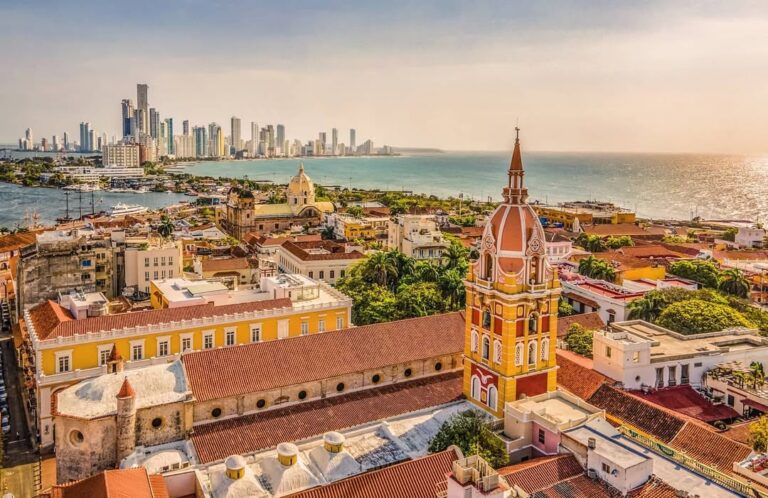
The walled city is the part of Cartagena the photographs are of: the square kilometer of colonial streets, balconies and plazas inside the stone ring the Spanish crown spent two centuries building, with the Caribbean on one side and the bay on the other. It is where the cathedral, the Inquisition’s palace, the oldest church in the city and the best museums are, where the restaurants and most of the boutique hotels are, and where a visitor spends most of the daylight hours whether they planned to or not. It is also small, hot, walkable in an hour end to end, and easier to enjoy with a few facts in hand: what the walls are and why they are there, which gate to enter by, what each plaza was before it was a photograph, what the museums cost in 2026 and on which days they close, what changed on December 29, 2025 when the horses left the streets, and where the heat and the crowds go by the hour. We run tours through these streets every day, our guides live in the city, and this is the walled city as we would explain it on the first morning.
The short version
Enter by the Puerta del Reloj, the clock-tower gate, and you are in the Plaza de los Coches; the Plaza de Bolívar is 230 meters further, the sea wall at the Baluarte de Santo Domingo 550, and Las Bóvedas at the far end 830, so nothing inside the walls is more than fifteen minutes from anything else. Walk the walls at seven in the morning, when the stone is cool and the circuit is empty; do the plazas before ten; spend the heat in the museums, which are the only cool rooms in the city, and eat at midday where the office workers eat; come back to the walls at about a quarter to six for the sunset; and give the evening to Getsemaní, one gate away. The museums close on different days, so read the table before you plan a Monday. Wear no gold chain in a crowd, ask the price of everything before you take it, and if you ride a carriage, know that it is electric now and what the district’s suggested fare is.
What the walled city is, and how big it is
Cartagena was founded in 1533 by Pedro de Heredia on the site of a Carib village called Calamarí, the word for crab, by the Instituto Cervantes’ guide to the city, and for its first half century it had no stone defenses at all. In 1586 Francis Drake walked in along the isthmus where the Avenida Santander runs today, the few defenders in an improvised trench could do nothing, and the city paid him a ransom for which his receipt, in Latin, survives. The walls are the answer to that morning. Felipe II sent the engineers Bautista Antonelli and Juan de Tejeda to fortify the Atlantic ports; a first wall of wood and wattle was begun in 1597; Antonelli and his nephew Cristóbal de Roda conceived the first great bastion, the Baluarte de Santo Domingo, around 1602 on the exact avenue Drake had used, and its first stone was laid on September 8, 1614. The ring was closed piece by piece over the next two centuries, through the French sack of 1697 and the English siege of 1741, and the last big piece, the barracks of Las Bóvedas, was finished in 1798. Colombia’s tourism agency puts the belt at eleven kilometers of walls and gives 1796 as the year the project was complete; the operator of the fortifications, the Escuela Taller Cartagena de Indias, calls the result the most complete colonial fortification in South America, and UNESCO, which inscribed the Port, Fortresses and Group of Monuments of Cartagena on the World Heritage list on November 2, 1984, calls them the most extensive fortifications in South America.
What people mean by the walled city is the part of the historic center inside that ring: the Centro, the original town around the cathedral, and San Diego, the quieter northern half that Cristóbal de Roda added to Antonelli’s plan, where the merchants and craftsmen of the middle class lived, by UNESCO’s description. Getsemaní, the third sector of the World Heritage site, was the suburb outside, with walls of its own and a drawbridge between the two; it is one gate away and has its own guide. The whole inscribed property is 192.32 hectares including the forts, and the walled center itself is about a kilometer across in either direction by the coordinates: 1.1 kilometers from the Baluarte de Santo Domingo at the sea end to the spur of La Tenaza at the northern tip, and 950 meters from the Puerta del Reloj to the Baluarte de Santa Catalina. That is why the whole circuit of the walls is an hour on foot and why the neighborhood works the way it does: everything is close, and the heat, not the distance, decides the day.
The city has three names for the same place. Centro Histórico is the official one, and the one the taxi tariff and the decrees use; Ciudad Amurallada is what the signs and the hotels say; and cartageneros call it the corralito de piedra, the little stone corral. A fourth name belongs to the whole city: La Heroica, which Cartagena received for 1815, when Pablo Morillo’s siege lasted 105 days and about ten thousand people died of hunger and disease rather than surrender the independence declared four years earlier, by the fortifications’ own history.
The walls: which stretch to walk, and when
The walls are free and public in the plainest sense: the ramparts are a promenade, people jog on them at dawn and sit on them at dusk, and there is no ticket and no gate. The stretch worth walking is the sea side. Start at the Puerta del Reloj, climb at the Baluarte de San Ignacio, which Roda finished around 1630 with its guns pointed at the Bahía de las Ánimas and which Herrera y Sotomayor enlarged in 1730, and follow the ramparts west and then north: the Baluarte de Santo Domingo, the pentagon where the walls began, with the great sentry box Herrera added at its point toward the sea; the long curtain of the Marina with the surf below; the Baluarte de Santa Clara; and the arcade of Las Bóvedas under the Baluarte de Santa Catalina, with the fortified spur of La Tenaza beyond it, which Antonio de Arévalo built from 1779 first as a breakwater against the storms that flooded the city every year and then, when he realized the new strip of sand could carry an enemy, as a fort with loopholes and inner ditches, reached from the bastion by a tunnel through the wall. Done at seven in the morning it takes an hour and you meet nobody; done at sunset it is the most crowded place in Cartagena, and worth it once.
The Baluarte de Santo Domingo is the famous sunset spot, and it changed in 2024. For two decades a bar, the Café del Mar, had it under a lease; in 2022 the Consejo de Estado ruled that a private business could not have exclusive use of a public monument, and on September 2, 2024 the district evicted it. The bastion is now called the Baluarte de la Gente, and the Escuela Taller, the school that runs the fortifications, has its own kitchen on top, staffed by the apprentices of its cooking workshop and serving the city’s own dishes; the view is the same, and the stretch of wall just north of it, toward Las Bóvedas, has the same sunset with fewer people. In January 2026 the district and the government of Italy ratified a cooperation program for the conservation of the walls and for pedestrian routes and elevated walkways connecting four zones of the historic center; the works had no published dates when this was written.
The gate and the first two plazas
The Puerta del Reloj is the front door. It was the Boca del Puente, the mouth of the bridge, the only way from the suburb of Getsemaní into the center, by a drawbridge over the San Anastasio canal; the gate built around 1631 was wrecked in the French siege of 1697, and Juan de Herrera y Sotomayor rebuilt it early in the eighteenth century as three bomb-proof vaults, the central one with a Doric arch for the traffic and the two sides for a guardhouse and stores, topped with a spire to hold the city’s clock and bell. The tower you see today, two octagonal bodies and a new spire, is from 1888 and by Luis Felipe Jaspe, a self-taught builder who also gave the city its theater. Cross under the arch and you are in the Plaza de los Coches, which has had six names and kept the one the people gave it. It was el Juez, for the lawyer who lived on the corner in 1536; el Esclavo, when it was the market where enslaved Africans were sold; Los Mercaderes, when the traders set up along one side at the end of the sixteenth century; the Plaza de Yerba; and the Plaza de los Coches when the town council let the carriages park along it at the end of the nineteenth century, and the gallows stood in the middle of it until into the twentieth. The council renamed it Plaza de Ecuador after the 1919 border treaty and nobody has ever called it that. The arcade along its side is the Portal de los Dulces, the sweets sellers, and the carriages that park here now are electric.
The second plaza is the Plaza de la Aduana, the widest and most elegant of the center by the Cervantes guide, where Pedro de Heredia lived in the building that fills one side and from which he and his brother Alonso fought off the French pirate Roberto Baal on July 25, 1544. It became the Plaza de la Aduana in 1790, when the customs administration moved in; the marble Columbus with an indigenous woman at his side was unveiled on October 12, 1894 and the council renamed the square Plaza Colón, then Plaza Rafael Núñez for the four-time president born in the city, and it stayed the Plaza de la Aduana. The Casa de la Aduana holds the offices of the Alcaldía today.
The Plaza de Bolívar, and the four institutions around it
The Plaza de Bolívar is the heart of the colonial city and the place to understand it, because the three powers of the colony still stand around it, the church, the crown’s tribunal and the cabildo, with the central bank’s museum across the way. It was the Plaza de la Catedral first; in 1610 Felipe III’s real cédula of March 8 installed the Tribunal of the Inquisition in Cartagena, two inquisitors, a prosecutor, secretaries and constables, the square became the Plaza de la Inquisición, and on February 2, 1614 it held the first auto de fe. In 1890 the organizers of the independence fiestas held bullfights in it without fences, until a bull gored a citizen who had challenged it; on November 11, 1896 the equestrian Bolívar was unveiled in the middle and the council changed the name. Today it is the shadiest square inside the walls, and the chess games under the trees are a Cartagena institution of their own.
The Palacio de la Inquisición on the west side was finished in 1770, after works that took three quarters of a century; it is three houses, two on the square and one behind, the Casa de los Calabozos, with a baroque portal cut in coral stone and, on the side street, the small barred window with a cross above it, the buzón de la ignominia, where denunciations were left anonymously. The tribunal was suspended at independence, restored after the siege of 1815 and abolished for good in 1821; the state has owned the house since 1945, and it is the Museo Histórico de Cartagena, with the cells and the instruments downstairs and the city’s history, slavery, the tribunal and independence in the rooms above. In 2026 it opens Monday to Saturday from 9 to 6 and Sundays and holidays from 10 to 4, for 24,000 pesos, 20,000 for children, students, teachers and seniors, free under five. Across the square the Banco de la República’s Museo del Oro Zenú is free, no reservation, Tuesday to Saturday from 9 to 5 and Sunday from 9 to 2, closed Mondays; its goldwork and its account of the Zenú canals that drained the flood plains of the Sinú are the best forty cool minutes in the city, and its Monday closure is the reason a Monday visitor should do the Inquisición first.
The cathedral of Santa Catalina de Alejandría, behind the square on the Plaza de la Proclamación, was built between 1577 and 1612 in place of a church of wood and cane; Drake, arriving in 1586 while it was still going up, fired a cannonball into the nave and destroyed three arches. The structure is almost the original; the facade and the dome were remade in 1908, the stone saints of the side street, the Calle de los Santos de Piedra, were replaced by Carrara marble ones, and a sundial still marks the hours on one facade. Inside, the marble pulpit with the four evangelists and the marble floor were the gift of bishop José Díaz de Lamadrid between 1778 and 1792, and among the old images is a Santa Catalina holding a sword said to have been Blas de Lezo’s. The plaza in front is where, on November 11, 1811, the crowd backed the Acta de Independencia that Getsemaní’s militia had forced; the Gobernación de Bolívar, the old cabildo, closes the square on the other side.
San Pedro Claver and the Jesuit corner
Two blocks toward the bay, the Plaza de San Pedro Claver is the corner the Jesuits built. The church, begun early in the eighteenth century and called San Ignacio and then San Juan de Dios before it took the name of the saint, has the richest facade in Cartagena by the Cervantes guide, cut from stone quarried on the island of Tierrabomba, and under its main altar of Italian marble, in a bronze and glass urn given by Leo XIII, lie the remains of Pedro Claver, the Jesuit who spent four decades meeting the slave ships in the port and died in the city in 1654. The Jesuits were expelled in 1767, and twice more in the republic’s first decades, and their college next door became a barracks and is now the Museo Naval del Caribe. The sanctuary and its museum open Monday to Friday from 9 to 4:30 and weekends and holidays from 10 to 4; foreign adults pay 30,000 pesos and foreign children, students and over-60s 22,000, Colombians 21,000 and 13,000, under-6s free. The Museo Naval, in the former college on the Calle San Juan de Dios, opens every day from 10 to 6, from 9 in the holiday seasons, for 24,000 pesos, 10,000 for students and 5,000 for children. On the same plaza, beside the Baluarte de San Ignacio, the Museo de Arte Moderno opens Tuesday to Friday from 11 to 6 and weekends from 11 to 5, closed Mondays, for 25,000 pesos at the full rate, 15,000 for children, 20,000 and 10,000 at the national rate with ID. The bronze figures on the plaza, the stone benches and the bastion behind make this the best corner of the center in the last hour of light.
Santo Domingo, and the streets with names
The oldest church in Cartagena is Santo Domingo, finished in 1559 by the Dominicans in five stages and constant poverty, on the plaza of the same name at the sea end of the center. When the walls were nearly done the friars found the foundations shifting and the street beside it in danger of sinking, so they threw buttresses across the lane, and the lane is the Callejón de los Estribos, the alley of the buttresses, the most Spanish corner of the city by the Cervantes guide. The bell tower leans, visibly, and the story cartageneros tell is that the devil, furious that the towers were going up, leapt from the plaza, hung from one and shook it, failed, and dived into the well in the middle of the square, whose water tasted of sulfur ever after; the architects’ explanation is that the facade sits on the street line of 1594 and the tower was built square to the cloister rather than to the facade. Behind it, the Calle de Santo Domingo and the Calle de la Factoría run north through the merchants’ quarter, past the Casa del Marqués de Valdehoyos, the eighteenth-century mansion of a man whose privilege was importing flour and enslaved people, where Bolívar stayed twice after liberating the city and which is a foreign-ministry building today. The house names on this side of the center are the ones the tours use; a guide who knows them turns a walk of eight blocks into the whole colonial economy.
San Diego: the quiet half
North of the Calle de la Factoría the center changes. San Diego was not in Antonelli’s plan; Cristóbal de Roda added it, and it filled with the artisans and the tradespeople rather than the merchants, which is still what it feels like: lower houses, the Plaza de San Diego and the Plaza Fernández de Madrid with their restaurant tables, fewer shops and, in the evening, the neighborhood’s own quiet. It ends at the northern tip in the three works that closed the ring. The Baluartes de Santa Catalina and San Lucas were begun after 1614 under the governor Diego de Acuña to shut the northeast, the one facing the sea and the other the Juan Angola creek, and finished in 1638; Santa Catalina was rebuilt in 1719 after the French bombardment. Between them the Cuartel de Las Bóvedas, the last great work of the last of the Spanish engineers, Antonio de Arévalo, was built between 1792 and 1798, the year on the royal arms over the central arch: twenty-three bomb-proof barrel vaults behind an arcade of forty-seven arches, built so that the troops would sleep inside the stretch of wall they had to defend, with two chimneys at the ends to move the air. They were barracks, then a prison in the wars of independence, where Francisco de Paula Santander was held, then a munitions store and a liquor warehouse, and they are the craft market now, the one place inside the walls to buy a hammock or a mochila from a stall with a roof over it. Beyond them is the spur of La Tenaza, and behind them, on the Plaza de la Merced, is the theater.
The Teatro Adolfo Mejía is Luis Felipe Jaspe’s other building, raised inside the abandoned chapel of La Merced of 1625 and opened on November 13, 1911 as the Teatro Municipal, one of the works for the first centenary of independence; a horseshoe of boxes behind pierced screens, Carrara marble stairs made in Italy, and, from the restoration finished in 1998, Enrique Grau’s nine muses on the ceiling and his Cartagena on the curtain. It was the Teatro Heredia from 1933, a cinema from 1937, closed for its own safety from 1970 to 1998, and reopened on July 31, 1998 under the name of the composer Adolfo Mejía. There are no published visiting hours; the way in is a ticket to a performance, and in January it is the main hall of the city’s classical music festival.
The museums inside the walls, with 2026 hours and prices
These are the prices on the institutions’ own pages in September 2026, in pesos; the fort is outside the walls and on the same morning, so it is here too. The closing days are the thing to plan around: the Zenú and the Museo de Arte Moderno close on Monday, the Inquisición and the Naval do not, and San Pedro Claver opens later on weekends.
| Place | Where | Open | Closed | Foreign adults | Colombians and reductions |
|---|---|---|---|---|---|
| Museo Histórico de Cartagena, Palacio de la Inquisición | Plaza de Bolívar, west side | Mon to Sat 9 to 6, Sun and holidays 10 to 4 | Never | 24,000 | 24,000; children, students, teachers and seniors 20,000; under 5 free |
| Museo del Oro Zenú, Banco de la República | Carrera 4 No. 33-26, Plaza de Bolívar | Tue to Sat 9 to 5, Sun 9 to 2 | Mondays | Free | Free |
| Santuario de San Pedro Claver and its museum | Carrera 4 No. 30-01, Plaza de San Pedro Claver | Mon to Fri 9 to 4:30, Sat, Sun and holidays 10 to 4 | Never | 30,000; children, students and over-60s 22,000 | 21,000; children, students and over-60s 13,000; under 6 free |
| Museo Naval del Caribe | Calle San Juan de Dios, the former Jesuit college | Every day 10 to 6, from 9 in holiday seasons | Never | 24,000 | 24,000; students 10,000; children 5,000 |
| Museo de Arte Moderno | Plaza de San Pedro Claver, by the Baluarte de San Ignacio | Tue to Fri 11 to 6, Sat and Sun 11 to 5 | Mondays | 25,000; children 15,000 | 20,000; children, students and seniors 10,000 with ID |
| Castillo de San Felipe de Barajas | On the hill of San Lázaro, 1.1 km from the gate | Every day 7 to 6 | Never | 38,000; children 6 to 13 and students 16,000 | 33,000; free over 62, under 6 and the last Sunday of the month except January and December |
The walls, the plazas, the churches at Mass and the arcade of Las Bóvedas are free. The theater sells only performance tickets. Guides and audio guides are not included anywhere on this list, and the fort’s are hired at its gate.
The carriages, and what changed in December 2025
For as long as anyone can remember, the ride through the walled city was a horse carriage from the Plaza de los Coches, and every guide, ours included, told people to skip it because of what the heat and the stone did to the horses. That ended on December 29, 2025. The district’s Decreto 2296 de 2025, signed on December 22, prohibits animal-drawn carriages in the historic center and the whole walled belt from the day the first electric carriages started to run, and on December 30 the mayor presented the first twenty-four on the Plaza de los Coches; the free pilot rides that followed ended on June 12, 2026, when sixty electric carriages, charged by solar panels at a depot in Chambacú, were handed over to the more than 150 families who had lived from the horses. The service runs every day from 9 in the morning to 11 at night, no reservation, paid to the driver in cash or by card with an electronic receipt on request, four adults or three adults and two children per carriage. The district’s suggested fares, which it publishes as informative and not fixed, are 170,000 pesos for a thirty-minute loop and 300,000 for an hour in low season, and 200,000 and 350,000 in high season, which it defines as December 15 to January 15, Holy Week, July and August, the October recess week and the fiestas of the first half of November; private hire is from 300,000 an hour. The boarding points are the Plaza de los Coches, the Plaza de la Aduana, the Parque Bolívar, the Plaza de San Pedro Claver, the Plaza de San Diego, the Serrezuela, the Baluarte de Santo Domingo and the Corredor Histórico. Our advice has changed with the horses: the ride is a fair way to see the center at night if you have the money and the legs are tired; ask the fare before you sit, because the list is suggested, not fixed.
What to eat inside the walls
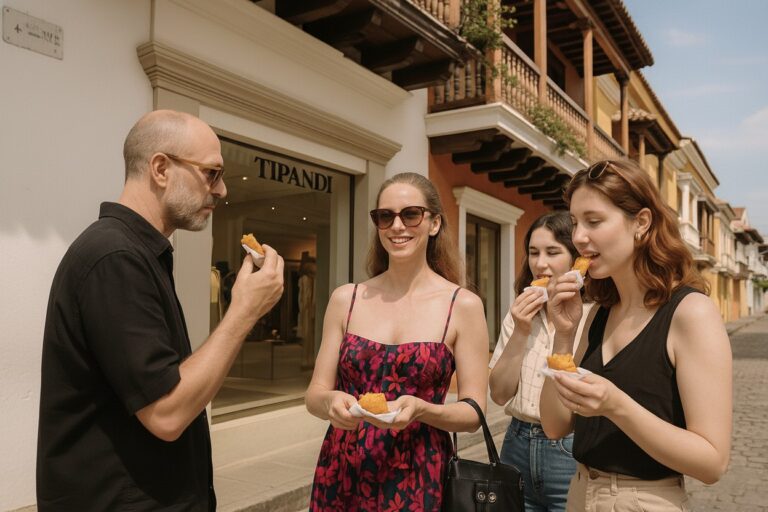
The center eats on the street and in the plazas as much as in the restaurants, and the heat sets the menu: fried things in the morning, the arepa de huevo, the carimañola of yuca and the empanadas, from carts and windows that have been frying them the same way for decades; fruit from the palenqueras, the women in the bright dresses whose families come from San Basilio de Palenque, whose bowls of mango, papaya and pineapple are a snack and whose photograph is a transaction, so agree the tip before you raise the phone and pay it gladly; the sweets of the Portal de los Dulces, cocadas and tamarind and the coconut and milk sweets that came with the African kitchen; coconut lemonade everywhere; and at midday the fish, the coconut rice and the patacones where the office workers eat, which is the rule for not paying five times the price. Our four-hour food walk of the walled city is built around five tastings, salty, sweet and drunk, with a guide who knows the vendors by name, and it is the best use we know of the hottest hours of the day.
Where to stay: inside the walls, or not
There are four honest choices and they are ten minutes apart. Inside the walls, the Centro is the colonial city at its densest, the restaurants and the plazas at the door, the noise until late and the prices to match; San Diego, the northern half, is the same architecture with quieter streets, Las Bóvedas and the sea wall at the end of the block, and it is where we would put a couple who want the center and their sleep. Outside the gate, Getsemaní is the neighborhood of the nights, one-story houses, hostels and boutique hotels and the plaza that fills every evening, five minutes from the Puerta del Reloj on foot; and Bocagrande, across the bay, is the towers and the beach, two kilometers away by taxi, the choice for families who want a pool and a swim from the hotel and are happy to come into the center by car. One practical note for anyone booking inside the walls: the airport taxi tariff has no zone called Centro, so a hotel here falls between the Getsemaní line and the Muelle de la Bodeguita line; the driver will name one of the two, and our airport guide has the whole table. We name no hotels on this page and take no commission from any. Every neighborhood of the city compared, with the distances, the airport fares and the rules before you book, is in our guide to where to stay in Cartagena.
Is the walled city safe?
Yes, by day and by night, and it is the part of the city where theft fell fastest in 2026 by the police’s own figures, which are in our Cartagena safety guide. The center is walled, policed and busy until late, and the things that reach visitors here have a shape: a gold chain snatched off a neck in a crowd, sometimes by a group that closes in; a phone taken from a hand on a crowded corner; a bill that is several times what it should be; a drink that was not watched. So the rules are the center’s own: no gold chain on the street, the phone in the pocket in the crowds of the Plaza de los Coches and on the walls at sunset, the bag in front, every price agreed before you sit, and after midnight the lit streets rather than the dark ones. The vendors, the palenqueras and the touts are persistent and not dangerous; a smile and a firm no is the whole technique. A licensed or app taxi back to Bocagrande after dark rather than the walk along the causeway, and the same to Getsemaní’s outer streets after the bars close.
Getting to the walled city, and around it
From Rafael Núñez airport the Puerta del Reloj is 4.4 kilometers in a straight line and about fifteen minutes by car. Under the district’s 2026 taxi tariff, Decreto 0051 de 2026, the fixed fare from the official stands at the terminal is 24,300 pesos to the Muelle de la Bodeguita, the pier beside the clock tower, and 20,200 to Getsemaní, with 1,100 more at night from 7 p.m. to 5 a.m.; the Transcaribe T102 bus stops a street from the terminal and costs 3,900 pesos with a card; and a private transfer with the driver waiting inside the terminal with your name, which is what we book for our guests through Safe Transfers, our transfer company, starts at 49 US dollars. Our airport guide has the three ways in side by side. Inside the walls everything is on foot, and the distances from the Puerta del Reloj by the coordinates are these: the Plaza de Bolívar 230 meters, the Plaza de San Pedro Claver 260, the Plaza Santo Domingo 330, the theater 450, the Muelle de la Bodeguita 490, the Plaza de la Trinidad in Getsemaní 500, the Baluarte de Santo Domingo 550, Las Bóvedas 830, the Castillo de San Felipe 1,080 and Bocagrande 2,150. The hours matter more than the meters: the streets belong to the morning until ten and to the evening from four, and the heat between is for museums, lunch and a siesta.
The calendar
The driest months are December to March, when the trade wind blows along the walls and the evenings are pleasant; the rains run from May to November with October the wettest, when a short violent afternoon storm floods the low streets and the plazas dry within the hour; and the sunset lands between about a quarter to six and half past six all year, which is when the walls fill. The whole month-by-month table, from IDEAM’s normals, is in our Cartagena weather guide. The center’s own weeks are the Cartagena Festival Internacional de Música, whose twenty-first edition runs from January 9 to 17, 2027 with the theater as its main hall and the walled city as its stage; the Hay Festival, January 28 to 31, 2027; the film festival FICCI, April 6 to 11, 2027; and the Fiestas de Independencia in the first half of November, with the Gran Desfile on November 12 in 2026. Those weeks are also the carriages’ high season and the hotels’.
A day inside the walls, in the order we would walk it
Seven in the morning on the walls from San Ignacio to Las Bóvedas, an hour, with the stone cool and the sea loud; then down into San Diego for a coffee on the Plaza de San Diego and the walk south through the Calle de la Factoría past the Valdehoyos house to the Plaza Santo Domingo, the leaning tower and the Callejón de los Estribos, while the streets still belong to the neighborhood. By half past nine the Plaza de Bolívar: the Inquisición first if it is a Monday, the Zenú first any other day, and the cathedral between them. At noon the fish and the coconut rice where the office workers eat, or the food walk if you booked it, then the Museo Naval or the Museo de Arte Moderno in the heat and a siesta at the hotel. At a quarter to six back on the walls at the Baluarte de Santo Domingo or the quieter stretch just north of it for the sunset, and at eight through the Puerta del Reloj to Getsemaní for the plaza and the night. If you have a second day, the Castillo de San Felipe at seven and the Rosario Islands or Playa Blanca on the water; our guide to the whole city has the days laid out by the clock. The fort itself, from the bonete of 1657 to Arévalo’s batteries, with the 2026 ticket, is in our Castillo de San Felipe guide.
What we do differently, and what we cannot promise
Our city tour walks the center in the first hours of the morning, before the heat and before the groups, with a guide who lives here and can read the house names, and it puts the fort and Getsemaní in the same morning so the walled city is understood as one thing with two neighbors rather than a stage set; our food walk does the same streets by their kitchens. What we cannot promise is the weather, which in October will send you under an arcade for twenty minutes, the exact opening of any church outside Mass, which depends on the parish, or the price of a carriage, which the district suggests and the driver sets. Every hour and price on this page was read on the institutions’ own pages on September 12, 2026 and will be read again; when a museum changes its tariff, this page changes.
Questions travelers ask
Where is the walled city in Cartagena?
On the point between the Caribbean and the Bahía de las Ánimas, 4.4 kilometers southwest of the airport in a straight line and two kilometers north of the towers of Bocagrande. Its front door is the Puerta del Reloj, the clock-tower gate, opposite the Camellón de los Mártires and Getsemaní.
How big is the walled city?
About a kilometer across in either direction: 1.1 kilometers from the Baluarte de Santo Domingo to La Tenaza and 950 meters from the Puerta del Reloj to the Baluarte de Santa Catalina, by the coordinates. The circuit of the sea walls is an hour on foot, and no two points inside are more than fifteen minutes apart. The whole World Heritage property, with the forts, is 192.32 hectares.
Why is Cartagena called the walled city?
Because of the eleven kilometers of walls the Spanish crown built around it between the first stone of the Baluarte de Santo Domingo on September 8, 1614 and the completion of the belt in the 1790s, after Francis Drake had taken the undefended city in 1586. The walls still stand almost entire, which is why UNESCO listed the port, the fortresses and the monuments in 1984.
Is the walled city safe at night?
Yes, on the main streets, which are lit, policed and busy until late. The risk is theft of chains and phones in crowds, not violence; wear no gold, keep the phone in the pocket, and take a taxi rather than a walk back to Bocagrande after dark. The figures and the habits are in our safety guide.
What is there to do in the walled city?
Walk the walls at dawn and at sunset, the plazas before ten, the six places in the table above in the heat, the food on the street and in the plazas, the arcade of Las Bóvedas, a performance at the theater if there is one, and the electric carriage at night if you want it. The fort, the islands and Getsemaní are the days and the nights around it.
Should I stay inside the walled city?
If you want the colonial city at the door and do not mind the noise and the prices, yes, and San Diego rather than the Centro if you want to sleep. Getsemaní is five minutes away and cheaper and livelier; Bocagrande is the beach and the pool, ten minutes by car.
How do I get from the airport to the walled city?
A fixed-fare taxi from the official stands at the terminal, 24,300 pesos to the Bodeguita pier by the clock tower or 20,200 to Getsemaní under the 2026 tariff, plus 1,100 at night; the T102 bus for 3,900; or a private transfer with the driver inside the terminal from 49 US dollars with Safe Transfers, our transfer company.
Plan it with us
Write to us on WhatsApp with your dates and we will put the walled city into the right hours of the right day, with the fort, Getsemaní and the water around it, or start with our Cartagena tours and our guide to the city. The city as a whole, from what it is to how many days it needs, is in our Cartagena travel guide.
Sources
The facts on this page were checked on September 12, 2026 against the following sources: UNESCO’s listing of the Port, Fortresses and Group of Monuments of Cartagena (1984, 192.32 hectares); Fortificaciones Cartagena de Indias, the Escuela Taller’s site, for the history of the walls, the Boca del Puente, the Baluarte de Santo Domingo, the Cuartel de Las Bóvedas, the title of La Heroica and the fort’s 2026 tariff; ProColombia for the eleven kilometers and the year 1796; the Instituto Cervantes’ guide to Cartagena de Indias for the founding, the Plaza de los Coches, the Plaza de la Aduana, the Plaza de Bolívar, the Palacio de la Inquisición, the cathedral, San Pedro Claver, Santo Domingo, the Baluartes de Santa Catalina and San Lucas and La Tenaza; the IPCC for the theater; the Museo Histórico de Cartagena, the Museo del Oro Zenú, the Santuario de San Pedro Claver, the Museo Naval del Caribe and the Museo de Arte Moderno for their hours and prices; the Alcaldía de Cartagena’s electric carriages page and its notices of December 26, 2025 and June 12, 2026, and its notice of January 13, 2026 on the cooperation with Italy; El Universal of December 30, 2024 on the eviction of the Café del Mar, which is press and not an official source; the Cartagena Festival Internacional de Música, the Hay Festival and FICCI for their 2027 dates; and our own Cartagena guides to the city, its safety, its airport and its weather, each sourced in place, for the taxi tariff, the police figures and IDEAM’s normals. Distances are calculated from coordinates.