September 12, 2026
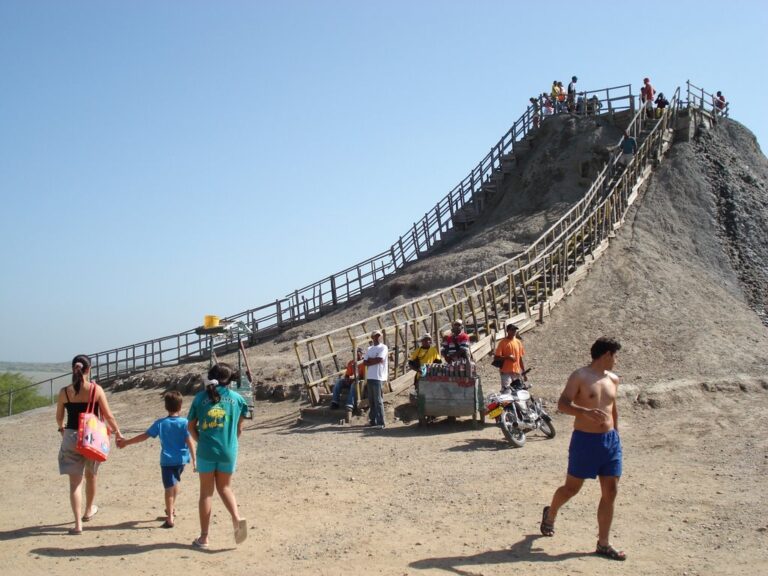
El Totumo is a mud volcano an hour northeast of Cartagena: a cone of grey clay with a wooden staircase up its side and a pool of warm, thick mud at the top that you climb into, float in, get massaged in, and then wash off in the lagoon at its foot with the help of the women of the village. It is the strangest morning most people spend on the Colombian coast, it is on almost every list of things to do in Cartagena, and almost everything written about it is either a brochure or a complaint. We run the day regularly as a private tour with a beach afternoon at Manzanillo del Mar, so this is the guide we give our own travelers before they book: what the volcano actually is by the country’s geologists, what happened when it erupted, what the visit is like minute by minute, what it costs and who the money goes to, what to wear, whether it is safe, and whether it is worth a day of a short trip.
The short version
El Totumo is real geology, not a theme park: one vent of a low mud volcano on the line between the departments of Bolívar and Atlántico, in the municipality of Santa Catalina, about 50 kilometers from the walled city in a straight line and an hour by road. The visit is short, about half an hour in the mud and half an hour rinsing off, and the rest of the day is what you make of it, which is why we pair it with lunch and an afternoon on the beach at Manzanillo del Mar. The entrance is included in our tour; for independent visitors the press put it at 20,000 pesos in 2025, with the massage, the minding of your things, the photos and the rinse paid as tips to the people who do them. Bring a swimsuit, old clothes, a towel and a full change of dry clothes, and small notes. It is worth it if you like an odd, funny, slightly grubby morning and a quiet beach; it is not a spa, and it is not the day to choose over the Rosario Islands if you only have one day out of the city.
What El Totumo is, by the geologists
The Colombian Caribbean between the Gulf of Urabá and Barranquilla sits on what the Servicio Geológico Colombiano calls the Sinú belt, a band of rocks where clay under high pressure, mixed with gas, pushes up through fractures toward the surface, lifting and cracking the ground and spilling out as mud and gas. Geologists call the phenomenon mud diapirism, and its surface expression is the mud volcano: a dome-shaped hill with convex slopes and a flat or trough-shaped top. The Servicio Geológico’s catalogue of the mud volcanoes of the central Caribbean, by José Henry Carvajal and Domingo Mendivelso, lists El Totumo as its number seven, and describes it precisely: a structure 800 to 1,000 meters across and 25 meters high on the boundary of Atlántico and Bolívar, east of the village of Pueblo Nuevo, with a trough-shaped crater 25 to 30 meters across on top, eight to ten small vents in it, and several cone-shaped vents on its flanks from which grey mud and gas emerge. The best known of those vents is the cone of El Totumo, the one with the staircase. The gas the geologists sampled at it was 89 percent methane, which is what the bubbles rising through the mud are, and a good reason to leave the lighter in the car. The mud is clay, mostly kaolinite and smectite, grey, warm to the touch and dense enough that you float in it whether you want to or not.
The eruptions, honestly
Mud volcanoes erupt, and this one’s neighborhood has. On April 27, 1999, the mud volcano of Pueblo Nuevo, the larger structure just west of El Totumo, threw out about 60,000 cubic meters of mud in a violent eruption whose flow ran down its northwest side to a shrimp farm and the edge of the Los Olivos neighborhood; by El Universal’s account on the twenty-fifth anniversary, 57 families were evacuated and one man died of a heart attack from the shock. El Totumo’s own structure produced an eruption of about 35,000 cubic meters on August 23, 2000, in the geologists’ record. In 2014 the Servicio Geológico warned, again by the press’s account, that an eruption could come at any moment because the usual interval between major events had passed. And on November 8, 2022, after weeks of rain, about a fifth of the cone slid away and the department’s risk office, on the municipality’s recommendation, ordered the tourist activity suspended until the structure dried out and could be repaired. It reopened, and the Servicio Geológico keeps GPS stations on the tops of Pueblo Nuevo and El Totumo that record the ground sinking by 17 to 35 millimeters a year. None of this is a reason not to go; it is the reason to go with people who know the place and to treat the rim as what it is, the top of a live geological feature rather than a swimming pool.
Where it is, and how the day gets you there
El Totumo is in the municipality of Santa Catalina, in the north of the department of Bolívar, with the department of Atlántico on the other side of the structure and the Ciénaga del Totumo, the lagoon where you rinse, beside it. From the Puerta del Reloj it is about 50 kilometers to the northeast in a straight line, and the road is the Vía al Mar, the coast road toward Barranquilla, with a turn inland at Loma de Arena; in a car it is about an hour each way. On our private day your guide picks you up at your hotel in the walled city, Getsemaní, Bocagrande or wherever you are staying in the city, drives the hour, walks you up, waits with your things, and drives you on to lunch and the beach; the road figures for the whole coast road, from the national concession’s numbers, are on Safe Transfers’ Cartagena to Barranquilla page. If you drive yourself, leave early: in our experience the cone is busiest in the late morning, when the shared tours from the city arrive.
The visit, step by step
You arrive at a flat, dusty clearing with the cone in front of you and the lagoon behind it. You undress to your swimsuit, hand your things to the person minding them (on our tour, your guide), and climb the wooden staircase up the side of the cone, which takes a few minutes and is steeper than it looks in photographs. At the top is the pool: a small crater of grey mud that you lower yourself into, shared with whoever else is up there. The mud holds you up; you cannot sink, and moving is slow and comic. Local masseurs work the pool, spreading mud over your shoulders and back for a few minutes, and the helpers at the rim take photos with your phone if you want them, which is the moment to have handed the phone to someone you trust. Half an hour is plenty. You climb out, walk back down with mud drying grey on you, and go to the edge of the ciénaga, where the women of the village take you into the shallow lagoon, pour water over you and scrub the mud off you with their hands, hair included, with a matter-of-factness that is the part everyone talks about afterward. Then you dry off, change into the dry clothes you brought, and the day moves on.
What it costs, and who the money goes to
El Totumo is a public place maintained by the community around it, not a private park, and the money works the way it does at every beach on this coast: a fixed entrance and a set of services paid separately, in cash, to the people who provide them. On our tour the entrance is included; in February 2025 El Universal put it at 20,000 pesos for independent visitors, with the massage, the minding of your belongings, the photographs and the rinse in the lagoon paid as voluntary tips, and that is the structure you will find. Nobody will show you a price list for the tips, so decide before you climb what you will give each person, carry it in small notes in a pocket of the dry clothes, and hand it over yourself at the end; a few thousand pesos to each of the four people who touched your morning is normal, and the people who do this work live on it. Do not argue about it at the rim, covered in mud, with your wallet in someone else’s hands. On our day the guide handles the entrance and tells you what is customary before you get out of the car.
What to wear and what to bring
A swimsuit you do not care about, because the clay stains; old shorts and a T-shirt over it for the drive; a towel that can be sacrificed; a complete change of dry clothes for the rest of the day, including underwear; a plastic bag for the muddy things; flip-flops rather than shoes; and sunscreen for after the rinse, not before, because the mud takes it off. Leave jewelry in the hotel safe, take your glasses off before you get in, and give your phone to your guide or to the minder before you climb rather than trying to hold it in the mud. If you wear contact lenses, keep your face out of the mud. Bring a bottle of water. Everything else, lunch included, is on the tour.
Is El Totumo safe?
For a visitor, the risks are ordinary ones. The staircase is wood, worn and steep, and the mud carried onto it makes it slippery; hold the rail and take it slowly, going up and especially coming down. The sun on the cone is direct and there is no shade until the lagoon, so do the volcano in the morning and keep a hat on until you are in the mud. The lagoon is shallow and calm where the women work. The geology is monitored, the eruptions in the record are years apart and the last serious event at the cone itself was the 2022 slide, after which the site was closed and repaired before reopening; if the department’s risk office closes it again in a wet season, the district and the press announce it, and we move the day. The risk here is not crime; it is the bill, which the paragraph above settles. The one rule that is not obvious: the gas rising through the mud is methane, so no cigarettes or lighters anywhere near the pool.
Manzanillo del Mar, and the rest of the day
The volcano is a morning, and the reason the day works is what comes after it. On our tour the car turns back toward the city and stops at Manzanillo del Mar, a village on the coast north of La Boquilla, about twelve kilometers from the clock tower in a straight line, for a lunch of fried or stewed fish, coconut rice, salad and patacones, cooked the way this coast has cooked it for generations and included in the price, and then four and a half hours on a beach with fewer vendors, fewer visitors and more room than anything inside the city, with the towers of Bocagrande on the horizon to the south. It is not the white sand of Barú, which is the honest comparison in our beaches guide; it is a long, quiet, local beach for an afternoon of doing nothing after a morning of doing something ridiculous, and the guide drives you back to your hotel when you have had enough. The month to prefer is any month in the dry season, December to April, when the road and the cone are dry; in October and November, the wettest months by the IDEAM’s numbers in our weather guide, the clearing is mud of a different kind and the slide of 2022 is the reminder of what rain does to the cone.
Is it worth it?
Yes, if you like an experience that is odd, physical and funny, if you are traveling with people who will laugh at each other covered in grey clay, and if you have a day to give to the country north of the city rather than to the sea. No, if what you want is a spa, a beautiful natural setting or a beach day, because El Totumo is none of those: it is a clay cone on a flat plain beside a lagoon, with a car park and vendors, and the pleasure of it is the absurdity and the people, not the scenery. We make no health claims for the mud. What we can promise is that your skin feels different for a day, that the photographs are the ones your friends ask about, and that the afternoon at Manzanillo del Mar is the quietest beach most of our travelers see on the coast.
El Totumo, the islands or Palenque: which day out of the city
With one day out of Cartagena, take the water: the Rosario Islands on a private boat, or, with children, the day at Playa Tranquila on Barú. With two, the choice is between El Totumo with Manzanillo, which costs less, starts earlier and ends earlier, and gives you the coast north of the city instead of the sea south of it, and San Basilio de Palenque, the village founded by escaped slaves an hour and a half inland, which is the day with the most to say; for most travelers we say Palenque, for a family with small children the volcano, and with three days you do both. The village, from the documents to the visit hour by hour, is in our San Basilio de Palenque guide. The whole city, from what it is to how many days it needs, is in our Cartagena travel guide, and every day trip and city tour we run, with the 2026 prices, is in our guide to things to do in Cartagena.
Questions travelers ask
What is the El Totumo volcano?
A mud volcano: not lava, but clay and gas pushed up from below through fractures in the ground, a phenomenon the Servicio Geológico Colombiano calls mud diapirism and which is common along the coast between the Gulf of Urabá and Barranquilla. The structure is a low dome 800 to 1,000 meters across and 25 meters high on the line between Bolívar and Atlántico; the cone you climb is its best-known vent, and the gas bubbling through the mud is mostly methane.
How far is El Totumo from Cartagena?
About 50 kilometers northeast of the walled city in a straight line, in the municipality of Santa Catalina, Bolívar, and about an hour by road on the Vía al Mar toward Barranquilla with a turn inland at Loma de Arena. Our tour picks you up at your hotel and drives it.
How much does El Totumo cost?
On our tour the entrance is included, with the private guide, the transport, lunch and the beach afternoon, from 138 US dollars per person for two travelers. For independent visitors the press put the entrance at 20,000 pesos in February 2025, with the massage, the minding of your things, the photos and the rinse paid as voluntary tips in cash to the people who do them.
Can you visit El Totumo without a tour?
Yes, by car, an hour each way on the coast road with the turn at Loma de Arena, paying the entrance and the tips yourself and minding your own things while you are in the mud. The tour buys you the hotel pickup, someone you trust holding your phone and wallet, the entrance handled, and the lunch and beach afternoon that turn a half-hour bath into a day.
Is El Totumo safe? Can it erupt?
Mud volcanoes do erupt: the neighboring Pueblo Nuevo volcano did in April 1999 and El Totumo’s structure did in August 2000, the Servicio Geológico monitors both with GPS stations, and in November 2022 the site was closed after part of the cone slid in the rains, then repaired and reopened. Day to day the risks are the slippery stair, the sun and the bill; hold the rail, go in the morning, decide the tips before you climb, and keep lighters away from the methane.
What should I wear to El Totumo?
An old swimsuit under old clothes, flip-flops, a towel you can throw away and a complete change of dry clothes for the afternoon, with a plastic bag for the muddy things. Glasses off and phone handed to your guide before you climb; sunscreen after the rinse, not before.
Is El Totumo worth it?
Yes for an odd, funny morning and a quiet beach afternoon, no if you want a spa, scenery or a beach day, and never as the one day out of Cartagena if the Rosario Islands are still on the list. Do it on the second day out of the city, with Manzanillo del Mar after it.
Plan it with us
Our El Totumo day is private: your own guide, your own car from your hotel door, the entrance handled, the volcano in the morning before the buses, lunch by the sea and the afternoon on the beach at Manzanillo del Mar, back at your hotel when you say so. The other days out of the city we run, the private boat to the Rosario Islands, the day at Playa Tranquila and San Basilio de Palenque with a guide from the village, are on our Cartagena tours page. Write to us on WhatsApp with your dates and your hotel, or start with the rest of our Colombia guides.
Sources
The facts on this page were checked on September 12, 2026 against the following sources: Volcanismo de lodo del Caribe central colombiano, by José Henry Carvajal Perico and Domingo Mendivelso, published by the Servicio Geológico Colombiano, for what a mud volcano is, the Sinú belt, the catalogue entry for El Totumo (v-7: dimensions, vents, clay, gas), the Pueblo Nuevo eruption of April 27, 1999, the El Totumo eruption of August 23, 2000 and the GPS monitoring; El Universal of May 1, 2024 for the evacuation and the death in 1999 and the Servicio Geológico’s 2014 warning, El Universal of February 12, 2025 for the entrance fee and the tips, and Semana of November 8, 2022 for the closure order (press, non-authoritative); our own tour page for the day’s program, inclusions and price, read today; and our Cartagena beaches and weather guides, each sourced in place. Distances are calculated from coordinates.