September 12, 2026
The short version
Jardín is a coffee town of about fifteen thousand people in the mountains of southwest Antioquia, 131 kilometers and a little over three hours from Medellín by the department’s own figure, with a stone basilica on a plaza that was declared a national monument in 1985 and that fills with families and coffee growers at dusk. It is one of Colombia’s eighteen official heritage towns, and in November 2024 the United Nations’ tourism agency named it one of its Best Tourism Villages. Most people who come to Antioquia and leave the city go to Guatapé. If you only have one day out of Medellín and want to see what the department looks like away from the valley, this is the one we would pick, and we run it as a private day with a working coffee farm built in.
That is the postcard, and it is true. This page also tells you three things the postcard leaves out. The earthquake of 10 August 2026 cracked the basilica and brought down objects and pieces of its interior, and while nobody in Jardín was hurt, what you can see inside the church on the day you visit is a question for the parish, not for us. The road in is a mountain road that landslides close in the rainy months, and when it closed in May 2025 the town lost 97 percent of its visitors in a fortnight. And the countryside around Jardín, like the whole of the Suroeste, has had two years of killings between armed groups fighting over extortion and drug-selling territory, which the police’s own open data puts at eleven homicides in the municipality in 2025 and twelve in the first half of 2026, up from two in all of 2024. None of that has touched a visitor in any report we could find, and we explain below why the day trip is unaffected. But you should read it here rather than on a news site after you book.
If you read one paragraph, read this one. Go on a day trip if the plaza, the basilica, the coffee farm and the drive are what you want; stay the night if the birds are, because the cock-of-the-rock reserve is a late-afternoon thing and the day trip has left by then. Check the road the day before. Ask the parish whether the church is open. And keep your evening to the plaza and the lit streets, which is what everyone in Jardín does anyway.
What Jardín is
The town was founded on 23 May 1863 and became a municipality on 3 March 1882, and by the Gobernación de Antioquia’s account its grid of streets was laid out by a priest, José María Gómez Ángel, which explains why the plaza and the church sit at the exact center of everything. The department gives its temperature as 18 degrees and its population as 15,293 on the 2022 projection; the municipality’s own submission to the United Nations agency describes 201 square kilometers running from 1,400 to 3,200 meters above the sea, with an average of 19 degrees (the heritage network’s own page for the town says 224 square kilometers and the same range), and the town itself sits in the lower part of that range, a few hundred meters above Medellín and noticeably cooler. The name, by the Gobernación’s telling, comes from the first settlers arriving from the Alto de las Flores and finding a valley of yarumo trees between two streams, which they called a garden.
Three official labels matter for a visitor. The Parque El Libertador and the church were declared a Monumento Nacional by Decreto 1132 of 24 April 1985, which is why the plaza has kept its shape and its colors. Jardín is one of the eighteen municipalities in the Red Turística de Pueblos Patrimonio, the national network created in 2010 for towns whose center is a national heritage asset, which Jardín joined in 2012, alongside Jericó and Santa Fe de Antioquia in the same department. And on 15 November 2024 UN Tourism named it a Best Tourism Village, one of 55 towns from 23 countries that year; the Ministry of Commerce’s release credits the town’s landscape, its sustainable-destination certification, and the first ethno-tourism route in Antioquia, run with the Emberá Chamí community of the Karmata Rúa reserve inside the municipality, and quotes the mayor saying that 58 percent of the municipal territory is natural reserve.
What Jardín is not: it is not in the coffee triangle. The Paisaje Cultural Cafetero and the towns of Salento and Filandia are a department and a half to the south, and our coffee region guide covers that country and what the earthquake did to it. Jardín is Antioquia’s coffee, steeper and smaller-scale and, by the growers’ federation’s own figure, mostly picked between September and December, when seven of every ten beans in the department come off the bush. If you want a working farm and a heritage plaza within a day of Medellín without flying anywhere, this is it.
The road from Medellín, which is the real constraint
Jardín is south-west of the city, past the exit at Ancón Sur and down through the coffee hills of Amagá, Bolombolo and Andes to the last climb into the town. The Gobernación’s figure is 131 kilometers and three hours twenty minutes; the Terminal del Sur’s is 134 kilometers; our own drivers plan on about three hours each way in a private car, which is why our day starts early. The first half of the road changed in March 2025, when the 4G concession Pacífico 1 opened its last section, between Camilo C and La Siria, as reported by El País, completing the new highway between the south of the valley and Bolombolo. The last stretch, from Andes up to Jardín, is still a mountain road.
The road is the thing to check the day before, and we mean that literally. In May 2025 landslides closed the Troncal del Café, the trunk road the Suroeste depends on; Jardín’s tourism secretary told El Colombiano that arrivals fell 97 percent, that the Mother’s Day weekend saw almost total cancellations, and that the town had discovered its near-total dependence on one road, in a municipality whose economy is 70 to 80 percent tourism by the same account. The Fiestas de la Rosa were postponed that year for the same reason. Rain is what does it, and the wettest months at the IDEAM station above the town are April, May, September and October. The Gobernación posts the state of the department’s roads; ask your hotel or ask us before you commit a day to it.
Two things on the way are worth the window. Cerro Tusa, the pyramid-shaped hill above Venecia, rises to 1,950 meters and is described by the department’s own tourism office as the tallest natural pyramid in the world; you see it from the road near Bolombolo, and climbing it is a separate, hard day with authorized guides and a limit of ninety people. And from Bolombolo the road follows the Cauca and then climbs through coffee the whole way, which is the Antioquia most visitors never see.
By bus, you leave from the Terminal del Sur in Medellín, not the Terminal del Norte, though Rápido Ochoa sells from both. Trans Suroeste runs from ticket window 2 at 40,000 pesos on the bus and 44,000 in the smaller van, and Rápido Ochoa from window 34 from 40,000 pesos, by the terminal’s own listing in September 2026. Buses stop along the way, so allow longer than the car. If you are staying the night, the bus is a reasonable way in; for a day trip the timetable is against you, and a taxi or a private car is the only way to be back in Medellín the same evening without spending the whole of it on a bus.
The plaza and the basilica
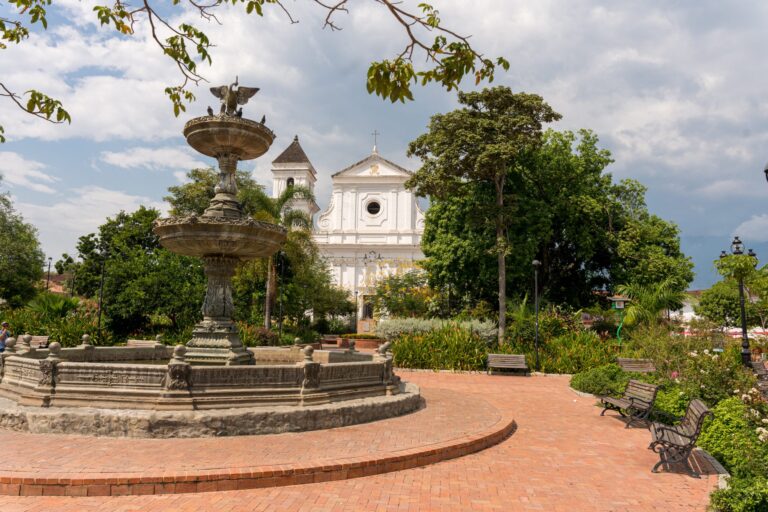
The Parque El Libertador is the town. Its cafés sit under the balconies around it, and from late afternoon it holds most of the population: coffee growers in from the veredas, families, and travelers who have understood that the plaza is the attraction and the rest is a walk. Sit down. The rule for the whole of Jardín is that the plaza is where you end every part of the day.
The Basílica Menor de la Inmaculada Concepción closes the plaza on its uphill side. The parish dates from 3 November 1881, by the Diocese of Jericó’s record; the present church was begun in 1918 and, in ProColombia’s account, built between 1918 and 1942 from hand-carved stone that parishioners carried from a quarry as penance, on plans usually attributed to the Italian Salesian Giovanni Buscaglione, who designed churches across Colombia in those years. It is neo-Gothic, grey and enormous for a town of this size, and it has held the rank of minor basilica, which Rome grants to few churches, since 2003, by the heritage network’s page for the town. Mass is at six and seven in the morning and half past six in the evening from Monday to Saturday, and seven times on a Sunday from five in the morning, by the parish’s own schedule; the parish phone is +57 604 845 55 25, and you will want it this year, for a reason we come to next.
Around the plaza, two buildings have been restored with national money in the last decade. The Teatro Municipal, from 1912, was rebuilt by Fontur and reopened in 2019; the Casa Museo, the adobe-walled, tile-roofed house facing the park that holds the town’s museum and exhibition space, was restored in a project of 2,874 million pesos, 80 percent of it from Fontur, and delivered in May 2025. The Casa de la Cultura carries the name of César Moisés Rojas Peláez. Ask at any of them what is open that day; the museum hours in a town like this follow the person with the key.
What the earthquake did, and what we cannot promise
At 7:34 on the morning of Monday 10 August 2026 a magnitude 7.4 earthquake, about a hundred kilometers deep with its epicenter in San José del Palmar, Chocó, shook the whole of western Colombia. The Gobernación de Antioquia’s bulletin of 14 August counted nineteen people injured and one dead in the department, in Támesis, with 3,351 homes, 406 schools and 27 hospital sites damaged, and the governor went to Jericó, Andes and Ciudad Bolívar, the Suroeste towns with the worst of it. Jardín’s mayor, Claudia Janeth Naranjo Agudelo, reported no one injured or killed in the municipality, and, as carried by the Antioquia press on 11 August, no damage of consequence to the town’s hotels and no suspension of tourism.
The basilica was the exception. Videos from the morning of the quake showed objects fallen from the altar area, religious images on the floor and debris that had come away from the church’s upper parts, and the mayor’s assessment, as reported, was cracks and damage to several structural elements with damage inside, and the towers still standing. Houses around the plaza and the town’s monastery were also damaged, and classes were suspended at several schools. By the middle of August a fund to repair the basilica was collecting donations; the Ministry of Culture said on 15 August that 22 of the 40 national heritage assets in the seven worst-hit departments had severe damage, and named the historic centers of Jericó and Santa Fe de Antioquia among the twelve with significant damage, without naming Jardín in what we could read.
Here is the honest consequence for your visit. The basilica is the reason the plaza is a national monument and the thing on every photograph of the town, and from the outside it is still there. Whether you can go inside, whether Mass has moved, and whether the tower and its view of the valley are open, we could not confirm from here in September 2026 and will not guess. Call the parish before you go, or ask us and we will call. Our day in Jardín includes the plaza and the church from the outside regardless, and the coffee farm, the lunch and the walk do not depend on it.
The coffee, which is the half of the day that always works
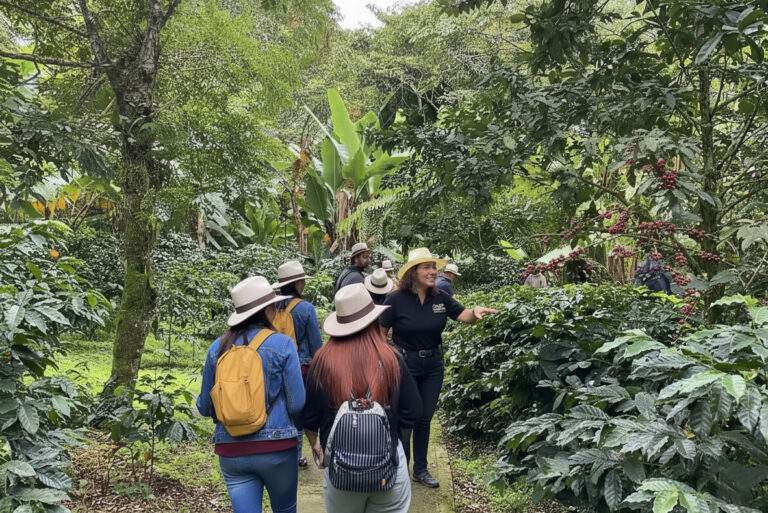
Every road into Jardín runs through coffee, and the point of coming with us rather than on a bus is an hour on a working farm with the family that runs it: the nursery, the bushes in flower or in fruit depending on the month, the picking by hand, the pulping and washing and drying that happen on the farm, and a tasting at the end that finally makes sense of the difference between what a farm produces and what most of the world calls Colombian coffee. The main harvest in Antioquia runs from September to December with the peak in October and November, by the growers’ federation, so a visit in those months finds the farm at full stretch, with pickers in from other regions and the drying patios full; a visit in the first half of the year sees the smaller mid-year pass and a quieter farm. Both are worth it. Do not expect a plantation in the Caribbean sense; Antioquia’s coffee is small farms on steep slopes, and the steepness is the story.
Lunch is included on our day, a Paisa lunch in one of the old restaurants in the center, with what the farms around the town produce. The trout, from the streams and the trout farm two kilometers from the plaza, is the dish the town is known for beyond coffee, and the town’s sweets, sold from shops on and around the plaza, are the thing to take home. Ask for the orange wine if you want the local curiosity; the terminal in Medellín lists it as one of the two things Jardín is known for.
Two cables, and only one of them runs
Jardín has two aerial cables and the guides that confuse them are wrong about both. La Garrucha is the one that runs: a homemade cable cabin about a kilometer long that a coffee farmer who was also a carpenter built to get his coffee and his goods down to the town without walking, with two cables anchored four meters into the ground at each end and a 220-volt motor, checked and approved by the municipality’s engineers once the neighbors asked to use it too, as Infobae told the story on the last day of 2024. It climbs from the town to the viewpoint the department calls the Filo de Oro, with the town and the basilica below and the coffee hills beyond. It is a wooden box on a wire, it is exactly as safe as the municipality’s inspection says it is, and it is the best few minutes in Jardín for the money. Ask the price and the hours at the station when you arrive; they change, and we would rather you heard them there than read a number here that is wrong by the time you do.
The other one, the steel-and-glass cable aéreo built by the department between 2004 and 2007 to link the town with the vereda La Ceiba, stopped running in 2017 for want of maintenance, after about ten years in which its use was as much for getting harvests down and market goods up as for visitors. In May 2023 the Gobernación announced a modernization of the Jardín and Jericó cables through the Promotora Ferrocarril de Antioquia, with the process held up by land titles in Jardín. We could not find a reopening as of September 2026. If someone sells you “the cable car to Cristo Rey”, ask which one; the hill with the Christ, two kilometers from the plaza by the department’s figure, is a walk.
The birds at half past four
The single thing in Jardín you cannot get anywhere near Medellín is the Andean cock-of-the-rock, Rupicola peruvianus, a bird the size of a pigeon whose males are an orange so bright it looks lit from inside, and which gather every afternoon at the same spot on a hillside to display to the females. The spot is the Reserva Natural Jardín de Rocas, in the canyon of the Río Volcanes in the vereda Serranías, 400 meters from the plaza by the reserve’s own description, which is to say a ten-minute walk. The reserve opens every day from three to six in the afternoon, says that about half past four is when you see the most birds, charges 17,000 pesos to Colombians and 25,000 to foreign visitors, and takes no reservations. Go with a long lens if you have one and with patience if you do not.
The catch is the hour. A day trip that leaves Medellín at seven, spends an hour on the farm, eats lunch and walks the town is on the road home by three or four in the afternoon to be back in the city by early evening, which is exactly when the lek begins. So the birds are the reason to stay the night, and the honest way to say it is this: our day gives you the coffee, the plaza, the basilica and the drive; the birds and the cave below are what the second day is for. If the birds are the point, book a hotel in the town and take the day trip as one-way transport, or read the section on staying the night below.
The Cueva del Esplendor, honestly
The Cueva del Esplendor is a waterfall that falls through a hole in the roof of a cave into a pool, about ten kilometers from the town in the vereda La Linda, on private land. It is the most photographed thing in the municipality after the basilica and the most misunderstood. The land’s owners closed it for 433 days in 2016 and 2017 because the crowds and the horses were destroying the ecosystem, and when it reopened on 8 December 2017, as El Colombiano reported, it was with rules that still govern it: a maximum of forty visitors a day, visits only in guided groups of up to twelve through one authorized agency, registration at an office on the Carrera 2 near the stadium, and no horses at all, because the horseback rides were eroding the trail. Visitors in the first half of 2026 describe a Willys jeep from the plaza to the reserve’s administration building, an entry fee of about 20,000 pesos, a jeep-and-entry package of about 80,000, and a walk of roughly four kilometers with a steep, rooted descent to the cave on a cable, taking most of a morning; those are travelers’ reports, not the reserve’s published tariff, and you should treat them as the order of magnitude and confirm the day before.
What that means: the cave is a half day with a walk in it, and it does not fit into a day trip from Medellín alongside the farm and the town. It is the second reason to stay the night. Wear shoes that can get wet, expect mud, and if the road or the trail has had a bad week of rain, or the reserve has closed after the earthquake for any reason, take no for an answer; the owners closed it once to save it and will do it again. The three-kilometer walk to the Cascada La Escalera, on the department’s list, is the shorter alternative for a morning.
The weather, by IDEAM’s numbers
IDEAM’s climatological station El Jardín sits at 2,161 meters, several hundred meters above the town, and its 1991 to 2020 normals are the only current official figures for the municipality. They say it rains 2,635.6 millimeters a year on 227.7 days, which is two days in three; that the driest months are January at 101.4 millimeters and February at 139.8, and the wettest May at 298.2, followed by September at 272.0 and October at 268.0; and that the temperature barely moves through the year, with a mean of 17.1 degrees, afternoon highs between 21.4 and 22.4 and nights between 13.0 and 13.8, at humidity of about 83 percent. The town, being lower, runs a degree or two warmer, which is the department’s 18 and the municipality’s 19.
The practical reading is simple. Mornings are the dry part of the day in every month and the afternoons bring the rain, so the farm and the walk go before lunch and the plaza takes the afternoon, which is how our day is built. December to February and July to August are the drier windows, and they are also the crowded ones. A jacket at night is not optional; this is not Medellín’s 24 degrees. And the road closes in the wet, which is the reason the wettest months matter more than the numbers suggest. The forecast that changes this in 2026 and 2027 is El Niño: IDEAM’s September release puts the probability of a very strong event in the last quarter of 2026 and the first of 2027 above 90 percent, with less rain and higher temperatures in the Andean region, which would make the coming months drier than the normals and the road more reliable. Medellín’s month-by-month weather is in its own guide.
The risk, stated plainly
Jardín markets itself as the prettiest town in Antioquia and for a visitor it behaves like one: a plaza full of families, a town where you walk everywhere, and a level of petty crime that the police’s open data puts at 21 thefts from people in all of 2025 and 14 in the first half of 2026, in a town whose economy is mostly visitors. We have found no report of a visitor being targeted by anything worse. That is the part of the picture that concerns your day, and it is fine.
The other part concerns the countryside around the town and the people who live in it, and we are not going to leave it out. The Suroeste of Antioquia has spent 2025 and 2026 in a war between armed groups, principally the Clan del Golfo and the Medellín-linked structures the press calls La Oficina de Andes and La Terraza, over extortion and the drug-selling trade in the coffee municipalities; El Colombiano reported in April 2026 that the subregion recorded 320 homicides in 2025, the most in its history and a rate of 76.8 per hundred thousand, and 81 more in the first quarter of 2026, with Ciudad Bolívar and Andes, Jardín’s neighbor, the worst affected. Jardín itself, by the National Police’s open data as updated on 18 August 2026, recorded two homicides in 2024, eleven in 2025, every one of them classified as a contract killing, and twelve between January and 7 July 2026, ten of them classified as attacks by organized armed groups; seven of the 2025 killings and eight of the 2026 ones were in the rural zone, and four in each year in the town. In December 2025 a barber was shot in his shop in town and a mototaxi driver in a vereda two days later, and a human-rights report quoted by the paper said the year’s killings in Andes and Jardín had tripled against 2024.
What that means for you, without softening it and without inflating it. The violence is targeted, between people in a specific trade, and it happens overwhelmingly in the veredas and at night; it is not aimed at visitors, and the town’s tourist economy, which its own tourism secretary puts at 70 to 80 percent of the whole, is the thing every side in it has an interest in leaving alone. The day trip, with a private car from your Medellín hotel, three hours of daylight road, a farm, a lunch and a plaza, and the same car home before dark, is not exposed to it. If you stay the night, do what the town does: the plaza, the restaurants and the lit streets around it in the evening, no walking on rural roads after dark, the reserve and the cave with their own guides in daylight, and a taxi or a jeep arranged through your hotel rather than flagged on the road. Neither the United States advisory of 31 March 2026, which keeps Antioquia off its Level 4 list, nor the British advice updated on 3 September 2026, which names only Urabá and Bajo Cauca in the department, includes the Suroeste. We would still rather you knew. Whether Medellín is safe, with the city’s numbers, is a separate page.
The calendar
The town’s own festival is the Fiestas de la Rosa, which in 2026 ran from 15 to 18 May in its twenty-seventh edition, around the anniversary of the founding, followed by the Semana de la Cultura from 19 to 23 May: trova, parades, free concerts on the plaza, a sancocho festival and a cabalgata whose proceeds that year went to the basilica. The dates move; in 2025 the fiestas were postponed by the road closures, and the department’s own tourism page still lists them in January, so take the Alcaldía’s announcement, not a guide, as the date. The Festival de Cine de Jardín runs in late September; the tenth edition was 25 to 28 September 2025, and the eleventh, on the theme of Colombia’s social leaders, publishes its 2026 dates on the festival’s own site. Holy Week, the December holidays and the puentes, Colombia’s long weekends, are when Medellín comes. The coffee harvest, September to December, is the best time to see the farm and the worst for the road.
Day trip or the night
The day trip gets you the drive, the farm and its tasting, the Paisa lunch, the plaza, the basilica from the outside and, if the hours allow, the Garrucha, and puts you back in Medellín by early evening. It is the right call for most people with three or four nights in the city, and it is the version we run. The night gets you the birds at half past four, the cave the next morning, the plaza after dark when the town is at its best, and a second, unhurried coffee. It is the right call if you have five nights or more, if birds matter, or if you are heading on to the coffee region rather than back to the city.
On that last point: a mountain road runs south from Jardín over the pass to Riosucio in Caldas, and it is how some travelers link Antioquia to the coffee region without going back through Medellín. It is slow, it is the road the town used as an alternative when the trunk road closed in 2025, and Caldas took its own share of the August earthquake; if you want to do it, ask about its condition that week and give it the day. Our own answer for most itineraries is in the Colombia itinerary guide: fly.
The other day trip. If you are choosing between Jardín and Santa Fe de Antioquia, the department’s old capital an hour and a bit to the west, the choice is climate and century. Santa Fe is hot, low, sixteenth-century and a shorter day; Jardín is cool, high, nineteenth-century and a full one. Guatapé, with the rock and the lake, is the third option and the most visited, and we wrote it its own guide. Three nights in Medellín gets one of the three; four gets two.
What we would do
With one day: leave the hotel at seven with us, be at the farm by ten, eat at one, walk the plaza and the church at two, ride the Garrucha if it is running, and be back in Medellín by seven. Check the road the night before and ask the parish about the church.
With a night: take the day above but stay, be at the Jardín de Rocas by four, eat trout on the plaza, and do the Cueva del Esplendor the next morning with the reserve’s guide, then the Casa Museo and a last coffee before the road. Book the hotel in the town center, check it has a Registro Nacional de Turismo at rnt.confecamaras.co like every property that rents to tourists in Colombia must, and ask it for the jeep.
With the harvest: October or November, farm first, and accept that the afternoon will rain.
Questions travelers ask
How far is Jardín from Medellín?
131 kilometers and about three hours twenty minutes by the Gobernación de Antioquia’s figure, 134 by the bus terminal’s; our private cars plan on about three hours each way. Buses leave from the Terminal del Sur with Trans Suroeste and Rápido Ochoa from 40,000 pesos.
Is Jardín worth visiting as a day trip from Medellín?
Yes, for the drive, the coffee farm, the plaza and the basilica, which is what our eight-hour private day contains. The cock-of-the-rock reserve opens from three to six in the afternoon and the Cueva del Esplendor is a half day, so those two need a night in the town.
Is Jardín safe?
For a visitor in the town, yes: 21 thefts from people in 2025 and no report of a visitor being targeted by anything worse. The municipality’s countryside has had two years of killings between armed groups, eleven homicides in 2025 and twelve in the first half of 2026 by the police’s open data, which is why we say stay on the plaza and the lit streets at night and do not walk rural roads after dark. Neither the United States nor the United Kingdom names the Suroeste in its advice.
Was Jardín damaged in the August 2026 earthquake?
Yes. Nobody was hurt in the municipality, but the basilica was cracked with damage inside, houses around the plaza and the monastery were damaged, and a repair fund was opened. Whether the church interior and tower are open on the day you visit is a question for the parish, +57 604 845 55 25.
What is the cable car in Jardín?
There are two. La Garrucha, a farmer-built wooden cabin about a kilometer long to the Filo de Oro viewpoint, runs; the department’s steel cable aéreo to the vereda La Ceiba has been stopped since 2017 and had not reopened as far as we could find in September 2026.
When can you see the cock-of-the-rock in Jardín?
Every afternoon from three to six at the Reserva Natural Jardín de Rocas, 400 meters from the plaza, with the most birds at about half past four; 17,000 pesos for Colombians, 25,000 for foreign visitors, no reservation, by the reserve’s own site.
What is the weather like in Jardín?
Cool and wet. IDEAM’s station above the town records a mean of 17.1 degrees, highs around 22, nights around 13, and rain on 228 days a year, driest in January and February and wettest in May, September and October. Mornings are the dry part of every day.
Plan it with us
We run the Jardín day from Medellín as a private trip with a working coffee farm, lunch and the town walk built in, and we know which weeks the road behaves and which it does not. Tell us how many nights you have in Medellín and whether the birds matter to you and we will tell you honestly whether it is a day or a night, or start with our Medellín tours and write to us on WhatsApp. Our Medellín guide has the city itself.
Sources
Gobernación de Antioquia: the municipal page for Jardín (founding, erection, distance, temperature, population, the 1985 monument decree) and its tourism site Antioquia es Mágica for Jardín and Venecia. Fontur and the Ministerio de Comercio, Industria y Turismo: the Red Turística de Pueblos Patrimonio (release of 24 August 2023), the Best Tourism Villages release of 15 November 2024, the Casa Museo restoration release of 23 May 2025; UN Tourism’s page for Jardín. Diócesis de Jericó, parish page of the Basílica Menor de la Inmaculada Concepción; ProColombia (colombia.travel) on the church. IDEAM 1991 to 2020 climatological normals for the El Jardín station, code 26195030, via datos.gov.co; IDEAM’s El Niño release of 10 September 2026. Policía Nacional and Ministerio de Defensa open data on homicides and theft from persons, datos.gov.co, rows updated 18 August 2026. Terminales Medellín, destination page for Jardín. Federación Nacional de Cafeteros, Comité de Antioquia, on the harvest calendar. Reserva Natural Jardín de Rocas, the reserve’s own site. Gobernación de Antioquia bulletin of 14 August 2026 on the earthquake. The following are press reports and are marked as such in the text: El Colombiano on the Cueva del Esplendor reopening (8 December 2017), the town’s cables (May 2023), the Karmata Rúa route (July 2023), the May 2025 road closures, the December 2025 killings and the Suroeste homicide figures (20 April 2026); Infobae on La Garrucha (31 December 2024) and the basilica repair fund (16 August 2026); Telemedellín and Alerta Paisa on the earthquake damage in Jardín (10 and 11 August 2026); Vanguardia on the Ministry of Culture’s heritage assessment (15 August 2026); El País on Pacífico 1 (March 2025); Hora 13 Noticias on the Fiestas de la Rosa 2026; Proimágenes Colombia and the festival’s own site on the Festival de Cine de Jardín; traveler reports on Tripadvisor for the 2026 Cueva del Esplendor prices. United States Department of State travel advisory for Colombia, 31 March 2026; United Kingdom FCDO travel advice for Colombia, updated 3 September 2026.