September 13, 2026
The short version
Barranquilla is the Colombian Caribbean’s working city. It has no colonial wall, no old town on a UNESCO list and no beach worth flying for, and it is the most interesting city on the coast anyway: a river port at the mouth of the Magdalena that grew on arrivals rather than conquest, that exports glass and footballers and Shakira, and that throws the biggest party in the country every February or March. It is hotter than Cartagena, drier than Cartagena and, once you are inside it, a great deal cheaper.
We are based in Colombia and we run four days in Barranquilla, which means this guide is the one we give our own travelers: what the city actually is, what the heat does to the shape of a day, the riverfront and the wheel that opened on it in December, how you reach the mouth of the Magdalena now that the train is gone, the stadium and the date it has this November, what you eat, what Carnaval is and when, and the risk by the police’s own numbers rather than by reputation. It sits alongside our Cartagena guide and our Santa Marta guide, the two cities most people pair it with.
If you read one paragraph, read this one. Two days is the right length: one for the Gran Malecón, the centre and the food, one for the river mouth or the ciénaga. Start at seven and be under a roof from noon to three, because the airport station’s own numbers put the average daily high at 32,8 degrees and the average night at 24,5, and the nights are the part people underestimate. Stay in El Prado or the north, carry a copy of your passport rather than the original, use a car at night rather than walking between neighbourhoods, and do not plan the trip around a museum’s opening hours, because most of them are not published anywhere we could find.
What Barranquilla is
Officially it is the Distrito Especial, Industrial y Portuario de Barranquilla, which is how the Alcaldía styles itself on every page it publishes, and the three words are the city in order of importance. It is the capital of Atlántico and the centre of a metropolitan area that adds Soledad, Malambo, Galapa and Puerto Colombia around it, governed jointly by the Área Metropolitana de Barranquilla. At the 2018 census DANE counted 1.120.103 people inside the district itself.
The thing to understand is that it is a river city, not a sea city. Barranquilla sits on the western bank of the Magdalena just upstream from where the river reaches the Caribbean, and everything about it follows from that: the port, the industry, the fact that the sea is somewhere you drive to rather than somewhere you look at from the hotel. It was never a Spanish colonial foundation with a plaza and a cathedral laid out by decree. It grew because ships needed a place to stop, and it filled up with people who arrived on them, which is why Lebanese, Italian, German and Jewish surnames are ordinary here and why the food is not quite the same as anywhere else on the coast.
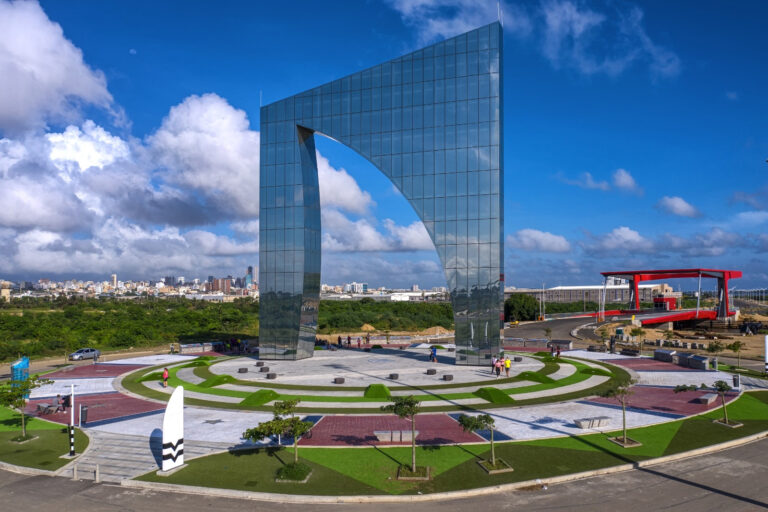
The modern version of the same story is Tecnoglass, the city’s glass and aluminium manufacturer, whose product covers the monument that has become the city’s postcard. La Ventana al Mundo, a pair of columns joined at the top by a window facing north, was designed by the Barranquilla architect Diana Escorcia and inaugurated on 14 August 2018 on a roundabout on the Avenida Circunvalar near Vía 40; El Heraldo puts it at more than three hundred tonnes and about three thousand square metres of glass. A port city that built its landmark out of its own factory’s product is telling you what it thinks of itself, and it is not wrong.
The heat, and what it does to the day
The numbers first, because they decide everything else. IDEAM’s 1991 to 2020 normals for the Aeropuerto Ernesto Cortissoz station, which sits at 14 metres in Soledad on the edge of the city, give an average daily maximum of 32,8 degrees across the year, an average mean of 29,4 and an average minimum of 24,5. The coolest month’s average low, in January, is 23,8. There is no cool hour in Barranquilla. There is a hot afternoon and a warm night, every month of the year.
Rain is the part people get wrong. The same station logs 920,5 millimetres a year across 61,1 rainy days, which is less rain on fewer days than Cartagena’s airport records two hours down the coast, and it is very unevenly spread: January, February and March together average under five millimetres, while September and October alone bring 332,6. When it does rain here it arrives as an afternoon collapse rather than a drizzle, and the city’s streets turn into the arroyos that Barranquilla is locally famous for, which is a genuine reason not to drive in a downpour rather than a colourful detail.
The other half of the climate is the one nobody mentions. From December to March the trade winds blow hard and steadily across the city, sunshine averages nine hours a day in January against five and a half in October, and evaporation peaks at 6,6 millimetres a day in March. That wind is why the dry season feels survivable at the same temperature that feels punishing in September, and it is the real reason Carnaval season is the pleasant time to be here. You will drink more water than you expect. Our own city tour page tells travelers to wear cotton and bring a hat, which is the shortest possible summary of the above.
What it means for a day: out early, indoors or under a roof from about noon to three, back out at four. That is not a warning, it is the timetable every local already keeps. Our guide to the best time to visit Colombia has the rest of the country’s seasons, which do not match this one.
The Gran Malecón, and the wheel that just opened on it
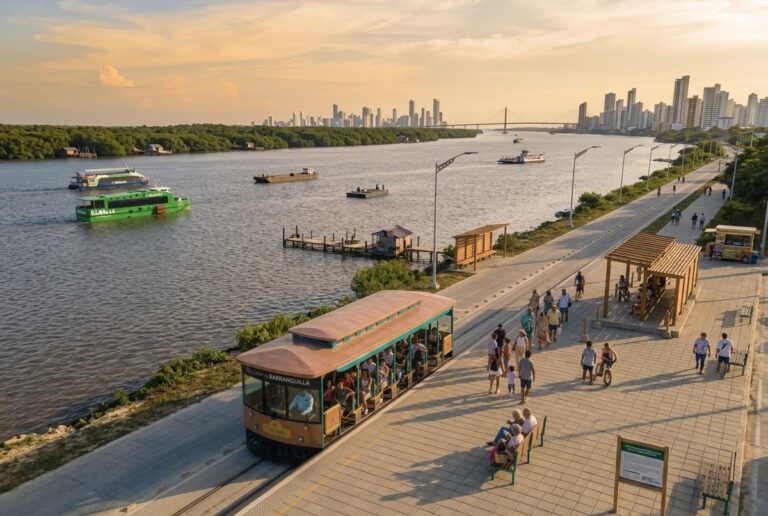
If Barranquilla has a centre of gravity for a visitor, this is it. The Gran Malecón del Río opened on 17 July 2017 and now runs more than five kilometres along the Magdalena, and we think it is the most successful piece of public space built in Colombia this decade: the Alcaldía counted more than 1,2 million visitors in December 2025 alone, the highest holiday season since it opened, with 190.000 on the Velitas weekend and 111.300 over the 24th and 25th.
It is a promenade rather than an attraction, so treat it as an evening rather than a stop. The river is brown, wide and busy with barges, the breeze comes off it after five, and the whole city walks there. Along it you will find the Caimán del Río food section, which the Alcaldía counts at twenty-seven kitchens, the Riobús Karakalí, and the statues of Shakira and Sofía Vergara, the city’s two most exported daughters, which are photographed more than anything else on the waterfront.
The newest thing on it is worth planning around. La Luna del Río, an observation wheel sixty-five metres across with forty-four air-conditioned cabins, was inaugurated on 13 December 2025. Its own page gives the hours as Tuesday to Sunday and holidays, ten in the morning to ten at night, and the price as 15.000 pesos a person, with the usual rules: no children under five, no pregnant passengers, under-fourteens accompanied, and no boarding for anyone with a pacemaker or a cardiac condition. It is closed on Mondays, which is the detail that catches people. Go after dark, when the river is black and the city is lit, and buy at the booth or through TuBoleta.
The other stop most visitors make is the Museo del Caribe in the Parque Cultural del Caribe, and here we have to be honest with you: we could not find its current opening hours or ticket price published on any official page, and the aggregator sites disagree with each other. The same is true of the Casa del Carnaval. We are not going to invent them. Our own city tour includes entry to the Casa del Carnaval, and if you go independently, ask at the door in the morning rather than trusting a listing, including this one.
Bocas de Ceniza, honestly
Bocas de Ceniza is where the Magdalena, which has crossed the entire country by then, finally reaches the Caribbean, and the meeting is visible: a brown river pushing into green sea along a line you can stand next to. It is the best hour in Barranquilla and the one most badly explained by every guide that mentions it, so here is what is actually there.
What you walk on is the tajamar occidental, a breakwater built out into the sea to hold the river’s channel open for the port. The Universidad del Norte’s Observatorio del Río, which inspects it, describes the western structure as running eight kilometres from the river mouth at kilometre zero back to the Las Flores neighbourhood. The works date from the second half of the 1920s into the 1930s, although the press does not agree on the dates: El Heraldo gives the construction as August 1925 to 23 May 1930 under the contractor Ullen & Company to a 1923 design by the firm Black, McKenney & Stewart, with the inauguration in 1936, while El Tiempo has written it as 1926 to 1935. Both are newspapers rather than a gazette, and we are giving you both.
The condition matters because it decides how you go. A little train used to carry visitors along the breakwater and it has been out of use for years. The Observatorio’s inspection found holes and scour along the structure, with material losses up to three metres long and a metre and a half deep and the rock armour thinned from kilometre three onwards; the last major maintenance it recorded was in 2016, and Cormagdalena was back stabilising eroded sections with rock in September 2025 after a stretch at kilometre 2+500 gave way. In July 2026 the district announced a rebuild: a tourist corridor of nearly five kilometres out to the mouth with walkways, a lighthouse, a second beach, a seafood market and infrastructure for a tourist train, at 380.000 millones de pesos, with Cormagdalena and the Universidad de Cartagena on the technical side. None of that exists yet.
So today there are two honest ways out there. You can go overland to Las Flores and take a mototaxi along the breakwater, which is what locals do and what the drivers there are organised to do; it is bumpy, exposed and entirely normal. Or you go on the water, which is cooler, slower and shows you the river traffic and the fishing boats on the way. Our own day does both: the boat up the Magdalena, then the motorbike ride out to the mouth itself with one driver per passenger, then a traditional lunch. Whichever way you go, take a hat and expect no shade and no railing.
Getting here is a short drive from either side of the coast. Cartagena transfers and Santa Marta transfers both carry this route, with the booking widget on the page.
The stadium, and the date this city has in November
Barranquilla’s other identity is football. The Estadio Metropolitano Roberto Meléndez is where the Colombian national team plays its home qualifiers, and the heat of this city at kickoff is a large part of why visiting teams dislike coming here. It is also, right now, a building site, and that changes what you can actually see.
The ground is being enlarged from about 43.000 seats to a planned 65.000 for football, with a hybrid pitch, new stands, screens and press facilities, at a reported cost of more than 45 million dollars, and the last of the new stands went in around July 2026. The reason for the hurry is fixed: CONMEBOL has confirmed on its own site that the 2026 CONMEBOL Sudamericana final will be played at the Metropolitano on 21 November 2026, and its inspectors reported in August that the works were on schedule. If you are in Colombia in November and you like football, that is the single biggest sporting night the country will hold this year, and this is where it is.
Between now and then, do not turn up at the Metropolitano expecting a league match. While the works run, Junior de Barranquilla has been playing its home games at the Estadio Romelio Martínez, the old ground in the city that opened in 1934; the Alcaldía marked the move with the club’s first match there on 7 February 2026 against Boyacá Chicó. It is smaller, older and closer in, and a Junior night in it is a better story than the same fixture in a half-finished bowl. Check the club’s fixture list before you plan around either ground, because both have moved once this year already.
El Prado, Barrio Abajo and the centre
Barranquilla’s architecture is not colonial, it is early twentieth century, and the two neighbourhoods worth your feet are both protected for it. El Prado was laid out in the 1920s as a garden suburb of large houses in every style an ambitious merchant could order from a catalogue, and it is a Bien de Interés Cultural today; the Callejones de El Prado, the lanes running through it, carry thirty-two murals. Barrio Abajo, older and poorer and right behind the Malecón, is a Bien de Interés Cultural of the district, and it is where Carnaval is actually made: the workshops that build the floats and the costumes are in these streets, and the Casa del Carnaval sits among them.
The centre itself, around the Paseo Bolívar and the Plaza de San Nicolás, is a working commercial downtown: loud, crowded on weekdays, shuttered and empty on Sunday, and not a place to wander alone after dark. Go in the morning, with a guide if you want the buildings explained, and treat the afternoon as somebody else’s.
What you eat here
This is the part of Barranquilla that survives any weather. Coastal Colombian food is its own cuisine and this city is the best place to eat it, partly because of the immigration that built the place: there is a Lebanese layer in the kibbeh and the stuffed grape leaves you will find on ordinary menus, and it has been here long enough to stop being foreign.
The things to try, in rough order of how likely you are to be handed one: the arepa de huevo, a maize cake fried, split, filled with a raw egg and fried again, which is a breakfast rather than a snack; butifarra, the small pork sausages named for Soledad next door, eaten with lime and a bollo; bollo de yuca or bollo limpio, boiled dough in a leaf, which is the coast’s answer to bread; sancocho, the soup that changes with whatever the day’s protein is; and to drink, chicha de corozo, a sour deep-red palm fruit drink, or a raspao when the ice cart passes. Our food tour builds a morning out of at least five tastings, savoury and sweet, with the drinks, and one honest note from our own booking page: it cannot accommodate vegans, so if that is you, tell us in advance and we will build something else.
Our Barranquilla food tour runs four hours with a private guide and hotel pickup, from 93 US dollars per person for two travelers.
The water: Mallorquín, Puerto Mocho and Puerto Colombia
Barranquilla is not a beach city and pretending otherwise sets people up for disappointment, but there is water and it is worth half a day.
The Ecoparque Ciénaga de Mallorquín, on the lagoon between the city and the sea, opened on 28 August 2023 with about five kilometres of boardwalk and trail through mangrove, and the Alcaldía counts more than a hundred and fifty bird species on it. It publishes the visitor rules, which are no food, no tobacco and carry your own water, but not the hours or the entrance fee, so ask before you go or come with someone who has the entry arranged. Our Mallorquín hike is three hours with the park entrance included, from 56 US dollars per person for two, and it is a morning activity in this climate, not an afternoon one.
Puerto Mocho, near Las Flores at the western end of the same stretch, is the city’s own beach, with more than a kilometre of enabled shoreline. Puerto Colombia, the old port town half an hour west that Barranquilla replaced, has the other one, along with the long pier that was the region’s ocean terminal before the river mouth was opened to ocean-going ships. Neither is the Caribbean of a postcard; the Magdalena’s sediment sees to that. If you want that water, it is in Santa Marta or on the islands off Cartagena, and our Colombia itineraries put them in the right order.
Carnaval, and the other 361 days
The Carnaval de Barranquilla is the second thing everyone knows about the city, and for a good share of its visitors it is the only reason they come. UNESCO proclaimed it a Masterpiece of the Oral and Intangible Heritage of Humanity in 2003 and inscribed it on the Representative List in 2008, and its file describes it plainly: it runs for the four days before Lent, and it carries the congo, the paloteo, the mico y micas, the cumbia, the puya and the porro.
That rule is how you work out the dates without trusting anyone. Carnaval is the Saturday to the Tuesday before Ash Wednesday, so the 2027 edition falls on 6 to 9 February; El Heraldo has published the same dates, and it is a newspaper, so confirm against the organisation’s own calendar before you buy flights. Book a year ahead. Hotel prices in this city during those four days are not related to the prices in this guide.
Two honest caveats. The first is UNESCO’s own: its file names growing commercialisation as a threat to the tradition, and you will meet that in the form of expensive grandstand tickets to parades that you can see for nothing a few blocks away. The second is that if you are not coming for Carnaval, you should still know when it is, because the four days before Lent are the worst possible time to arrive in Barranquilla wanting a quiet city. The rest of the year the workshops in Barrio Abajo are still building next year’s floats, and that is the version of Carnaval we can show you any week.
The risk, stated plainly
This is the question people actually type, so here is the answer with the numbers behind it rather than an adjective.
By the national police’s open data, which runs to 31 July 2026, the district of Barranquilla recorded 333 homicides in 2022, 375 in 2023, 493 in 2024 and 429 in 2025. In the first seven months of 2026 it recorded 381, against 267 in the same seven months of 2025. That is a rise of about 43 percent year on year, and it is the honest headline: Barranquilla’s homicide figure is going the wrong way while most of the country’s tourist cities are flat. Against the 2018 census population, 2025’s total works out at roughly 38 homicides per 100.000 people, which is our arithmetic on those two published figures rather than a police rate.
What that violence is matters more to you than the total. Of the 381 killings recorded in 2026 to the end of July, the police classify 332 as sicariato, contract killing, and 32 as fights; 352 were committed with a firearm; every one of them is recorded in the urban zone. Seven were classified as atraco, a robbery. That is the shape of a criminal war, not of street crime: the press reports it as a fight between Los Costeños, Los Pepes, the Clan del Golfo and smaller groups over extortion, drug sales, gota a gota lending and land, and the neighbourhoods that appear in those reports are peripheral ones such as La Esmeralda and Altos del Río rather than the places a visitor goes. We found no report of a visitor being targeted.
The crime that does reach visitors is theft, and it is not rising. Comparing the same months to avoid a trap in the data, theft from people ran to 5.362 cases from January to July 2025 and 4.947 in the same months of 2026, about eight percent lower. One warning about that dataset, since we are showing you it: the 2024 annual total of 7.490 is not comparable with the years on either side, because its monthly rows from January to July run at about a third of the months before and after, which looks like a change in recording rather than a real collapse in crime. That is why we compare like months rather than annual totals, and why you should be careful with any page that tells you theft in Barranquilla halved in 2024.
What we tell our own travelers: the daytime city, the Malecón, the museums, the stadiums, El Prado and the north are a normal visit. Do not walk between neighbourhoods at night, take a car instead and order it rather than hailing it, keep your phone in your pocket in the centre and on the Malecón at busy hours, carry a copy of your passport rather than the original, and do not go looking for the neighbourhoods in the news. Neither the United States advisory of 31 March 2026 nor the United Kingdom’s Colombia advice of 3 September 2026 names Atlántico or Barranquilla among the areas they tell people to avoid, which is worth knowing in both directions: this city is not on the list, and the list is not the whole picture. Our CEO’s answer on whether Colombia is safe is the longer version of the same argument.
Did the August earthquake reach here
People are asking, so: on 10 August 2026 an earthquake of magnitude 7,4 with its epicentre in Chocó shook western Colombia, and the damage was in Pereira, Manizales, Armenia and Cali. In Barranquilla it was felt and offices and apartment buildings were evacuated, as El Tiempo reported that afternoon, and we have found no damage report naming Atlántico in the bulletins we could read. The coast is a long way from that fault, and nothing about a trip to Barranquilla has changed because of it. The cities that were hit are covered in our Cali guide and our coffee region guide, which carry what reopened and when.
Getting here, and getting around
You fly into Ernesto Cortissoz, which is not in Barranquilla but in Soledad, the municipality immediately south of it, and is close enough that the drive is short and slow rather than long. Domestic connections from Bogotá and Medellín are frequent, and there are international flights, but most travelers arrive here overland from Cartagena or Santa Marta, which is a straightforward couple of hours in either direction on a good road.
In the city, the mass transit system is Transmetro, which runs on dedicated lanes with feeder buses. The Área Metropolitana de Barranquilla set the fare from 19 January 2026 at 3.700 pesos on ordinary days and 3.800 on Sundays and holidays, for Transmetro and for the ordinary bus network alike. It is cheap, it works and it does not go where most visitors want to go; the Malecón, El Prado and the north are better reached by car. Apps work here. In this heat, the honest advice is that walking between sights is a beginner’s mistake between eleven and four, and the four hundred metres you underestimate is the one that ruins the afternoon.
Where to stay
Stay in the north. El Prado, Alto Prado, Villa Country and Riomar are the neighbourhoods with the hotels, the restaurants and the short taxi rides, and El Prado has the additional advantage of being the one that looks like something: it is the protected garden suburb described above, and a few of its 1920s houses are hotels now. The centre is for daytime and the Malecón is for evenings; neither is where you want your luggage.
Whatever you book, check that it is legally registered. Any property in Colombia that rents to tourists must hold a Registro Nacional de Turismo, the free lookup at rnt.confecamaras.co takes a minute, and an unregistered property gives you nothing to appeal to when a booking fails. The same rule and the same check appear in our Cartagena lodging guide.
When to come
December to March is the season: it is the driest quarter by a long way, the trade winds are blowing, and the city is at its most sociable. It is also the most expensive, and the four Carnaval days are their own market. September and October are the wettest months by a wide margin and the least windy, which is a genuinely hot combination, though the rain arrives in afternoon bursts rather than all day. The shoulder months of April, May and November are perfectly reasonable if you accept an afternoon storm.
Two days is enough for the city and a third buys you the river mouth or the ciénaga without hurrying. If you are building a coast trip, the sensible order is Cartagena for the walled city, Barranquilla for the river and the food, Santa Marta and Tayrona for the water, and our itineraries lay that out with the drives.
Questions travelers ask
Is Barranquilla worth visiting?
Yes, for two days, if you want a real Colombian city rather than a preserved one. We think it has the best riverfront in the country and the best coastal food; it also has a genuine architectural quarter in El Prado and a carnival with no equal in Colombia. It does not have a beach worth the flight or a colonial centre, and anyone who tells you it is a substitute for Cartagena has not been to either.
Is Barranquilla safe for tourists?
The daytime city is a normal visit and we have found no report of a visitor being targeted, but be straight about the context: the police’s own open data show 381 homicides in the district in the first seven months of 2026 against 267 in the same months of 2025, and 332 of those are classified as contract killings tied to a war between criminal groups over extortion and drug sales, in peripheral neighbourhoods. Only seven were robberies. Theft from people, the crime that touches visitors, is slightly down year on year. Stay in the north, move by car at night and keep your phone away in crowds.
How many days do you need in Barranquilla?
Two, or three if you want Bocas de Ceniza or Mallorquín without rushing. One day works if you are breaking a drive between Cartagena and Santa Marta and you spend it on the Malecón and in the centre.
When is the Carnaval de Barranquilla?
The four days before Lent, by UNESCO’s own description, which puts the 2027 carnival on 6 to 9 February. Confirm against the organisers before booking flights, and book accommodation close to a year ahead.
How hot is Barranquilla?
The airport station’s 1991 to 2020 normals give an average daily high of 32,8 degrees and an average low of 24,5, with no cool month; January nights average 23,8. December to March is windy and dry, September and October are wet and still.
Can you still go to Bocas de Ceniza?
Yes. The little train is long out of service and the breakwater has eroded in places, with Cormagdalena repairing sections as recently as September 2025 and a full rebuild announced in July 2026, but people go every weekend, by mototaxi from Las Flores or by boat up the river. There is no shade and no railing, so go early and take water.
Can you watch the Colombian national team or Junior play?
The Estadio Metropolitano is being rebuilt from about 43.000 to a planned 65.000 seats and hosts the CONMEBOL Sudamericana final on 21 November 2026. While the works run, Junior has been playing at the Estadio Romelio Martínez in the city, from February 2026. Check the fixture list before you plan a night around either.
Barranquilla or Cartagena?
Cartagena if you have one city and want the Caribbean of the photographs. Barranquilla if you have three days on the coast and want to see how people actually live on it, or if you are coming for Carnaval, which has no equivalent anywhere in the country.
Plan it with us
We run Barranquilla as private days with your own guide and car, which in this climate is less a luxury than a way of keeping the middle of the day usable: the city tour with the Malecón, the centre and the Casa del Carnaval, the food tour, the Magdalena and Bocas de Ceniza boat day and the Mallorquín hike. All four are listed on our Barranquilla page.
If you would rather we planned the whole trip, write to us on WhatsApp with your dates and we will build the coast around them, or start with our Colombia itineraries.
Sources
Alcaldía de Barranquilla, Distrito Especial, Industrial y Portuario: the Gran Malecón’s opening date, length and the December 2025 visitor figures, the Luna del Río, the Ecoparque Ciénaga de Mallorquín’s opening and visitor rules, Puerto Mocho, the heritage status of El Prado and Barrio Abajo and the murals of the Callejones, and Junior’s move to the Estadio Romelio Martínez. Gran Malecón, the operator’s own page for La Luna del Río: hours, price, dimensions and boarding rules. Área Metropolitana de Barranquilla: the public transport fare from 19 January 2026. DANE, 2018 census: the district’s population. IDEAM 1991 to 2020 climatological normals for the Aeropuerto Ernesto Cortissoz station, via datos.gov.co. Universidad del Norte, Observatorio del Río: the length and condition of the tajamar occidental. CONMEBOL: the date and venue of the 2026 CONMEBOL Sudamericana final. UNESCO: the Carnaval’s 2003 proclamation and 2008 inscription, its description and the commercialisation caveat. Policía Nacional and Ministerio de Defensa open data on datos.gov.co, homicides and theft from people by municipality, rows to 31 July 2026. United States Department of State advisory of 31 March 2026 and the United Kingdom’s Colombia advice of 3 September 2026. Press, and marked as such in the text: El Heraldo and El Tiempo on the construction and rebuilding of the tajamar and on La Ventana al Mundo, El Tiempo and Infobae on the Metropolitano’s capacity and cost and on the criminal groups behind the homicide figures, El Tiempo on the earthquake being felt in the city, and El Heraldo on the 2027 Carnaval dates. Tour facts are read from our own tour pages on the day of publication.