
September 13, 2026
The short version
Barichara is a small town on the lip of a tableland in Santander, built out of the same pale sandstone the ground under it is made of, twenty-four kilometres from San Gil and nine from the hamlet of Guane. It has been called the prettiest little town in Colombia since May 1975, by the municipality’s own account, and Fontur’s national heritage-towns network still uses the line. For once the slogan is doing very little work.
The three things worth knowing before you book. First, it is a place to sleep, not a place to visit for an afternoon: it is quiet, it is two degrees cooler than San Gil and it has thirty-two fewer days of rain a year, and the best hour in it is seven in the morning. Second, the reason it looks the way it does is a management plan with legal force, not good taste — the stone in the streets, the absence of billboards and the ban on tourist buses inside the historic centre are all written into a ministerial resolution. Third, the single best thing to do from it is to walk the old stone road down to Guane, which takes a morning and costs the bus fare back.
Come between November and February. Give it two days if you only want the town, three if you want the canyon as well.
What Barichara actually is
Administratively it is a municipality in the provincia de Guanentá, one of the eighteen that make up the Provincia Guanentina, at 1.336 metres by the Alcaldía’s own figure. Physically it is two things: the Mesa de Barichara, a broad tableland with gentle slopes that it shares with Villanueva, and the edge where that tableland stops and drops away west to the río Suárez. The town sits exactly on the join. That is why every street running west ends in a view and why the streets running north and south do not.
The municipality is the town, the centro poblado of Guane and seventeen veredas. For the department around it — San Gil, the Chicamocha canyon and how the pieces fit into a week — see our Santander guide. The urban core is almost entirely housing: the Alcaldía’s own land-use table gives 73,38 per cent to dwellings and another 15,25 per cent to houses that are also shops, which between them is nearly nine tenths of the built area. There is no industrial quarter and no commercial strip. What you are walking through is a residential town that happens to be beautiful, and it is worth remembering that at eleven at night.
Why it looks like that
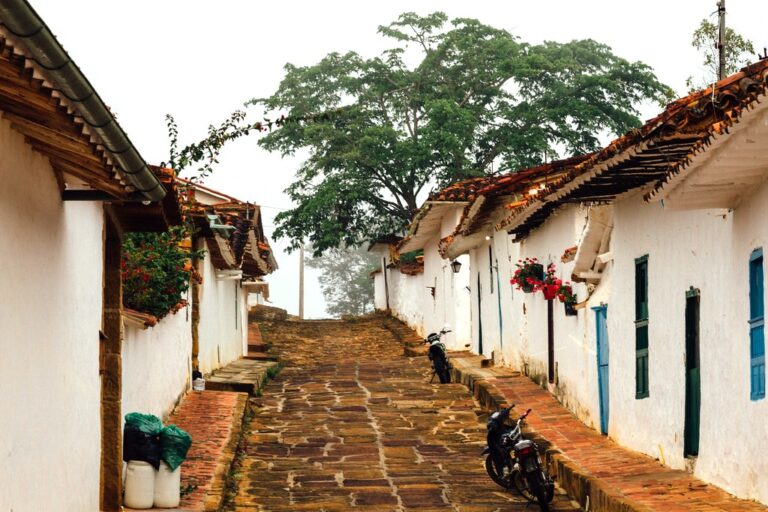
The hillside is soft sandstone that splits into flat blocks. The town was built from the ground it stands on — walls of cut stone and rammed earth, streets paved in the same stone, doorframes and lintels cut from it, and the whole place one colour because it all came out of the same quarry. Locals call the technique piedra rajada, split stone, and you can still watch it being done.
The second reason is legal. Barichara’s historic centre and the Camino de Guane are both national heritage, and since 2015 they have been governed by a Plan Especial de Manejo y Protección issued by the Ministry of Culture. That plan is the reason the town has not been allowed to become a version of itself for visitors.
The rules that shape what you see
Most guides describe Barichara as well preserved and leave it there. It is worth knowing what is actually holding it in place, because several of these rules will affect your day.
The streets have to be stone. Any work on a street inside the protected area must use the traditional system of stone slabs with a traditional joint that does not stand proud of the stone. That is why the surface is even underfoot rather than merely old.
Tourist buses are restricted from entering the protected area, along with any vehicle over 3,5 tonnes. This is the rule that changes a trip: a coach cannot deliver you into the middle of the town. It also means that at any hour the streets are as quiet as they look in the photographs.
The Camino de Guane is pedestrian only. The plan prohibits all motor traffic on it, along its whole protected length.
There are no billboards. Advertising hoardings are prohibited inside the protected area outright.
New free-standing buildings are limited to one storey above ground. Nothing new can rise above the roofline you can see.
A 2019 amendment extended the plan to the roads into town: any work on them has to include a metre-and-a-half pavement, a stone or rammed-earth wall 1,2 metres high, and a five-metre planted setback behind it with no building and no parking. That is what the approach looks like now, and it is deliberate.
The town’s own history, which begins with a rock
The Alcaldía’s account starts in 1702, three years before the town existed, with the image of the Immaculate Conception appearing on a limestone rock. A chapel of rammed earth and tile went up on the spot, the first houses went up around the chapel, and on 29 January 1705 Captain Francisco Pradilla y Ayerbe, from Borja in the province of Zaragoza, founded the settlement — recorded in the municipality’s own words as the twelfth village in the territory of the Guane people.
It became a viceparish on 15 February 1714. In January 1741 a neighbour, María de Soto, sold the founder the land the parish needed for sixty patacones, and his family petitioned the viceregal authorities to be separated from San Gil, which they finally were in July 1751, under the name Nuestra Señora de la Concepción de Barichara y San Lorenzo Mártir. In January 1800 the town asked the Viceroy to make it a Villa with absolute independence from San Gil; independence from Spain then cancelled the privilege, and on 7 April 1821 the council recorded that the Liberator had restored it.
The pattern in all of that is one long argument with San Gil about not being a suburb of San Gil, which is worth holding in mind when you read that Barichara is a day trip from there.
The church, and its ten columns
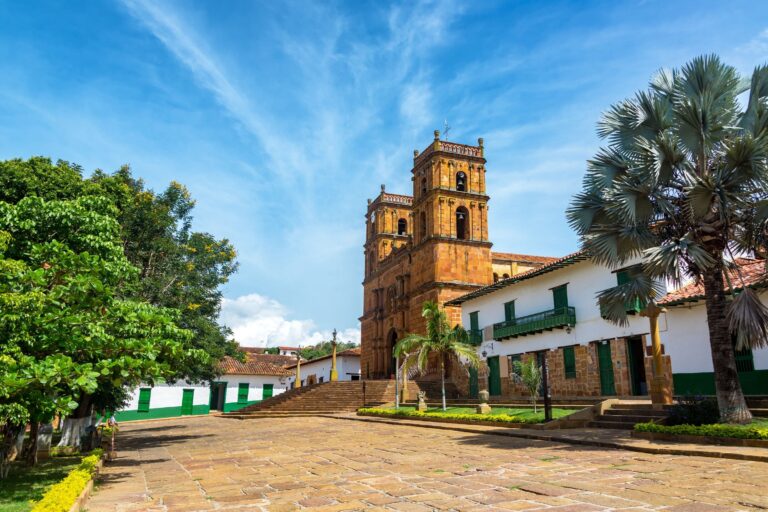
The Templo de la Inmaculada Concepción on the main plaza is the one building you should not walk past. It was begun by Dr. Martín Pradilla y Ayerbe, who died in 1802 and is buried in its presbytery, and the municipality’s own history singles out two things about it: the stonework, and the ten monolithic columns that hold it up. Monolithic means each one was cut from a single block and brought there whole. Stand at the back and look up the nave before you look at anything else.
It is a working parish church, not a monument with a ticket desk. Mass times move and we are not going to print a timetable we cannot stand behind; if you want to see the interior without a service in it, ask at the door.
Santa Bárbara, the cemetery, and the walk west
The Capilla de Santa Bárbara sits at the top of the town, and the reason to climb to it is not the chapel but what is behind it: the ground stops and the Suárez valley opens up underneath. Go at the end of the afternoon.
The cemetery is more interesting than that sounds. It is built of the same stone as everything else, by the same hands, and it is the clearest place in town to see what local masons do when nobody is watching.
Beyond that there is no list. Barichara is small enough that you can walk every street in two hours, and the correct way to spend a first afternoon is to do exactly that without a map.
The Camino Real down to Guane
From the western edge of town an old stone road drops through the canyon to Guane, nine kilometres away by road and rather less on foot. It is the best single thing to do in Santander.
The road is pre-Hispanic in origin. The Guane people laid it; the Spanish paved and extended it. It is a Bien de Interés Cultural of national scope, declared by Resolución 790 of 31 July 1998, and the management plan protects seven kilometres of it at a total width of eighteen metres, with a twenty-five-metre buffer on both sides along the whole length and the whole urban area of Guane inside the protected zone. The stretch walked from Barichara down is shorter than the protected extent: El Tiempo’s culture desk gives it as 5,5 kilometres and two to two and a half hours downhill, and adds a restoration in 1988 — press figures, marked as such, because the article attributes them to no government body.
What it is actually like: downhill the whole way, in the open, on uneven stone, with the canyon widening in front of you. There is no shade to speak of. Start at seven. By ten the stone is hot and the walk stops being a pleasure.
Do not walk it uphill unless you specifically want to. There is a bus from Guane back to Barichara and everybody takes it.
Getting here is a long drive from anywhere. Bogotá transfers has the road north through Santander on one page with the booking widget on it, and the Colombia transfers hub has the airport run from Bucaramanga.
Guane
Guane is a corregimiento of Barichara, a centro poblado of about fifteen square kilometres with a plaza, a church, and a palaeontological and archaeological museum with marine fossils from when this whole mesa was seabed. The protected zone of the camino covers the entire urban area of it, which is why it has stayed a hamlet and not become a car park with a café.
It is small. An hour is enough, which is convenient, because an hour is roughly what you want before the bus back up.
The crafts, and the Escuela Taller
The workshops in Barichara are real ones, not displays. Stone carving is the obvious one; paper made from fique fibre is the other thing the town is known for.
The Fundación Escuela Taller de Barichara is part of the Ministry of Culture’s national Escuelas Taller programme and teaches, in the Gobernación de Santander’s own list: loom weaving, traditional cooking, hand bookbinding, the Guane mochila, dressmaking, pottery, ceramics, embroidery and string music. It is housed in the town’s old boarding school, which was recovered for the purpose. It does not publish visiting hours or a fee, so we are not going to print either; ask when you are there.
What the weather does, and why
Barichara is dry, and the Alcaldía explains why in a way no travel site bothers to. The Serranía de los Cobardes stands between the mesa and the middle Magdalena valley. The humid air coming off the river has to cross the range, loses its water doing it, and arrives as dry, cloudless wind — which leaves the town’s surface exposed to the sun for most of the day. That is the whole mechanism, and it is also why the stone gets so hot.
The numbers. IDEAM’s 1991–2020 normals for the Santa Isabel station give Barichara 1.038,3 millimetres a year on 107,6 days of rain. January is the driest month at 27,3 millimetres and February second at 34,7; October is the wettest at 137,3 and May second at 125,2. Set that against San Gil, twenty-four kilometres away, at 1.181,4 millimetres on 139,5 days: Barichara has thirty-two fewer days of rain a year. That is not a rounding difference, and it is the strongest single argument for sleeping up here.
Temperature is the municipality’s own figure, because the normals carry no temperature for this station: an urban average of 22 degrees in a range of 19 to 28, with a daily swing of four or five degrees. The nights are genuinely cool, which San Gil’s are not. Note also that the Santa Isabel station sits at 1.300 metres, thirty-six metres below the town, so if anything it reads slightly warmer and wetter than the streets do.
The pattern is bimodal: wet peaks in April and May and again in September and October, dry windows from June to August and from November to February.
The risk, stated plainly
There is no security problem here for visitors and the open data says so rather than us. The national police publish homicides and theft by municipality through datos.gov.co, both series currently running to 31 July 2026, so the only honest comparison is January to July against January to July. On that basis Barichara recorded no homicides at all in either year, and theft of persons went from six to seven — in a town this size, that is one incident either way.
Aratoca and Curití, the neighbours, also recorded no homicides in either period. San Gil went from one to five and its theft of persons fell from 87 to 64.
What that means on the ground is ordinary care and nothing more. The real risks here are the ones you sign up for: a stone road in the sun, a slope with no railing, and a canyon rim.
Getting there, and getting around
The Alcaldía’s own distances: 24 kilometres from San Gil, 118 from Bucaramanga, 445 from Bogotá, and nine from Guane.
Through Bucaramanga is the sensible way. Fly into Palonegro and drive south. The road drops into the Chicamocha canyon and climbs out of it, so allow more time than the distance suggests and stop at the rim, because it is one of the great views in South America and you will be driving past it.
From Bogotá by road is 445 kilometres and a long day. It only makes sense if you are already driving north or you are joining Barichara to Villa de Leyva, which is an unusually good pairing: two colonial towns built in stone, both dry, and different enough that you do not feel you have seen the same thing twice.
In town you walk. There is nothing in Barichara that is not within two hours’ walking of everything else in Barichara. Between towns, local buses run to San Gil and down to Guane and they are cheap and slow. What a driver buys you here is the early start, and on the Camino Real the early start is the whole difference between a good morning and a hot one.
Where to stay
Sleep in Barichara. It is the single change that most improves a Santander trip, and everything above is the argument for it: quieter, two degrees cooler, thirty-two fewer wet days, and no coaches allowed into the middle of it.
The town has small hotels and restored stone houses rather than resorts, and it has very few hostels — if you are travelling on a hostel budget, San Gil is where they are. Whatever you book, check the property holds a Registro Nacional de Turismo number. Any accommodation trading legally in Colombia has one and will show it.
How long to give it
Two days is the honest minimum: an afternoon and evening in the town, the Camino Real the next morning, the bus back from Guane, and a slow second afternoon.
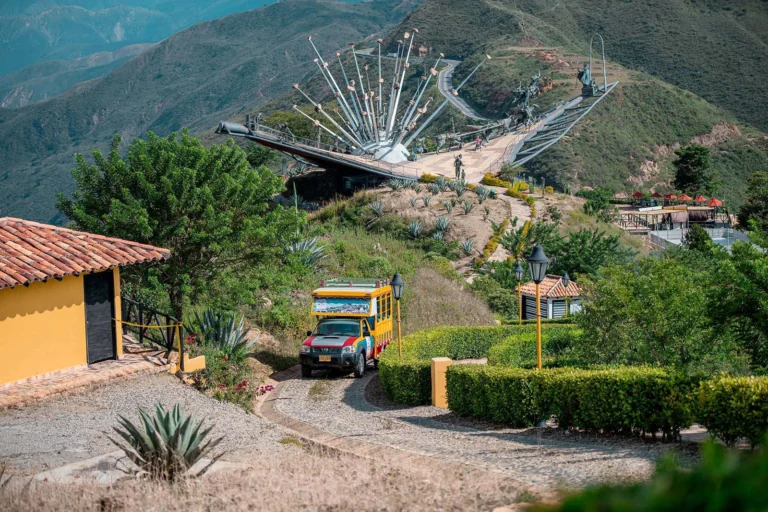
Three days adds the Chicamocha canyon — the cable car, or a flight over it, or both. The canyon, the park’s 2026 prices and the four windows the cable car runs in are all in our Santander guide.
Four days adds the water, which means Juan Curí or the pools at Pescaderito outside Curití.
On timing, November to February is the dry window and the best of the year. Holy Week and the fortnight after Christmas are when Colombians travel, and Barichara fills.
What it costs
Barichara itself is close to free. The streets cost nothing, the church costs nothing, the viewpoint at Santa Bárbara costs nothing, and the Camino Real costs the bus fare back up from Guane. What you pay for in Santander is the canyon park and the driving.
Our own tours in the area, per person with two people travelling, run from 87 dollars for the Camino Real walk to 192 for the quad day, with the two that centre on Barichara at 87 and 188. What that buys is a private driver and a guide, hotel pickup, and a start early enough to matter.
What to bring
Shoes with grip, before anything else. The whole town is cut stone and the Camino Real is five and a half kilometres of uneven stone downhill. Sandals are the commonest mistake people make here.
Then sun. There is almost no shade on the camino and none at all at the viewpoints, the cloud cover is low by the Alcaldía’s own account, and the light at 1.336 metres is stronger than it feels. Hat, sunscreen, more water than you think.
And something warm for the evening. The daily swing is four or five degrees and the town cools off properly after dark, which is exactly why sleeping here is better than sleeping in San Gil.
Questions travellers ask
Is Barichara worth more than a day trip? Yes, and the day trip is the common mistake. Most people come from San Gil for three hours in the middle of a hot afternoon, which is the worst light and the worst heat of the day.
Can a tour bus drop me in the centre? No. The management plan restricts tourist buses and any vehicle over 3,5 tonnes from the protected area.
How hard is the walk to Guane? It is downhill for five and a half kilometres on uneven stone. You need decent shoes and working knees rather than fitness, and you need to start early because there is no shade.
Do I have to walk back up? No. There is a bus from Guane and everyone takes it.
Is it cooler than San Gil? Two degrees by the two municipalities’ own figures, 22 against 24, and considerably drier — thirty-two fewer days of rain a year.
When is it busiest? Holy Week, the fortnight after Christmas, and long weekends. A dry January week that is not the first two is close to perfect.
Plan it with us
We are a Colombian company and we run six tours in Santander. Every one of them is private, with a driver and a guide who work for us and pickup from where you are staying.
If you want the shape of it from someone who has done it: two nights in Barichara, the Camino Real on the first full morning, the canyon on the second, and a slow afternoon in the town before you drive back. Tell us when you are coming and we will build the rest around it.
Sources
Alcaldía de Barichara, its own Geografía and Historia pages (altitude, coordinates, distances, land use, the seventeen veredas, the temperature range and urban average, the humidity, the bimodal rainfall, the Serranía de los Cobardes, the founding date and founder, the 1702 chapel, the parish and villa history, the church and its ten monolithic columns, the May 1975 title, Resolución 005 of 30 June 1975 and Decreto 1654 of 3 August 1978); Ministerio de Cultura, Resolución 688 de 2015 as modified by Resolución 3961 de 2019 (the 1978 decree for the historic centre, Resolución 790 de 1998 for the Camino de Guane, the seven kilometres by eighteen metres of protected road, the twenty-five-metre buffer, the stone-paving rule, the restriction on tourist buses and vehicles over 3,5 tonnes, the pedestrian-only camino, the billboard prohibition, the one-storey limit and the 2019 access-road rules); Fontur, Red Turística de Pueblos Patrimonio (Pueblo Patrimonio since 2010); Gobernación de Santander (the Escuela Taller’s trades and its home in the old boarding school); IDEAM 1991–2020 climatological normals via datos.gov.co, station Santa Isabel in Barichara and Hacienda el Mamonal in San Gil; Ministerio de Defensa open data via datos.gov.co for homicides and theft of persons by municipality, both series to 31 July 2026; El Tiempo for the Camino Real’s walked length, walking time and 1988 restoration, marked in the text as press because the article cites no official body. Prices, timetables and opening hours change; check them before you travel.