
August 15, 2025
Three days in Bogotá covers what everyone comes for: La Candelaria, the Gold Museum, Botero, Monserrate, one serious day of eating and one day trip out of the city. Five days adds the mountains that ring the capital and the neighborhoods where Bogotá actually lives. Seven days is when the city stops being a stopover and becomes the trip. We run private tours here all year, so this is the order we would do it in, with the closures, the Sundays and the altitude already built in, and with our own tours slotted where they save you the most time. What the city is, where to stay and how to read it are in our Bogotá guide.
How many days do you need in Bogotá?
Two full days is the minimum that does not feel like a layover. Three is what we recommend to anyone passing through on the way to Cartagena, Medellín or the coffee region. Five is right if you want one day trip and one morning in the mountains. Seven is for people who want to eat well, walk a lot and see the countryside without rushing.
If Bogotá is one stop on a longer trip, our Colombia itinerary for 7, 10 or 14 days puts the capital in order with Medellín, the coffee region and the Caribbean.
One number shapes all of them. Bogotá sits at 2,640 meters above sea level and Monserrate’s summit at 3,152. Whatever your day count, make the first day gentle: walk, eat, drink water, and leave the hikes for day two or later.
Five things that change any Bogotá itinerary
The weather is one season, worn in layers. The city’s average temperature is 13 degrees Celsius, with daytime highs around 18 to 20 and nights near 8 to 10. January, February, July and August are the drier months; April is the wettest. Rain can arrive on any afternoon in any month, so every day below assumes a light jacket and a layer you can take off by noon.
Mondays and Tuesdays are not museum days. The Gold Museum is closed on Mondays and free on Sundays. The Botero Museum is closed on Tuesdays and free every day it opens. Monserrate’s pedestrian trail also closes on Tuesdays, although the funicular and cable car run daily. If your trip includes a Monday or a Tuesday, make it your day trip or your hiking day.
Sunday is a different city. Ciclovía closes a 141-kilometer network of streets to cars from 7 a.m. to 2 p.m. every Sunday and holiday, the Usaquén flea market only happens on Sundays, the Gold Museum is free and Monserrate’s round trip is discounted. Whichever day of your trip lands on a Sunday becomes day seven below.
The day trips are one to three hours each way. Zipaquirá, Guatavita, Villa de Leyva and La Chorrera all sit outside the city, and the drive is part of the day. That is why we do them as private tours with the vehicle included rather than as bus connections you assemble yourself.
Getting around is the part first-time visitors get wrong. We do not hail street taxis, and we explain why here. Before you land, read our honest take on safety, how much English you can expect, how tipping works and what to pack.
Days 1 to 3: the Bogotá everyone should see
Day 1: La Candelaria, the Gold Museum, Botero and Monserrate
Start where the city did. La Candelaria was founded in 1538, and its cobblestones, painted colonial walls and courtyard doorways are still the densest concentration of history in the country. Begin at Chorro de Quevedo, the founding square, and walk down to Plaza de Bolívar, where the Cathedral, the Capitolio and the seat of national politics face each other across one open space that has seen every turn of Colombia’s recent history.
Two museums sit a few blocks apart and cost almost nothing. The Gold Museum holds the Muisca Raft, the object that sent Spanish expeditions across a continent looking for El Dorado, and it is free on Sundays. The Botero Museum shows the collection Fernando Botero donated to the country, his own work beside his Picassos and Monets, in a colonial mansion that never charges admission. Lunch is Casa Vieja, a heritage house where ajiaco, the capital’s chicken, potato and guasca soup, is the dish to order.
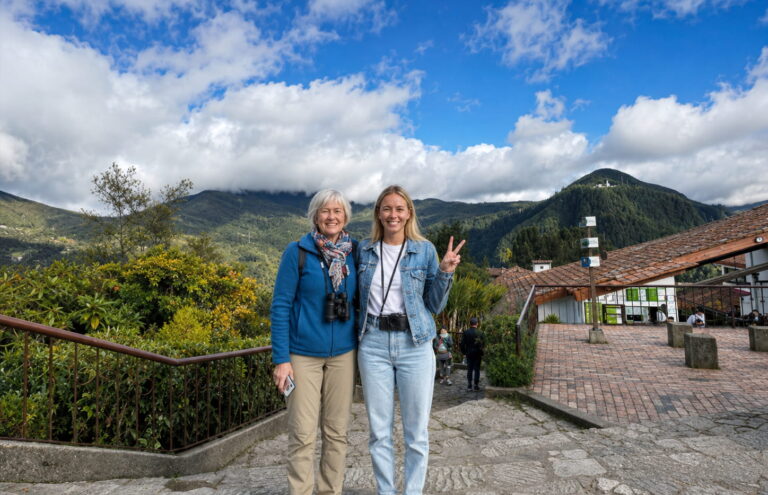
Finish at Monserrate. The funicular and the cable car climb to 3,152 meters, and on weekdays and Saturdays they run until 10 p.m., which means you can time the ascent for the last light and watch eight million people switch their lights on below you. Go slowly at the top. This is the highest point of most people’s trip.
Day 2: Eat your way through the city, then throw a tejo
Breakfast at Les Amis Bizcochería, where mornings are treated as an art form: mango with coconut cream, berries with buffalo Greek yogurt, or the Tostada Eli, brioche with mascarpone and rhubarb compote.
Then go back to La Candelaria for the food you will not find on a menu. Arepas that predate the Spanish, almojábanas that arrived with the colonial administration and never left, obleas filled with arequipe to order by vendors whose practice goes back to the nineteenth century, and chocolate santafereño with cheese at La Puerta Falsa. Our four-hour private food tour walks this in the right order and ends with a Colombian coffee tasting at Chorro de Quevedo. If you want to study first, read our guides to Bogotá’s street eats and the city’s best arepas.

In the afternoon, choose how you want to read the walls. Our three-hour graffiti tour moves from Chorro de Quevedo through the market streets of La Concordia with a guide who knows the artists and the politics behind each mural, and ends at Café Herencia with a cup of coca-leaf tea. If you would rather cover ground, the four-hour private bike tour rides from La Candelaria’s plazas through leafy residential neighborhoods and some of the strongest street art in Latin America, with bikes, helmets, a technical assistant and hotel pickup included.
Dinner is a choice between Mesa Franca, for shareable plates like buffalo-whey fondue and charcoal-roasted rabbit, and Tremé, for elevated comfort such as truffle-infused coconut rice. If you want the city’s most talked-about kitchen, book El Chato, where Álvaro Clavijo reworks Colombian ingredients with avant-garde technique. Then do the most Colombian thing on this list: a private tejo night on a downtown court, where steel discs fly at gunpowder targets and the beer is part of the rules. Carry on to the best bars in Bogotá afterward.
Day 3: Underground, then up to the lake that started El Dorado
The one day trip to take if you only take one. The Salt Cathedral of Zipaquirá is carved 180 meters underground inside a working salt mine, and it is not a reconstruction: mass is still held there. From Zipaquirá, the road climbs to Lake Guatavita, a near-perfect circle inside an ancient crater at 3,100 meters, where Muisca caciques covered themselves in gold dust and made the offerings that became the El Dorado legend. The walk to the rim is about 150 steps at altitude, and the lake is closed on Mondays (on Tuesdays when the Monday is a holiday). Our Zipaquirá and Guatavita day does both in ten hours, private, with the drive and the context handled. If you would rather see the lake with the drowned town of old Guatavita and the Tominé reservoir, the seven-hour Guatavita day trip is the quieter version.
Two of the day trips in this plan now have their own guides: our Salt Cathedral of Zipaquirá guide, with the 2026 tickets and hours, and our Villa de Leyva guide, in one day or two.
Days 4 and 5: the Bogotá most visitors never see
Day 4: Dawn on the mountain, afternoon with the artists
Bogotá’s eastern hills are a protected forest that starts at the end of the street, and many people think the best view of the city is not from Monserrate. The Las Moyas hike is six kilometers to rocky viewpoints at 3,300 meters, at a moderate pace that suits most active travelers from age ten up. Access to the trail is only allowed between 6 and 8 a.m., which is exactly why it is quiet. If you want a real páramo, the Chingaza hike leaves at 6:30 a.m. for the highlands east of the city, where frailejones grow one centimeter a year and the wetlands supply most of Bogotá’s drinking water; your guide tracks signs of the Andean spectacled bear on the way to the Peñas Blancas summit.
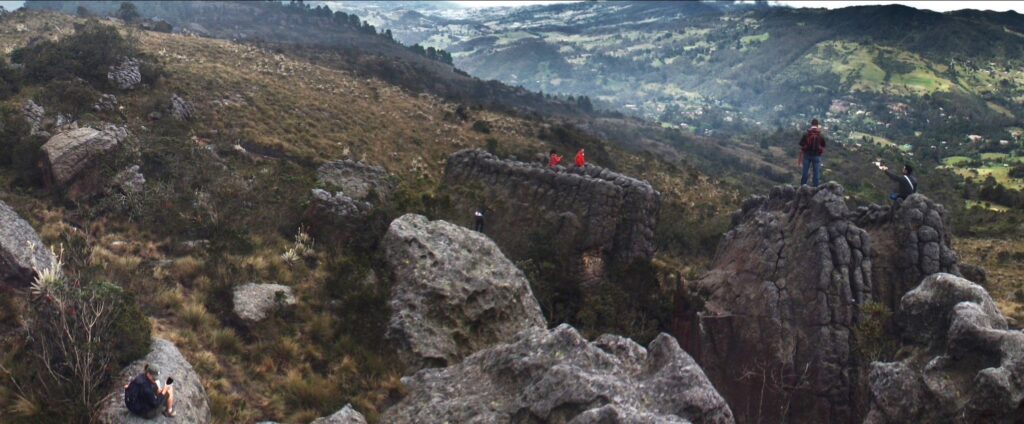
Las Moyas by Young Shanahan, licensed under CC BY 2.0.
Come down for the afternoon in the San Felipe Art District, where industrial warehouses have become galleries and studios. Start at Espacio Odeón, a venue for contemporary Colombian artists working with light, identity and social commentary, then cross to NC Arte, where the exhibitions lean editorial and often international. As evening falls, shift to wine and conversation at BWS, a wine bar that pairs boutique vintages with cheese boards and tapas.
Day 5: Coffee country in a day, or the city from the cable car
Most coffee experiences in Colombia need a flight. Hacienda La Coloma sits about an hour and a half south of Bogotá near Fusagasugá, in warmer, lower country, and it is a working farm. The eight-hour day follows the full arc, from seedbeds where plants spend three to four years before their first harvest, through the plantation, de-pulping, washing, drying and roasting, to a tasting of the hacienda’s own coffee and its house-made coffee liquor.
If you would rather stay in the city, the El Paraíso tour rides the TransMiCable over Bogotá’s southern slopes to a neighborhood that has rewritten its own story with murals, community gardens and a small museum built by the people whose lives fill its walls. It is six hours, guided by locals from the neighborhood, using TransMilenio and the cable car the way residents do.
Give the evening to the north. Zona T and Zona Rosa are the city’s retail and dining nucleus, with Colombian designers alongside global labels at Andino and boutiques, cafés and live music in the courtyard at El Retiro. For dinner with a view, use our romantic restaurants guide; for a slower afternoon, the spa at Four Seasons Casa Medina is where we send people who have overdone the altitude.
Days 6 and 7: further out, then slower
Day 6: Villa de Leyva and Ráquira
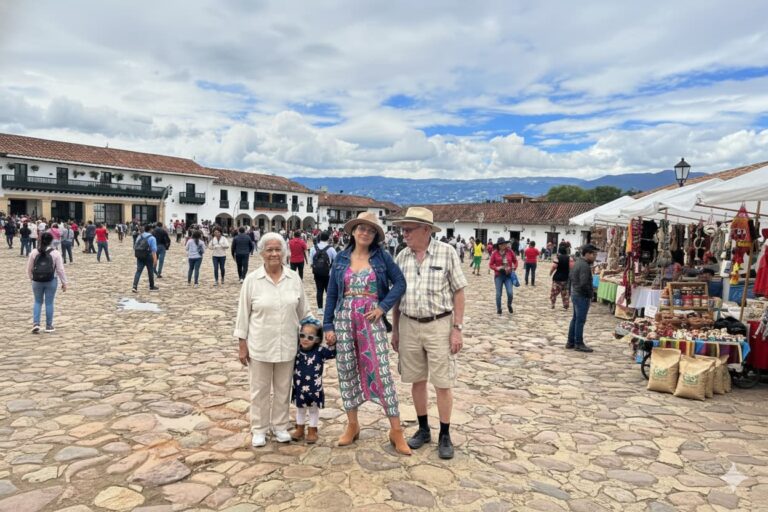
Three hours north of Bogotá, the Boyacá valley holds some of the oldest intact colonial architecture in South America and a fossil record 130 million years deep. The day builds on the way up: the Andean reservoir at Sisga, then Ráquira, Colombia’s pottery capital, where the artisan streets are saturated with color and ceramics are still the town’s economy. Villa de Leyva itself was founded in 1572 and has been a national monument since 1954; its Plaza Mayor is one of the largest cobblestone squares on the continent, and the fossil valley around it and the mineral pools of Pozos Azules complete a twelve-hour day.
Hikers can swap this for La Chorrera, Colombia’s tallest waterfall at 590 meters, ninety minutes east of the city in the cloud forest of Choachí, with the 55-meter El Chiflón at the trailhead and the Guadalupe viewpoint on the way out. If you have the night to spare, the two-day Zipaquirá and Villa de Leyva tour joins day three and day six with an overnight in Villa de Leyva and a stop at the Puente de Boyacá, where independence was decided on August 7, 1819.
Day 7: A Bogotá Sunday
Move this day to whichever date is your Sunday. From 7 a.m., Ciclovía turns Carrera Séptima and 141 kilometers of other streets over to cyclists, joggers, skaters and families, with fruit vendors and street performers filling the gaps until 2 p.m. Follow it north to Usaquén, where the Sunday flea market spreads through leafy streets and plazas framed by mustard-colored colonial facades. Hacienda Santa Bárbara offers shaded courtyards, boutiques and cafés for lingering; lunch is Viva la Vida, known for locally sourced dishes, or a wander through Seratta Gourmand Market for artisanal cheeses, cured meats and cold-pressed juices.
If you skipped the Gold Museum on day one, Sunday is the free day. If you want Monserrate a second time, the round trip is discounted on Sundays and the pedestrian trail opens at 5 a.m. Finish the week with high tea at The Artisan D.C. Hotel or Four Seasons Casa Medina: scones, finger sandwiches, floral teas and tiered stands, Bogotá’s genteel side. If your seventh day is not a Sunday, spend the morning instead in Quinta Camacho, an enclave of English-inspired early twentieth-century houses now restored as boutiques and guesthouses, or in La Soledad in Teusaquillo, which shares the style with a few contemporary takes.
Only a weekend?
Take day one exactly as written and add the tejo night. On day two, hike Las Moyas between 6 and 8 a.m., book the food tour for late morning, and give the afternoon to the graffiti tour or to Usaquén if it is a Sunday. Zipaquirá and Villa de Leyva wait for the next visit. Our 72-hour local’s guide is the longer version of this plan, and if you are only connecting through El Dorado, our layover guide explains how to see Monserrate and the Old Town between flights.
Where to stay
Stay in Chapinero if you want to walk to dinner and eat well every night; in Zona T and Zona Rosa for nightlife and shopping at your door; in Usaquén for quiet streets and the Sunday market; and in La Candelaria if history matters more than nightlife. Families should start with our family-friendly hotels, and LGBTQ travelers with these twelve hotels.
Frequently asked questions
Is three days enough for Bogotá?
Yes, for the core: La Candelaria, the two museums, Monserrate, one day of eating and one day trip. You will leave either Zipaquirá or Villa de Leyva for next time, and you will not see the mountains at dawn.
What is the best month to visit Bogotá?
January, February, July and August are the drier months. Any month works if you pack layers and a rain jacket; April is the wettest.
Which days should I avoid for the museums?
Monday for the Gold Museum, Tuesday for the Botero Museum and Monserrate’s pedestrian trail, and Monday for Lake Guatavita. Use those days for hikes and day trips.
Can I do the day trips without a tour?
Both can be reached by intercity bus, but you will be assembling transfers at both ends and the day gets long. A private tour with the vehicle included is how we do it, and it is the difference between a full day out and a full day in transit.
Traveling with children or with your parents?
Swap the tejo night and the hikes for the kid-friendly museums and these things to do with children; for older travelers, start with our guide for seniors and the museums worth their time. The Perfect Day tour works for both, because the transport is included and the pace is yours.
What if I am only passing through the airport?
Our five-hour layover tour meets you in Arrivals at El Dorado, drives to Monserrate and the Old Town, and returns you to your gate on time.
Plan it with us
Every tour in this itinerary is ours, private, in English or Spanish, and most include hotel pickup. Send us your dates and the cities you have in mind on WhatsApp, or browse all our tours in Colombia and put the week together yourself.
If you are comparing companies before you commit, our guide to the best travel agencies in Colombia explains how to check any agency’s registration and what a serious quote should include.