September 9, 2026
The Rosario Islands are the day everyone books in Cartagena and the day most people do badly: a crowded launch from the public dock, a fixed schedule, two hours on a beach that fills at eleven, and a bill at the end for things nobody mentioned. We run our own boats to the islands every week, so this is the guide from the other side of the dock: what the islands are, what a good day out there looks like hour by hour, what it costs once you add the park fee, the insurance and the dock, the rules that the park and a court now enforce, and our answer on the aquarium.
The short version
The islands are a national park about an hour by boat from Cartagena, and the water is the reason to go: living coral to snorkel over, small beaches, and Playa Blanca on Barú at the end. Go privately if you can, because the day then belongs to you and the boat leaves before the wind and the crowds; go on a shared boat from the Muelle de la Bodeguita if the budget says so, and know that the schedule is theirs. Budget for three separate charges beyond the boat: the park entrance fee, the mandatory accident insurance every visitor has needed since March 2026, and lunch on the beach. Bring reef-safe sunscreen, small notes and, on our boat, your own snorkel mask. Skip the dolphin show unless you have decided in advance that you want one. Which months the sea is calm, and which it is not, are in our Cartagena weather guide.
What the Rosario Islands are
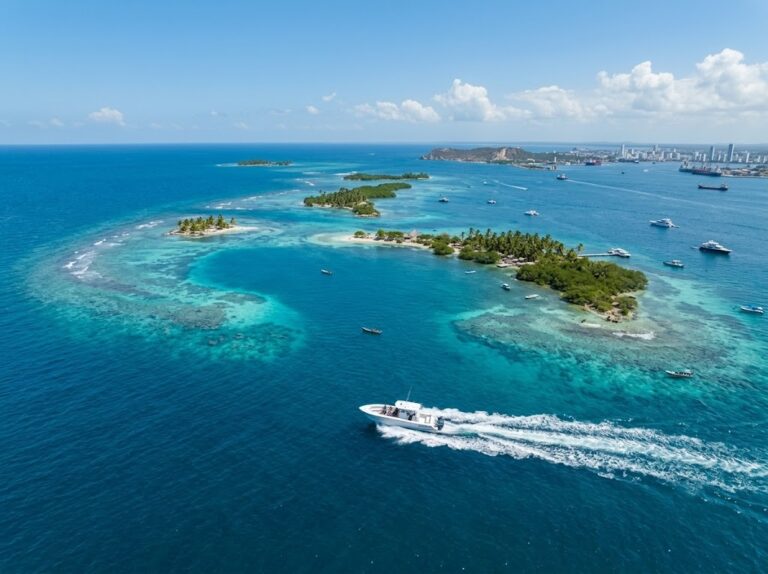
The Islas del Rosario are an archipelago of coral islands off the coast southwest of Cartagena, inside the Parque Nacional Natural Corales del Rosario y de San Bernardo, a marine park declared on June 6, 1977, that covers 123,394 hectares and holds the most extensive coral platform of Colombia’s continental Caribbean, around 420 square kilometers of reef. Isla Grande is the largest island, with the island hotels and a mangrove lagoon; Isla San Martín de Pajarales has the Oceanario, the aquarium; the small islands around them are private houses, a few hotels and a great deal of shallow, clear water. Two places that every boat visits are not islands at all: Cholón, a lagoon of anchored boats and floating bars on the Barú side, and Playa Blanca, the long white beach on the coast of Barú, which is joined to the mainland by a bridge and belongs to the same park. That geography matters for the day, because the beach is close to the city and the islands are farther out, and a well-planned boat does the far part first.
Private boat or shared boat
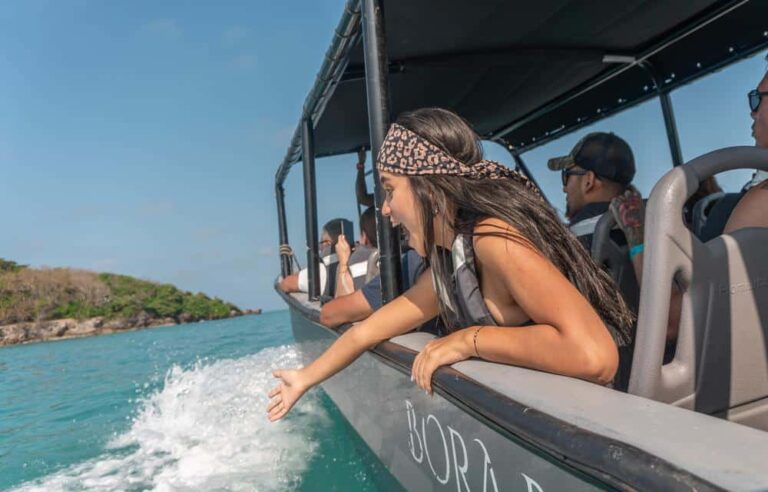
There are two ways to do it. The shared boats leave from the Muelle de la Bodeguita, the district’s tourist dock by the Old City, which the city expected to move more than 21,000 passengers on some 520 departures over Holy Week 2026 alone; they are the cheapest option, they run to a fixed schedule with fixed stops, and the queue at the dock in the morning is where you pay the park fee and the insurance. Private boats leave from the marinas and nautical clubs that the maritime authority, Dimar, authorizes for passenger departures, among them the Bodeguita itself, the Club de Pesca, the Club Náutico and the Todomar, Rosales, Santa Cruz, Náutica Integral and Manzanillo marinas; a boat that leaves from anywhere else has no passenger list filed with the authority behind it, which is why we do not use them. Our private Rosario Islands boat leaves from the Todomar marina in Bocagrande with hotel pickup, your own captain and crew, a private guide and all-risk insurance, for eight hours, with a two-traveler minimum.
A good day, hour by hour
Early pickup at your hotel, because the sea is flattest and the beaches emptiest before ten, and fifteen minutes to the marina. About an hour out to Playa Grande, where the coral starts, and an hour in the water with masks: the reef here is alive, and the fish and the fan corals are the reason the park exists. Two hours at Cholón, which is either the best part of your day or the part you shorten; on a private boat you decide, and the captain anchors where you can swim. Then the run back toward the coast and four hours at Playa Blanca under a reserved, shaded spot with chairs, at the good end of the beach, while the shared boats are unloading their crowds in the middle. Lunch is fresh fish, coconut rice and patacones cooked on the beach and paid on the spot. The boat leaves when the light starts to go soft and you are back at the hotel in time to shower and see the sunset from the walls. On a shared boat the same day runs in the opposite order and to someone else’s clock; on ours the order is the point.
What it costs
The boat is not the whole price, and the operators who quote only the boat are the ones whose guests arrive at the dock surprised. Count four things. The boat or tour itself: ours starts at 349 dollars per person with two travelers, and includes the guide, the pickup, the private boat with captain and crew and the insurance on the boat; it does not include lunch, drinks or snorkel gear, so bring a mask or rent one at the marina. The park’s entrance fee, charged per person for the Rosario sector, which the tariff published at the start of 2026 puts at 13,500 pesos and which you confirm at the dock. The mandatory accident insurance for every visitor to the park, in force since March 1, 2026, under Resolución 273 de 2024 of Parques Nacionales, sold by the approved insurers and separate from the entrance fee. And lunch on the beach, which you order and pay for yourself; agree the price before the fish goes on the grill, and if a bill looks wrong, Titán Chat, the district’s WhatsApp line on +57 304 251 1127, answers 24 hours a day and has already reversed absurd bills at Playa Blanca. The shared boats add a dock fee at the Bodeguita; the Oceanario, if you choose it, charges 40,000 pesos for adults and 30,000 for children from two to ten as of April 2026, boat not included.
The rules of the park, and the court order on the water
This is a national park, and Parques Nacionales publishes the rules for it: no single-use plastics, no collecting shells, starfish or coral, no loud music, no fires, nothing taken from the water. Reef-safe sunscreen is not on the official list, but it is the one that protects the thing you came to see. The rule that matters most is where you swim. In October 2025 the Tribunal Administrativo de Bolívar, ruling on a popular action by the Fundación Leypoar, gave the district sixty days to mark swimming zones separate from boat traffic at eight beaches, among them Cholón, Playa Blanca, Bocagrande and Tierra Bomba, after the death of a 28-year-old swimmer struck by a propeller at Cholón in June 2024 and of a 21-year-old hit by a yacht there in 2019. Until the buoys are everywhere, the rule on our boat is the one the captain gives: swim on the side away from the traffic, never behind the boat, and never at Cholón outside the area the crew points to.
The rest of what reaches visitors in Cartagena, on land and on the water, is in our guide to whether Cartagena is safe.
The reef, honestly
The coral is alive and it is also under stress, as everywhere in the Caribbean: warm-water bleaching, boat anchors, sunscreen and the sheer number of visitors. Colombia’s One Million Corals program has been growing and transplanting coral fragments in these islands for several years, and you will see the nurseries if you snorkel with someone who knows where they are. What you can do in a day is small and real: do not stand on the coral, do not touch it, wear a shirt in the water instead of a second coat of sunscreen, and choose a boat that anchors on sand.
When to go
From December to March the trade winds blow and the crossing is choppy; the port authority can hold the smaller boats on the worst mornings, and a private captain leaves early to beat the wind. From April to November the sea is calmer and the visibility for snorkeling better, with afternoon storms from September into November that pass quickly. Weekends, Holy Week, Christmas and the long weekends fill the shared boats and Playa Blanca; a weekday between April and June or in September is the islands at their best. Our guide to Cartagena beaches compares Playa Blanca, Playa Tranquila and the beaches in the city, and our guide to things to do in Cartagena puts the island day inside a two- or three-day plan.
The Oceanario question
The aquarium on Isla San Martín de Pajarales is on almost every shared itinerary, and it is a dolphin show with shark feeding and reef tanks. Some families love it and some travelers would rather not have paid to see dolphins perform; both are fair, so decide before the boat, not at the gate. Our Playa Tranquila day includes it because it is the version of the islands that works for small children; our private boat leaves it out unless you ask.
Questions travelers ask
How far are the Rosario Islands from Cartagena?
About an hour by boat from the marinas and the Bodeguita dock, a little less to Playa Blanca on Barú, which is closer to the city than the islands themselves.
Is one day enough for the Rosario Islands?
Yes. A full day, leaving early, covers snorkeling at Playa Grande, a stop at Cholón and the afternoon at Playa Blanca. Staying overnight on Isla Grande is for people who want the islands without the day boats.
How much does a day at the Rosario Islands cost?
The boat or tour, plus the park entrance fee per person, the mandatory accident insurance since March 2026, and lunch on the beach. Our private boat starts at 349 dollars per person with two travelers; shared boats from the Bodeguita cost much less and run to a fixed schedule.
Do I need insurance to visit the Rosario Islands?
Yes. Since March 1, 2026, every visitor to the national park needs the mandatory accident insurance under Resolución 273 de 2024, bought from the approved insurers and separate from the park fee.
Can you snorkel in the Rosario Islands?
Yes, and it is the best thing there: living coral at Playa Grande and around the islands. Bring your own mask on our boat, wear a shirt instead of extra sunscreen, and never stand on the reef.
Is Playa Blanca part of the Rosario Islands?
No. Playa Blanca is on Barú, the coast south of the city that a bridge joins to the mainland, inside the same national park. Most island boats end the day there because it is on the way home.
Plan it with us
Our islands day is private, with hotel pickup in the Old City, Getsemaní, Bocagrande, Castillogrande and El Laguito, and a guide who lives here. Write to us on WhatsApp with your dates, or see everything we run on the coast on our Cartagena tours page. The city as a whole, from what it is to how many days it needs, is in our Cartagena travel guide. The other day out of the city, the mud volcano of El Totumo with an afternoon at Manzanillo del Mar, is in our El Totumo guide.