
September 12, 2026
The short version
Bogotá’s night is a strip, not a district. It runs about nine kilometers up the eastern edge of the city, from the student bars and chicha doorways of La Candelaria in the south, through Chapinero and one of the largest clubs in the world, by its own count, to the Zona T, the Parque de la 93 and the quieter tables of Usaquén in the north, and the whole thing sits at 2,640 meters, where the night air is close to single digits and the first aguardiente lands harder than it does at the coast. Nothing serious starts before ten. The law says the music stops at three, and in nineteen mapped zones at five. TransMilenio stops at eleven. Those four facts decide the shape of every evening here.
We are based in Colombia and we run private tours in Bogotá every week, which means we collect guests from hotels the length of that strip and put them back at the door afterwards, sometimes at two in the morning after a night of tejo. This is the guide we give them, and it sits alongside our Bogotá guide: where the night actually happens and who each part suits, what time things start and end and the decree that says so, what is in the glass, what the risk genuinely is by the city’s own numbers rather than by reputation, and how you get home when the buses have stopped.
If you read one paragraph, read this one. Decide how you are getting home before the first drink, and make it a car ordered from inside the venue, never a taxi flagged on the street. Never leave a drink where you cannot see it and never accept one you did not watch being poured. Do not take a stranger you met tonight, in person or on an app, back to where you are sleeping. Keep the phone in your pocket on the pavement. Those four sentences are what the district’s own security secretariat, the United States advisory and the British government all say in their own words, and they are the difference between a great night in Bogotá and the story you tell at the embassy.
The cold, the altitude and why the night starts indoors
Bogotá sits at about 2,640 meters in the neighborhoods you will be drinking in. By IDEAM’s 1991 to 2020 normals for the airport station, the mean temperature is 13.9 degrees, the daytime highs run from 18.5 to 20.2 across the year and the nightly lows from 6.4 in January to 9.6 in April and May. Read that again before you pack: at midnight on a Zona T rooftop the air is close to single digits, every month of the year, and the rooftops that work are the ones with heaters and blankets. Nobody here goes out in shorts. A jacket is not optional and an umbrella is a good idea in the two rainy seasons, April to May and October to November, when the airport station logs more than a hundred millimeters a month. December to February and July to August are the drier windows, and a clear night in January is as cold as this city gets. Our weather guide has the month-by-month table.
The altitude changes the drinking, not only the weather. The district’s health secretariat tells new arrivals to take one or two days to adapt, to rest, to drink water and to avoid excess alcohol and tobacco in that window, and the CDC’s advice for anyone sleeping above 2,450 meters is no alcohol at all for the first 48 hours. We put it more simply to guests who land at four and want to go out at nine: the first night in Bogotá is a dinner, not a rumba, and the aguardiente can wait until you have slept here once. Our altitude guide explains what the thin air does and to whom.
The geography is easy once you see the grid. Calles run east to west and their numbers rise as you go north; carreras run north to south and rise as you go west, away from the hills. Every place in this guide is on a strip a few blocks wide either side of the Carrera Séptima, and the calle number tells you how far north you are: La Candelaria around Calle 11, the Centro Internacional and La Macarena around Calle 26 to 30, Chapinero around Calle 45 to 72, the Zona T at Calle 82, the Parque de la 93 at Calle 93, Usaquén at Calle 118. Crossing from one end to the other is a short car ride at midnight and forty minutes in the evening peak, which is why we tell people where to sleep before we tell them where to drink; that argument is in our where-to-stay guide.
The Zona T, the Zona Rosa and the Parque de la 93
The Zona T is the pedestrianized T of streets where Calle 82 meets Carrera 13, and the Zona Rosa is the wider block of the city around it, roughly Calles 79 to 86 between Carreras 11 and 15; Bogotanos use the two names for the same night. This is the part of the city with the most restaurants, rooftops, clubs and luxury shops per block, the business hotels, the embassies’ dinner reservations, and the highest bill in the city. Eleven blocks further north the Parque de la 93 is a square park of Calle 93 ringed by restaurants and bars that lean older, calmer and more expensive, and the streets between the two, Calle 85 in particular, are a continuous row of bars that fill from Thursday.
What it is good for: it is dense, it is walkable, most staff speak some English, it has the widest range of anything in the city between a natural-wine bar and a reggaeton floor, and it is the one part of Bogotá where you can change your mind three times in an hour without getting in a car. It is also where the city’s security effort is concentrated, and the Zona Rosa is one of the nineteen zones the district mapped in December 2025 for five-in-the-morning hours. If you have one night in Bogotá and you want the version everyone describes, it is this.
What is wrong with it: it is the most expensive night in the country, it is the least Colombian-feeling, and it is where the crimes that reach visitors are concentrated for the same reason the visitors are. The alert the district issued in February 2026 on the “paseo millonario,” the taxi hailed on the street that turns into a tour of cash machines, named the Zona T, Modelia and Galerías and the streets around bars as the places it starts. Chapinero, the district the Zona T belongs to, led the visitor districts for phone theft between January and May 2026 with 1,376 cases. None of that is a reason not to go; all of it is a reason to order the car from inside and keep the phone in the pocket. The block-by-block version, with the addresses of the rooftops, is in our Zona T and Zona Rosa guide, and the bars themselves are in our list of the best bars in Bogotá.
Chapinero: Theatron, Lourdes and the cocktail bars
Chapinero is the localidad in the middle of the strip, and it is three different nights depending on the calle. Around the Plaza de Lourdes and the calles in the fifties and sixties are the bars and clubs that made Chapinero the center of the city’s LGBTQ life, and the largest of them is Theatron, at Calle 58 Bis No. 10-32, a former cinema turned into a club that its own site now counts at twenty rooms and calls one of the largest in the world. Our reviewers have been through most of those rooms and the honest summary is that it is a night in itself, that the cover often includes drinks, that the crowd is everyone, and that the security is strong and polite. It is a car ride of about three kilometers from the Zona T, not a walk. Our Theatron review, our list of gay clubs and our lesbian-friendly picks cover the rest of the district’s queer night, and the drag is in a guide of its own.
Further south, around the Marly TransMilenio station on the Avenida Caracas, is a smaller and younger strip of bars, the third of the three Chapinero zones on the five-in-the-morning list. Further north and uphill, Chapinero Alto, the Zona G around Calle 69 and Carrera 5, and the brick houses of Quinta Camacho hold the city’s serious restaurant district and the cocktail bars that come after it, the speakeasies and the rooftops where the drink costs what it costs in London and is better made. This is where we send a couple, or anyone whose idea of a night is a long dinner and two drinks somewhere quiet, and it is where most of our guests sleep, for the reasons in the where-to-stay guide. The whole district, block by block, is in our Chapinero guide, and the themed bars are in our gastrobares list.
La Candelaria and the center: chicha at the Chorro, and the rule for the night
The colonial center is the oldest night in Bogotá and the one with the most conditions. On a weekday evening the blocks around the Chorro de Quevedo, the small sloping plaza at Carrera 2 at the top of the hill, are the busiest in the neighborhood, filled with students from the universities a few streets away, and the alley that drops off its lower corner, the Callejón del Embudo, sells chicha, the fermented corn drink the Muisca were making before the Spanish arrived, from clay cups in painted doorways. Chicha has a history worth one paragraph: after the riots of 9 April 1948 the government blamed it, and Ley 34 de 1948 required it to be made industrially and sold in sealed glass bottles, which no chichería could do, so it went underground for decades while the beer companies ran advertisements saying it made people stupid. It is back, it is cheap, it is stronger than it tastes, and our rule is one, in the afternoon or early evening, with a guide, and not three.
The rule for the night in La Candelaria is the one we give in our La Candelaria guide and it has not changed: the lit and busy streets are the few between the Plaza de Bolívar and the Chorro, the neighborhood empties when the universities close, and everything south of Calle 7, west of the Carrera Décima and up toward the hills of Egipto and Belén is a car ride after dark, not a walk, however short it looks on the map. The British government’s advice page for Colombia, updated on 3 September 2026, says British nationals have been robbed at gunpoint in the Candelaria area, and the Avenida Jiménez TransMilenio station on the neighborhood’s northern edge was among the stations with the most reported theft in the city in 2025. Dinner in the Zona G and a drink in Chapinero is a ride home from here, not a stroll, and the hotel should be on a main street. Salsa has its old bars in the center and in La Macarena to the north, under the same rule: a car to the door and a car from it.
Usaquén, Teusaquillo and the rest of the strip
Usaquén, the colonial village the city grew around at Calle 118, is a dinner and a drink rather than a night: the restaurants around its plaza, a few bars, and an early close by the standards of the Zona T. It is where we send families and anyone who has done the Zona T before. Note that the Usaquén on the district’s five-in-the-morning list is a strip on Calle 172A, far to the north, and not the plaza. Our Usaquén guide covers it.
Teusaquillo, the residential district west of Chapinero, has the Park Way, a tree-lined boulevard of small bars and cafés that Bogotanos like and visitors rarely find, and Galerías, west of it, is a traditional rumba sector of crossover bars and salsa that the district left off the extended-hours list in December 2025, along with Palermo, so it closes at three. Both are cars from where you are staying. The rest of the city, the south and the far west, has its own nights and they are not written for visitors; we do not send guests there and neither does anyone who lives here.
What time anything starts, and what time it ends
Start late. Restaurants fill from eight, bars from ten, clubs do not get going before eleven and the queue at Theatron is a midnight queue. Thursday is a real night here, Friday and Saturday are the nights, Sunday is dead almost everywhere and Monday is when many of the bars are closed. If you arrive at a club at nine you will have it to yourself, and that is not a compliment.
The closing hour is a decree, and this is a city that has been arguing about it for thirty years. In December 1995 the mayor, Antanas Mockus, imposed the “hora zanahoria,” no alcohol sales from one in the morning, and his second term moved it to three in 2002; a 2014 decree let six zones run to six; the numbers have moved several times since, as the Colombian press has recorded in detail. The rule today is Decreto 293 de 2025, in force since 1 July 2025. Bars and clubs may sell and serve alcohol from ten in the morning until three the next morning; shops, supermarkets and liquor stores from ten until 11:59 at night; restaurants are exempt unless alcohol is their main business, which is why the good ones keep pouring wine with dinner. Drinking is banned within 200 meters of a school, and the decree exists in part to kill the “amanecederos,” the illegal after-hours dens that used to open when the legal places shut, which is the honest reason we tell guests that what is still open at four outside the zones is not a place to be.
The zones are the exception. The decree promised extended hours in “zonas focalizadas,” and Resolución Conjunta 001 de 2025, signed on 27 December 2025 and published two days later, drew nineteen of them on maps, chosen from twenty-seven candidates on noise, security and coexistence criteria, where bars and clubs may run until five in the morning. For a visitor three of them matter, all in Chapinero: the Zona Rosa, Chapinero Central and Marly. The other sixteen are in Usaquén on Calle 172A, Bosa, Kennedy, Fontibón, Engativá, Suba, Los Mártires and Puente Aranda, and the district left out several traditional rumba sectors, among them Galerías and Palermo in Teusaquillo and the Calle 116 in Usaquén. The zones are reviewed every six months and can be switched off for noise complaints and emergency calls, so the map you read about in January may not be the map in force when you land. Neither the Parque de la 93 nor La Candelaria appears by name on the list, and whether the Zona Rosa polygon reaches Calle 93 is a question for the maps in the resolution’s annex. Whether a specific venue can serve until five depends on which side of a line on those maps it sits, and the only reliable way to know is to ask the door, which is the same answer we give in Medellín and Cartagena, for different reasons.
Two national rules sit under the local one. The drinking age is eighteen, by Ley 124 de 1994, and the doors check because the venue pays for the mistake, so carry a copy of your passport with you and leave the original in the safe. And since Ley 1335 de 2009, nobody smokes indoors in Colombia, in bars, restaurants or clubs, and the law does not allow a smoking room, which is why the terrace is where the smokers are and where the coats go missing.
What you are drinking
The bottle on a Bogotá table is aguardiente, and the local one is Néctar, made by the department of Cundinamarca’s own distillery; it is anise, it is drunk neat in small shots from a shared bottle, and one round at 2,640 meters is worth two at sea level. Rum is the other bottle, whisky the status one, and beer the thing everyone actually drinks most of, from the big national brands to a craft scene with a taproom in most of the neighborhoods above. The cocktail bars of the Zona G and Chapinero Alto are as good as any in Latin America and priced like it. Chicha, above, is the center’s own drink. Coffee is the morning-after drink, and Bogotá does it seriously; our coffee guide has the shops.
Two practical things. Clubs sell tables with a bottle, and a group that wants to sit down will be steered toward one; a bottle of aguardiente or rum with mixers for four to six people is the normal unit, and it is how the venue makes its money, so the cover on the door is often credited against it or includes the first drinks. Ask before you pay anything. And the ten percent service charge on a restaurant bill is voluntary by law and has to be offered, not imposed; how that works, and what to tip a bartender, is in our tipping guide.
On drugs, one sentence, because someone will offer. The personal dose is not a crime in Colombia, but the police can fine consumption in parks and marked perimeters and seize what you carry, the club will throw you out, and the person selling at the door is the classic first link in a robbery. Do not.
Tejo, and why we take people to it
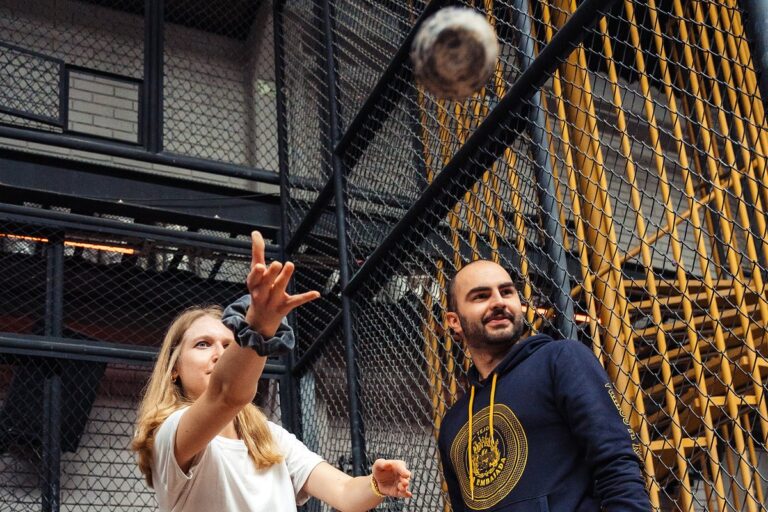
Tejo is the national sport of Colombia by Ley 613 de 2000, and it is the best night out in Bogotá for a group that does not want a nightclub. You throw a metal disc underarm down a lane at a clay target studded with small paper packets of gunpowder, and when you hit one it explodes, loudly, and everyone drinks. It is of pre-Hispanic origin by the usual account, it is played in every town in the highlands, and it is the one thing on this page that a Bogotano’s grandmother has done.
We run it as a private evening: your own guide, private pickup from your hotel and the twenty-minute drive downtown to La Embajada, a tejo hall where the lane is reserved for your group, two hours of play with the rules explained and four beers per person included, insurance, and the car back to the door afterwards. It is over-eighteens only and three hours in total. We put it on the first or second night rather than the last, because it is the one that makes the rest of the trip go better, and because a tejo hall on a Thursday is more Bogotá than any rooftop.
Andrés Carne de Res, and the night out of town
The most famous night out from Bogotá is not in Bogotá. Andrés Carne de Res is a restaurant, bar, dance floor and theater set in Chía, the next municipality north, up the Autopista Norte, and for decades Bogotanos have driven out to it for a birthday or a visiting friend and come back at four. It has a city branch, Andrés D.C., in the Zona T, which gives you most of the show without the drive, and a chain of smaller plazas in the shopping centers. If you go to Chía, go with a driver who is coming back for you, book a table, eat, and treat the bill as part of the show. It is the one place in this guide where we would rather you took our car than an app, because at three in the morning on the northern highway the app is a lottery.
The risk, stated plainly
Bogotá’s night is safe for a visitor who follows a short list of habits, and the habits exist because the crimes are specific. In order of how often they reach visitors: a phone taken from a hand or a table; a drink or a date that ends in a drugging; a taxi hailed on the street; a cash machine at the wrong hour. The violence in the city’s homicide numbers happens in districts you will never see; what reaches the strip is theft and drugging. The full argument is in our Bogotá safety guide; this is the night-time version.
The numbers, so you know the scale rather than the rumor. By the national police’s open data, updated on 18 August 2026, Bogotá recorded 123,017 reported thefts from people in 2025, about 340 a day, and 66,574 between January and July 2026, 13 percent fewer than in the same months of 2025; the district’s own mid-July count put the drop at 18 percent, and either way the direction is right. In Chapinero, the district that holds most of this page, the local mayor’s office reported 4,141 thefts from people in the first half of 2025 against 6,059 in the first half of 2024, four homicides against nine, and 560 arrests. Phones are the object: 14,274 stolen across the city between January and May 2026, about 101 a day, with Chapinero, Teusaquillo and Usaquén among the six districts with the most.
Drugging is the crime the city itself warns about most, and it is the one that harms visitors here. In March 2025, when the police put more than a hundred officers into Chapinero’s rumba zones, the district said 53 thefts by toxic substances had been reported that year already, that Chapinero, Teusaquillo and Suba held 57 percent of them, and that 11 percent of the victims had met the perpetrators through Tinder, Grindr or Chat Bogotá. The security secretariat’s February 2026 note on the same crime says the substances are usually given in liquids, that they do not change the taste of a drink and have no smell, that the contact often begins on a dating platform or in a nightlife venue, and that a victim is steered to move somewhere else; its advice is to tell someone where you will be and with whom, to choose visible, busy places with controlled entry, never to accept a drink already poured and never to lose sight of yours, not to drink to excess, and to distrust any pressure to change location. The United States advisory for Colombia, updated on 31 March 2026, keeps the country at Level 3 and does not put Bogotá at Level 4; its sentence on this is that criminals use dating apps to attract victims, ask to meet in hotels, restaurants and bars, and that many US citizens in Colombia have been drugged, robbed and even killed by criminals posing as dates. The British government’s page names scopolamine, says the drugs can be given through food, drinks, cigarettes, aerosols and paper flyers, and adds that criminals posing as police operate in Bogotá. We repeat all of it because it is the thing that keeps getting ignored: a stranger you met tonight, a drink you did not watch, and a room they now know the address of are three links in one chain, and breaking any one of them collapses the risk.
The wrong taxi is the third. The “paseo millonario” is a Bogotá crime with a name, a street-hailed taxi whose driver lets accomplices in and drives the passenger from cash machine to cash machine, and the US advisory’s sentence is that US citizens have been killed during robberies while using taxis hailed on the street. The February 2026 alert named the Zona T and the streets around bars as where it starts. The rule is not which car you choose but how you get into it: order it from inside the venue, check the plate on the screen, share the trip, and get out if the route makes no sense. It is the whole reason for our rule about not taking street taxis in Bogotá. Cash machines are a daylight job inside a bank or a shopping center; the British advice says the criminals often select their target at an ATM at night, and our ATM guide says the same thing at more length.
What the city is actually doing about it
More than the reputation suggests. The 2025 decree above was written as a security measure as much as a licensing one, and it came with the semi-annual review that can switch an extended-hours zone off. In March 2025 the police ran an operation of more than a hundred officers and district officials across Chapinero’s rumba zones aimed specifically at drugging thefts, brawls and unlicensed venues. On 12 September 2026 the police’s anti-kidnapping and anti-extortion unit, the Gaula, launched a campaign called “Que no te marquen la copa,” “don’t let them mark your glass,” with more than a hundred officers in the city’s rumba zones, searches and background checks in the rumba zones, staff trained to recognize the symptoms of a drugged customer, and the Gaula’s line, 165, printed on the cups; the same release said kidnapping was down 56 percent and extortion down six percent between January and August 2026 against the same months of 2025. The district’s victim-support team, AIDE, takes reports on (601) 377-9595, extension 1137, and the emergency number, day or night, is 123. None of this replaces the habits above; it is why the habits work.
Getting home
TransMilenio is the thing that catches people out. The red buses and their stations run from four in the morning to eleven at night on weekdays, from five to eleven on Saturdays and from five to ten on Sundays and holidays, by the hours TransMilenio has given the press, and the 2026 fare is 3,550 pesos on a Tullave card. It is excellent for the morning and irrelevant for the night: it is closed before your night is, and Avenida Jiménez, Calle 45 and Calle 100, three stations on the strip, were among those with the most reported theft in the city in 2025. Do not plan on it for the return leg. Our getting-around guide has the card, the routes and the rest.
That leaves cars, and Bogotá has two kinds. The yellow taxi runs on a meter under a tariff the city sets each year; for 2026, under Decreto 042 de 2026, the meter starts at 4,500 pesos, adds 159 per 100 meters, has a minimum fare of 8,000 and adds a surcharge of 3,800 at night, from eight in the evening to five in the morning, and all day on Sundays and holidays. A taxi ordered through its company’s app or by the venue is fine; a taxi flagged on Calle 85 at two in the morning is the one crime on this page with a name. The apps, Uber, DiDi, Cabify and inDrive, work across the city day and night in the legal grey zone they occupy everywhere in Colombia, and at the airport they are not authorized, which is a separate matter covered in our airport guide. Whichever you use, order it from inside and walk out to it when it is at the door. If you are with us, that is not a decision you have to make, because the car back to your door is part of what we are running, and our airport transfers, with the driver inside the terminal holding your name, are operated by Safe Transfers by Cielo.Travel.
The calendar
Bogotá’s big nights are free and outdoors, and the city publishes them in March. Idartes’ Festivales al Parque for 2026 run Jazz al Parque on 12 and 13 September in the Parque El Country, Rock al Parque, the thirtieth edition of the largest free rock festival in Latin America, on 10, 11 and 12 October, Hip Hop al Parque on 24 and 25 October, and Salsa al Parque on 28 and 29 November, the last three in the Parque Simón Bolívar. They are free, and they are worth planning a trip around. The big ticketed concerts, at El Campín and the Movistar Arena, are in our concerts guide.
Halloween is the biggest costume night of the year for adults as much as children, and the clubs price 31 October like New Year’s Eve. December is candles on the pavements on the night of the 7th, novenas, office parties that end at the tejo hall, and the city’s Christmas route of lit parks and plazas through the month; the hotels are full and the bars are fuller. Election weekends usually bring a nationwide ley seca, a ban on alcohol sales from the Saturday evening to the Monday morning, and the next national vote after the 2026 presidential round is the local elections of October 2027. And the morning after any of it, on a Sunday or a holiday, the Ciclovía closes 141 kilometers of streets to cars from seven until two, which is the best hangover cure this city offers.
What we would do, by how many nights you have
One night: dinner in the Zona G, then the Zona T on foot, a rooftop with heaters and one club if you must, and the car home ordered from the bar. If it is also your first night at this altitude, make it the dinner and the rooftop and skip the club.
Two nights: night one as above. Night two is tejo, downtown, with the beers included, and an early finish that leaves you able to climb Monserrate in the morning.
Three or more: add Chapinero, which means Theatron if you want the biggest room in the country and the Zona G’s cocktail bars if you want the smallest, or the drive to Andrés in Chía with a driver waiting. If a Sunday falls in the trip, spend it on the Ciclovía and in Usaquén’s market, and let the night be a quiet one, because the city’s is.
Questions travelers ask
Is Bogotá safe at night?
On the strip, in the Zona T, the Parque de la 93, Chapinero and Usaquén, yes, with the habits above, which exist because the crimes are specific: phones, drugged drinks, street taxis and cash machines. La Candelaria is a day neighborhood with a few lit blocks at night and a car for everything else. The current United States advisory is Level 3 for Colombia and does not put Bogotá at its highest level.
What time do bars close in Bogotá?
Three in the morning, under Decreto 293 de 2025, in most of the city; five in the morning in the nineteen zones mapped in December 2025, which for a visitor means the Zona Rosa, Chapinero Central and Marly. Shops and liquor stores stop selling at 11:59 at night. Ask the door whether a specific venue is inside a zone.
Zona T or Chapinero for a night out?
The Zona T for range, English, walkability and the rooftops. Chapinero for Theatron, the queer night, the cocktail bars of the Zona G and a Colombian crowd. With two nights, do one of each; they are three kilometers apart and a short car ride.
Can I use Uber and the other apps at night?
In the city, yes, day and night, despite the legal grey zone. Order the car from inside the venue and check the plate before you get in. At the airport the apps are not authorized and you want the meter taxi from the official lane or a booked transfer.
Is TransMilenio open late?
No. It runs to eleven at night from Monday to Saturday and to ten on Sundays and holidays, and it is not how anyone here gets home from a night out. Plan on a car.
What is the drinking age, and do I need my passport?
Eighteen. Doors ask for ID; carry a copy of your passport and leave the original in the hotel safe.
Is Theatron worth it?
Yes, for anyone, for a night. It is one of the largest clubs in the world by its own count and the center of the city’s queer life; go after midnight, check the coat, keep the phone in a pocket and take a car both ways.
Does the altitude make the alcohol stronger?
It makes you weaker. The city’s health secretariat and the CDC both say to avoid alcohol in the first day or two at 2,640 meters, and we plan our guests’ first night as a dinner for that reason.
Is drinking on the street allowed?
A beer on the pavement is not in itself an offense since a 2019 ruling of the Constitutional Court, but the law that followed the same year lets mayors mark perimeters, around schools above all, where it is fined, Bogotá’s decree bans it within 200 meters of a school, and the officers who patrol the Zona T at two in the morning move drinkers along. Keep the drink inside the venue.
Plan it with us
Every tour we run in Bogotá is private, with hotel pickup and a guide who lives here, and the tejo night is the one we would put first. Tell us what kind of night you want and how many you have, and we will build it, including the ride back, or start from our Colombia itinerary if the rest of the trip is still open. Write to us on WhatsApp with your dates, or see everything we run in the city on our Bogotá tours page.
Sources
Alcaldía Mayor de Bogotá and the Secretaría Distrital de Gobierno: Decreto 293 de 2025 and its ABC, the April 2025 consultation on the hours, and the January 2026 ABC of the nineteen zones; Resolución Conjunta 001 de 2025 of the Secretarías de Gobierno, Planeación and Ambiente, published in the Registro Distrital on 29 December 2025, read on the district’s legal register. Secretaría Distrital de Seguridad, Convivencia y Justicia: the March 2025 operation in Chapinero, the February 2026 note on drugging thefts, the March 2026 crime figures, and the 12 September 2026 Gaula campaign, all on bogota.gov.co; the Alcaldía Local de Chapinero’s first-half 2025 balance. Policía Nacional and Ministerio de Defensa open data on datos.gov.co, theft from people, rows updated 18 August 2026. Secretaría Distrital de Movilidad: Decreto 042 de 2026 taxi tariff. TransMilenio: the 2026 fare and transfer window; the system’s operating hours as it has stated them to the press. IDEAM 1991 to 2020 climatological normals for the El Dorado station, via datos.gov.co. Secretaría Distrital de Salud and the CDC Yellow Book 2026 on altitude and alcohol. Idartes: the 2026 Festivales al Parque calendar. IDRD: the Ciclovía. Instituto Distrital de Turismo and our own guides for the neighborhoods. Theatron’s own site for its address and room count. United States Department of State: Colombia travel advisory of 31 March 2026. United Kingdom Foreign, Commonwealth and Development Office: Colombia safety and security page, updated 3 September 2026. Ley 124 de 1994, Ley 1335 de 2009, Ley 613 de 2000, Ley 2000 de 2019 and Sentencia C-253 de 2019 of the Corte Constitucional, the last two as reported by the legal press. Señal Memoria, RTVC, on Ley 34 de 1948 and the chicha. The history of the hora zanahoria and the list of sectors left out of the zones are as reported by El Espectador, El País and Infobae, press rather than gazette, and are marked as such above. Tour facts are read from our own tour pages on the day of publication.